


Local manufacturer races to tap potential in medical technology
Racer Technology's microfluidic chip, which takes only minutes to give blood test results, is part of CEO Willy Koh's drive to grow the firm into a world player
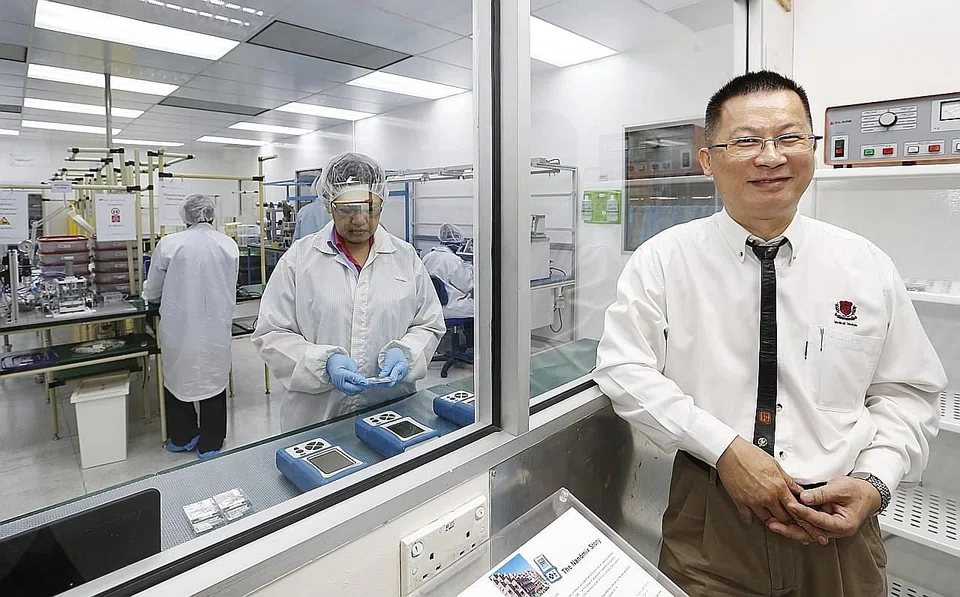
AS governments race to prepare for the possibility of an Ebola outbreak in their countries, a local medical device manufacturer, Racer Technology, has already produced a diagnostic kit that can test for the disease.
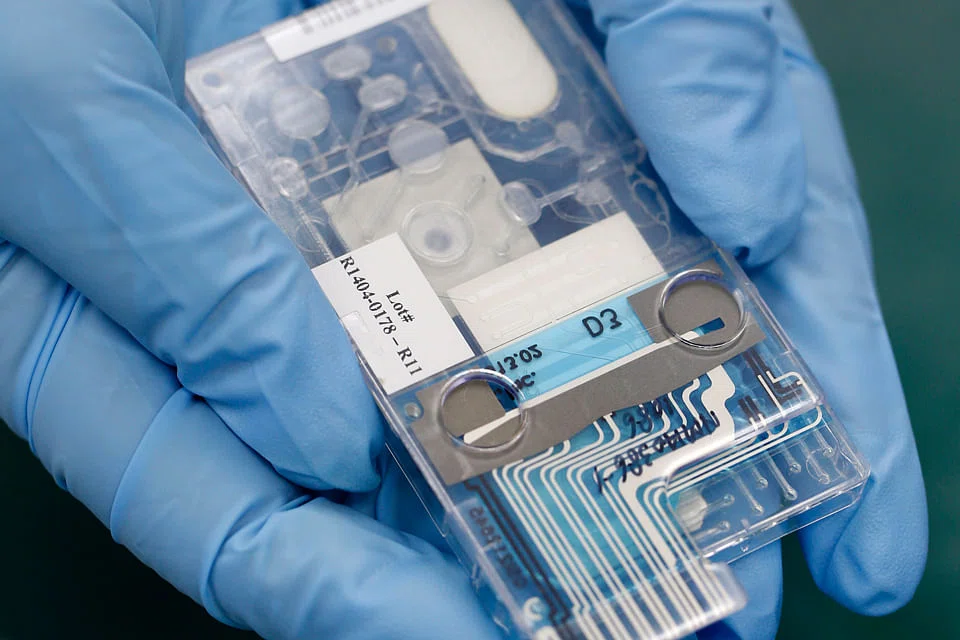
It is part of a collaboration with a United States start-up, Nanomix, and the test kit is awaiting approval by the US Food and Drug Administration.
The diagnostic tool, which is essentially a microfluidic chip, identifies a disease through changes in fluid properties at micro-level dimensions and enables clinicians to carry out tests at the point of care.
So, instead of the one or two weeks needed to process a blood test, the microfluidic chip can do so in a matter of minutes. And the same science can be applied to create those credit card-sized test kits that can determine if someone has dengue fever, HIV or if a patient is suffering from cardiac arrest.
Recognising the potential of microfluidics, the founder and chief executive officer of Racer Technology, Willy Koh, seized the opportunity to build up the company's capabilities in this area.
The move towards microfluidic technologies is part of Mr Koh's plans to augment the company's growth.
Currently, the medical technology manufacturing business contributes about 35 per cent of the firm's revenue. Last year, the firm posted a revenue of S$40 million and Mr Koh said sales is expected to rise by five per cent this year. He added that he hopes to grow the company to at least S$90 million in the next five years.
This is no mean feat considering the company's humble beginnings.
Established in December 1988, Racer Technology had started off designing medical products and devices but the sector is one that requires "deep pockets", said Mr Koh, who added that this is a long-term investment.
On average, it takes about 12 years before a medical product reaches the production stage. Of the products that are developed, about half do not make it to the market.
To finance the company in the mean time, Mr Koh said he dived into precision industries including automotive, security products and consumer electronics, which had "lean margins".
"The transition took about 20-odd years and slowly, we requested for medical parts production and sub-assemblies, as we are also involved in the mechanical design for our customers."
The ability to spot opportunities served Mr Koh well. He noticed that his customers had difficulties looking for a supplier in Asia that supported high-mix and low-volume production at that time, so he started off with a one-off phototype and sub-assembly.
Gradually, the firm shifted into full turnkey projects and had its products CE certified, which meant that the products complied with the requirements of the relevant European health, safety and environmental protection legislation. Now, the company, which has a mix of offices and factories in the US, China, Indonesia, Malaysia and India, is concentrating on areas of healthcare and lifestyle, which Mr Koh said are more profitable.
The straight-talking boss understands that change is constant and recognises the importance of being able to quickly adapt to these changes. It is perhaps one reason the company has gone from strength to strength in the last 20 years.
Still, the road ahead is long and hard, noted Mr Koh. The biggest challenge? China.
Mr Koh said the company is facing stiff competition from Chinese medical technology firms and has already lost "quite a number of projects" to them. This, as the time taken to approve a higher risk medical product (Class IIb) in Singapore can be double that of the time taken in China. In Singapore, the Health Sciences Authority takes an average of about nine months to do so.
China now does it in four to six months.
Time is also of the essence in the consumer electronics sector. Mr Koh explained that while it used to take between 12 and 18 months to develop and push out a consumer product, the cycle has now been shortened to six months.
He acknowledged that it is very difficult for Singapore companies to compete with those in Taiwan or China, especially when the costs of production drops "by the day". Rising manpower costs here are also not favourable for the firm, which has started pushing production to its factories in China, Batam and Malaysia.
Another concern raised by Mr Koh - the shortage of management staff with good soft skills. The gap is more glaring as the employees are made to multitask, noted Mr Koh, who strongly believes in teamwork.
Citing the example of geese flying in a "V" formation when they head south for winter, Mr Koh said he believes the same principle can be applied at Racer Technology.
"The whole flock adds at least 71 per cent greater flying range than if each bird flew on its own. (At Racer Technology) the stronger staff will lead and help the weaker ones."
Hopefully, this motto will serve the company well as it participates in the world's largest medical trade fair, along with a delegation of other Singapore small-and-medium enterprises in the medical technology industry.
Known as Medica/Compamed, the trade fair will be held in November in Dusseldorf, Germany, and Racer Technology will be vying for international contracts and seeking opportunities for tie-ups with established medical device and biomedical conglomerates.
TRENDING NOW

Malaysian king buys stake in Singapore-listed mining firm expanding into rare earths

Grab CEO’s wife Chloe Tong on life with Anthony Tan and finding her purpose

Once staunchly pro-China, Malaysian Chinese businesses are now distancing themselves from Beijing

Longer wait times expected as S’pore healthcare institutions report system disruptions

