US$335m in new venture funds launched for S-EA tech startups
Singapore
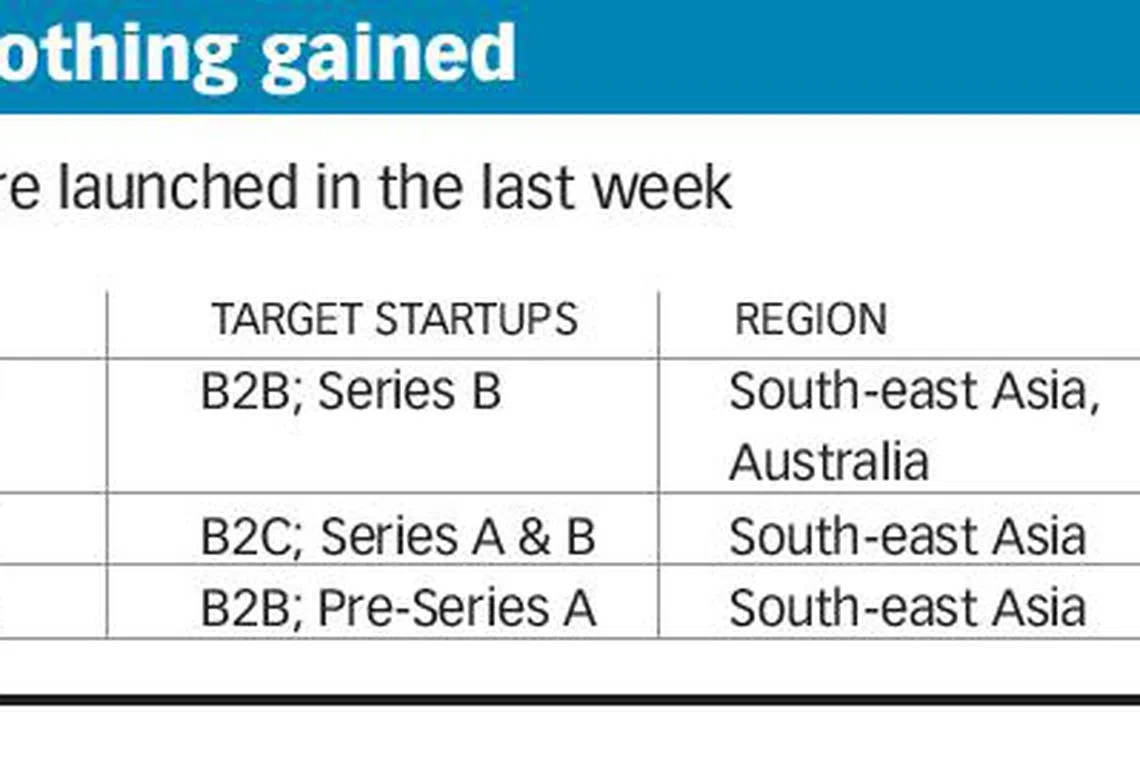
SOUTH-EAST Asia's startup ecosystem is coming into its own. In just the past week, three new venture funds totalling US$335 million were launched for the region's startups, The Business Times has learnt.
About two thirds or US$200 million will be dedicated to business-to-business (B2B) startups, a breed of companies that is increasingly catching the fancy of investors here. B2B startups, unlike business-to-consumer (B2C) startups, are said to begin to monetise their products early in their evolution and enjoy predictable cash flows, making them an enticing investment.
Qualgro and Tin Men - two Singapore-based venture capital firms - are each launching a US$100 million fund to support B2B startups.
Qualgro said investors have committed to 60 per cent of the fund in its first close. While Tin Men did not disclose total commitments received to-date, it said it expects the fund to reach its final close by third quarter next year.
Asked about the focus on B2B, Qualgro managing partner Heang Chhor said his firm invests in companies with three qualities: a technology advantage; the potential to be regional or global leaders in their space; and the potential to exhibit positive unit economics and business fundamentals at scale.
"B2B companies may be more likely to meet this criteria. They are, in general, less constrained by country boundaries. If they have superior products or services, they can sell to clients across geographies," said Mr Chhor, a Cambodian-born former entrepreneur who holds a French passport and is now a Singapore permanent resident.
Qualgro (an amalgamation of the words "quality" and "growth") is able to offer its portfolio startups "top-level connection with corporates globally", made possible by Mr Chhor's 26-year stint at McKinsey & Company, where he was a senior partner and board member. This allows B2B startups to easily find customers and grow their network, he said.
Jeremy Tan, co-founder of Tin Men, said his firm would go as far as to conduct sales calls with enterprise customers on behalf of their portfolio companies, and accompany the latter on sales road trips to help pitch their products. B2B startups in their early stages benefit most from "portfolio acceleration" (the acquiring of corporate clients), he reasoned.
The latter is why Tin Men continues to render hands-on support even after its startups have signed up initial customers. It would help them set up their own channel partnerships, build and train their internal sales teams, implement marketing initiatives, and put in place systems for performance tracking, operational efficiency and governance, said Mr Tan.
"These 'portfolio acceleration' activities are not easy to conduct. But if one has the ability to do so, these activities dramatically lower the likelihood of any one company failing and increase the value of every success."
He noted that B2B startups are unique in that they begin to monetise their products early in their evolution. It is also possible to measure customer profitability using real account-level data, a task that is "almost impossible to do for early-stage B2C startups". Moreover, once a B2B client is secured, cash flows are highly predictable, Mr Tan said.
"In contrast, it is much harder to influence the success of B2C startups except by providing capital. B2C startups tend to have a much longer search for a viable business model and face huge amounts of competition from both established players and fellow startups."
Even those that succeed in "fashioning a business model" can consume a lot of capital along the way, Mr Tan said. "To boot, these successful companies tend to be a very small minority in the universe of companies. This means that the B2C space is much more unpredictable and the rewards for success are highly concentrated among only a few companies."
Venture capital firm Openspace Ventures, for instance, is said to have scored a winner in Go-Jek, the Indonesian ridehailing app now valued at some US$5 billion and in which Openspace was an early investor. Go-Jek currently powers the bulk of returns for Openspace, which has 19 portfolio companies in total.
Last week, Openspace announced that it has closed a second fund amounting to US$135 million - US$10 million above its target size - for B2C startups at the Series A and B stage.
Hian Goh, founding partner of Openspace, noted that a group of new institutional investors - hailing from markets including the US, Australia, Europe and Japan - had backed its second fund. Asked about the significance of having a good number of institutional investors on board, Mr Goh said that such investors possess the "highest bar of quality".
He added: "They recognise Openspace as a potential top performer. At the same time, we are making sure they pay attention to South-east Asia. For many of them, it's the first time they have committed to the region and we are excited to make this happen for our ecosystem."
Mr Goh said Openspace's competitive advantage is a strong operational and business development team comprising people who are "employed full time" to work with and grow its portfolio companies. Openspace also has staff based in major South-east Asian countries (such as Indonesia, Vietnam and Thailand) to be close to its companies there.
Speaking on the region's opportunities, Mr Goh said it has a very "mobile-centric distribution model for Internet services", and is seeing a ubiquitous adoption of such services not only in transportation and e-commerce, but also in tertiary services like healthtech, fintech and edutech.
Qualgro's Mr Chhor added: "What is special about South-east Asia is the incredible pace of tech adoption in both its emerging and developed markets. The mobile-first trend - a leap-frog to the Internet via smartphones, skipping the desktop and feature phones - is a great example."
Mr Chhor is a firm believer that the region - with its more than 600 million population - will increasingly produce talented entrepreneurs able to create and grow regional and global tech businesses of "comparable quality as in the other regions".
Added Mr Goh: "We are now seeing experienced returnees from overseas helm Internet companies in Indonesia, the Philippines and Thailand, while in Singapore, the quality of engineers and experienced entrepreneurs continues to grow."
Tin Men's Mr Tan added that founding teams here are starting to be composed of "enterprising people who have cut their teeth in large corporations" and have now "chosen a path outside of corporate comfort". "As such, we see a lot of commitment and skin-in-the-game, deep market knowledge and relevant skills."
The ultimate key to talent is about designing job scopes and team processes that are aligned with the company's objectives and that also fairly incentivise the talent, said Mr Tan. "You'd be surprised by how little people know about ESOP (employee share option plan) even when it is offered to them."
"It's about communicating (processes and incentives) appropriately to achieve the desired effect."