

Making a difference via social and sustainability bonds
Their attraction lies in the added positive environmental and societal benefits that they provide

DESPITE global uncertainty and interest rate volatility, issuance volumes of social and sustainability bonds have remained stable. Investors can expect to earn the same or similar return on both types of bonds as on similar conventional bonds.
Their attraction lies in the added positive environmental and social benefits these bonds provide; in other words, we believe there is no case of doing good costing investors.
Social bonds raise money for projects, assets or activities that benefit individuals and societies. These include access to essential services such as healthcare and education, affordable housing and basic infrastructure, creating jobs, food security and socioeconomic advancement and empowerment.
Sustainability bonds raise money for both social and environmental projects, assets and activities through a single bond.
Issuance of social bonds grew steadily in the first three years after 2017, and then increased nearly tenfold after the Covid-19 pandemic spread. Governments, development banks, agencies and companies used the social bond format to help finance social projects in the face of the pandemic and its associated expenditures, as well as the subsequent recovery.
Issuance volumes of social and sustainability bonds held steady at around 300 billion euros (S$436.9 billion) in 2022 and 2023. We see it as reassuring that issuance remained stable despite the uncertainties in the aftermath of the pandemic, and the geopolitical conflicts in Ukraine and the Middle East.
The steady level of issuance also flew in the face of interest rate volatility. The 20-year average of the MOVE index, which measures US bond market volatility, was 85.8 points. In 2023, it rose to 118 points.
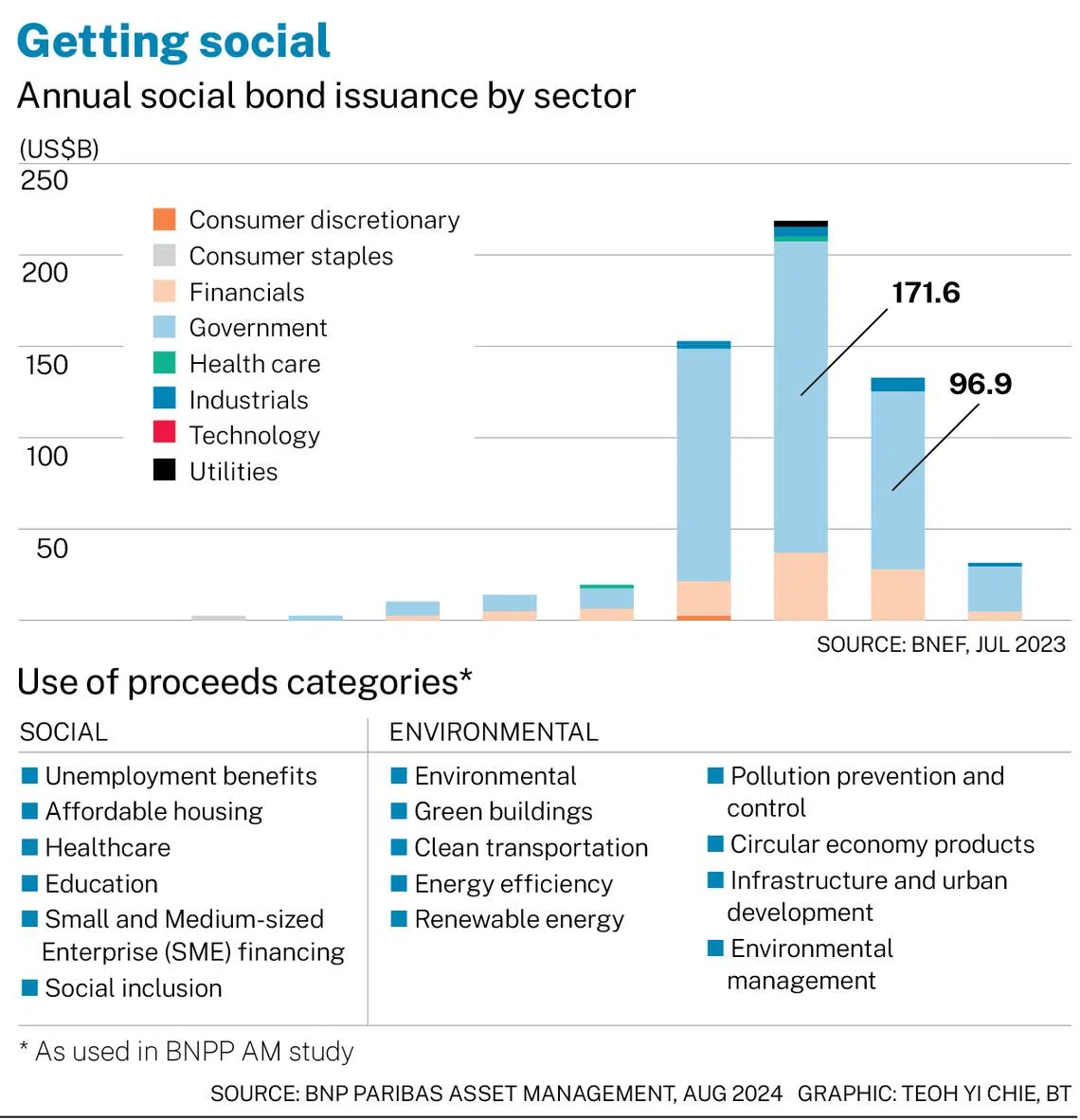
For us, the issuance indicated the continued conviction of issuers, investors, bond structurers and other parts of the financial ecosystem in the social and sustainability bond format within issuers’ bond issuance plans.
Unlike green projects, assets and activities, social projects are harder to identify in issuers’ operating models. For example, a steel manufacturer is likely to have fewer large social projects to fund compared to a development bank whose mandate is to improve outcomes for society.
Assessing the ‘social-ness’ of social bonds
The European Union Platform for Sustainable Finance published a draft social taxonomy in July 2021 to help assess the degree of “social-ness” of a social bond’s proceeds. While this should help identify which activities can be seen as contributing substantially to social objectives, it has no measures to determine the extent of the contribution of each activity towards such objectives. So far, the taxonomy remains in draft form and there are no clear timelines as to when it will be formalised as a regulation.
We have developed our own social bond assessment methodology as we believe social bonds should be differentiated in terms of ambition, specificity and integrity.
- Ambition is about the issuer’s determination to contribute towards particular social objectives and how it intends to develop its activities to address those objectives
- Specificity concerns the identification of precise target populations and the social hardships they face, which the issuer intends to mitigate with the proceeds
- Integrity is about the processes and management systems governing the use of the proceeds of the bond, mitigating potential risks from the associated projects, and measuring and reporting on the social bond programme
The level of recommendation we give to each social (and sustainability) bond that we assess can be positive when the bond exceeds our minimum expectations; neutral when the bond simply achieves what we expect of it; or negative, when the bond falls below our expectations. This is assessed through our in-house social bond methodology.
Understanding the impact
We recently conducted an analysis of the performance of almost 580 social and sustainability bonds in terms of their actual use of proceeds, the allocation across use-of-proceeds categories and the related positive impact that resulted. The information is split by region, type of social and environmental category, which UN Sustainable Development Goals were being targeted and the impact results of the social or environmental activities financed.
The study also provides numerous examples of the effectiveness of particular social bonds issued by a range of sovereign and corporate issuers in Europe and around the world. The social projects funded by such bonds have led, for example, to reducing poverty by granting unemployment benefits, providing access to education to low-income households, and helping low-income households secure a home via social and affordable housing projects.
Malika Takhtayeva is sustainable fixed-income lead (Emea); Xuan Sheng Ou Yong is sustainable fixed income lead (Asia Pacific), BNP Paribas Asset Management
TRENDING NOW

S$8 billion wiped off OCBC value as shares slide 5.8% in heavy trade

Grab CEO’s wife Chloe Tong on life with Anthony Tan and finding her purpose

Brookfield denies accusation it cut Soilbuild out of Mapletree deal

8 public officers referred to police over property buys near unannounced MRT stations: Chan Chun Sing

