More upside likely for Chinese equities
The forward price-to-earnings ratio of MSCI China is currently close to 11 times, below that of most developed and emerging markets
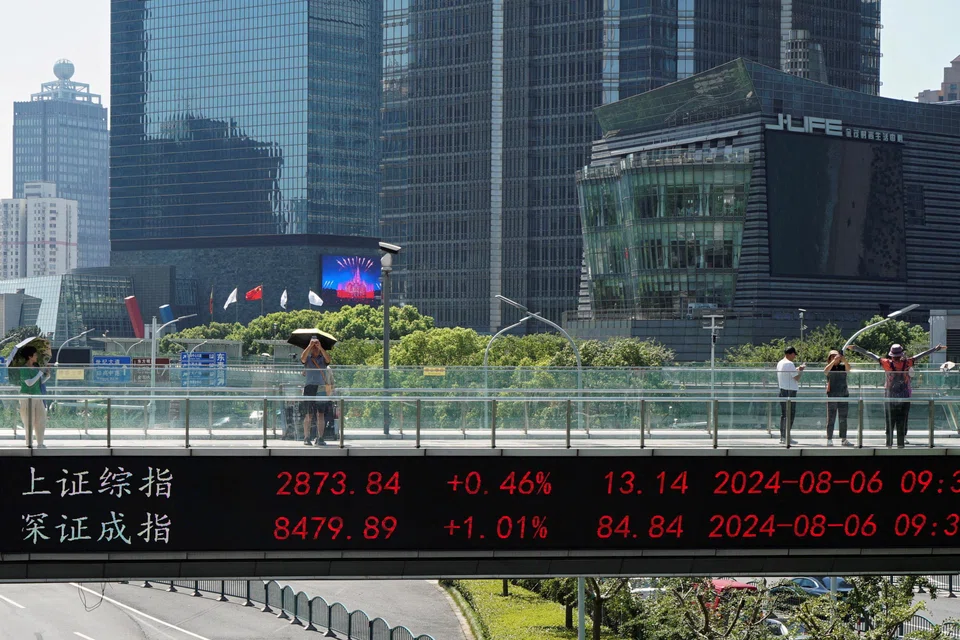

CHINESE equities are once again in the spotlight with strong gains since August 2024. Driven by policy interventions, the MSCI China index has risen more than 27 per cent year to date. This is the first time Chinese equities outperformed global equities after three years of negative returns.
The People’s Bank of China (PBOC) and other regulatory bodies introduced significant monetary easing measures, including a 20 basis points (bps) policy rate cut, a 50 bps cut in the Required Reserve Ratio and an 800 billion yuan (S$148.4 billion) investment aimed at bolstering the domestic equity market.
PBOC also introduced a 500 billion yuan swap facility and a 300 billion yuan re-lending facility to encourage stock repurchases, a maiden direct intervention in the equity market which significantly boosted market liquidity.
These coordinated efforts, sometimes compared with Japan’s “three arrows of policy stimulus”, comprising monetary, fiscal and structural reforms, are designed to stabilise struggling sectors such as housing and consumption while supporting capital market sentiment. Since these announcements, investors have closed out part of their underweight positions.
Crossing the pain threshold
Employment uncertainty, falling asset prices and subdued income growth have resulted in feeble demand and persistent disinflation. Policy responses for the past two years, which focused on boosting supply and incremental monetary loosening without the critical fiscal support, have failed to address the fundamental issues.
Stubbornly weak domestic demand reflects a looming liquidity trap, as seen in post-bubble Japan in the 1990s, demonstrating the failure of monetary policy in an environment of debt deflation. Youth unemployment rate (18 to 24 years old, excluding students) reached a high of 18.8 per cent in August, a potential risk for social stability.
The plethora of measures to stabilise the economy and capital markets also suggests that the problems are serious enough to warrant attention from the Chinese government.
Fiscal policy to the rescue?
Investors’ hopes of a large fiscal support package were quickly dashed as the succeeding National Development and Reform Commission and Ministry of Finance (MOF) press briefings did not commit to a specific quantum.
Beyond the monetary measures, the Chinese government also relaxed home purchase restrictions and lowered mortgage rates for refinancing, to stimulate the beleaguered property market and household disposable spending.
The additional issuance of 400 billion yuan of local government bond should alleviate a portion of the revenue shortfall due to falling tax revenues and a weak land sales market. The usage of local special bond proceeds was also broadened for the purchases of undeveloped land and unsold homes.
Additionally, the Chinese government has also expanded the white-list property funding programme to four trillion yuan by end of 2024 and major cities have also relaxed property purchase policies.
Separately, the MOF announced the issuance of central government special bonds to boost the Core Tier 1 capital of China’s six biggest banks. These measures will collectively raise the lending capacity, though credit growth is likely to stay muted unless employment rate and income prospects improve.
The silver lining, however, is the forward guidance that the government has ample fiscal room and would deploy it as necessary. This effectively sets a floor for the economy, which will cascade into stabilising investment sentiment.
The pronounced weakness in the Chinese economy and stock prices is also the result of a pervasive negative outlook by consumers and businesses. This stems from a combination of geopolitical challenges, a lack of policy support, earlier campaign-style crackdowns on some businesses and forced deleveraging in the real estate sector since 2020. While the recent rhetoric on private businesses has turned more supportive, it remains to be seen if private entrepreneurs will revive their optimism on the economy’s future.
Lessons from Japan and China’s unique challenges
Japan demonstrated the high cost of a spiralling debt deflation; nominal gross domestic product stagnated for almost two decades despite ultra-low interest rates. The malaise continued under a period of cautious policy response until the decisive “three-arrow” policy by the late prime minister Shinzo Abe.
Surely, the circumstances of China today are very different from that of Japan in the 1990s. The scale of the property bubble in Japan and attending contagion to the banking system were more severe, coupled with a second-order effect of a compromised credit transmission.
For China, local government financing challenges stemmed from an unsustainable revenue model based on land sales, which impeded fiscal transmission. A high debt load heavily constrained local government spending. Based on Bloomberg Economics estimates, local government only spent 45 per cent of this year’s planned budget. Hence, the measures to deal with local government debt and fiscal spending are a step in the right direction.
In the long term, while central government debt levels are still low, some form of refinancing, explicit central government guarantees and fiscal transfers will be necessary. It is imperative that China takes quick and decisive actions to not fall into the same pitfalls as Japan.
Investment implications
Despite an improving outlook, several risks could derail the rally in Chinese stocks, the foremost being the upcoming United States presidential elections. Former president Donald Trump, if re-elected, has proposed 60 per cent tariffs on imports from China. Under a Kamala Harris presidency, the protectionist posture against China is also unlikely to improve. More interventions will be needed to sustain China’s economic momentum.
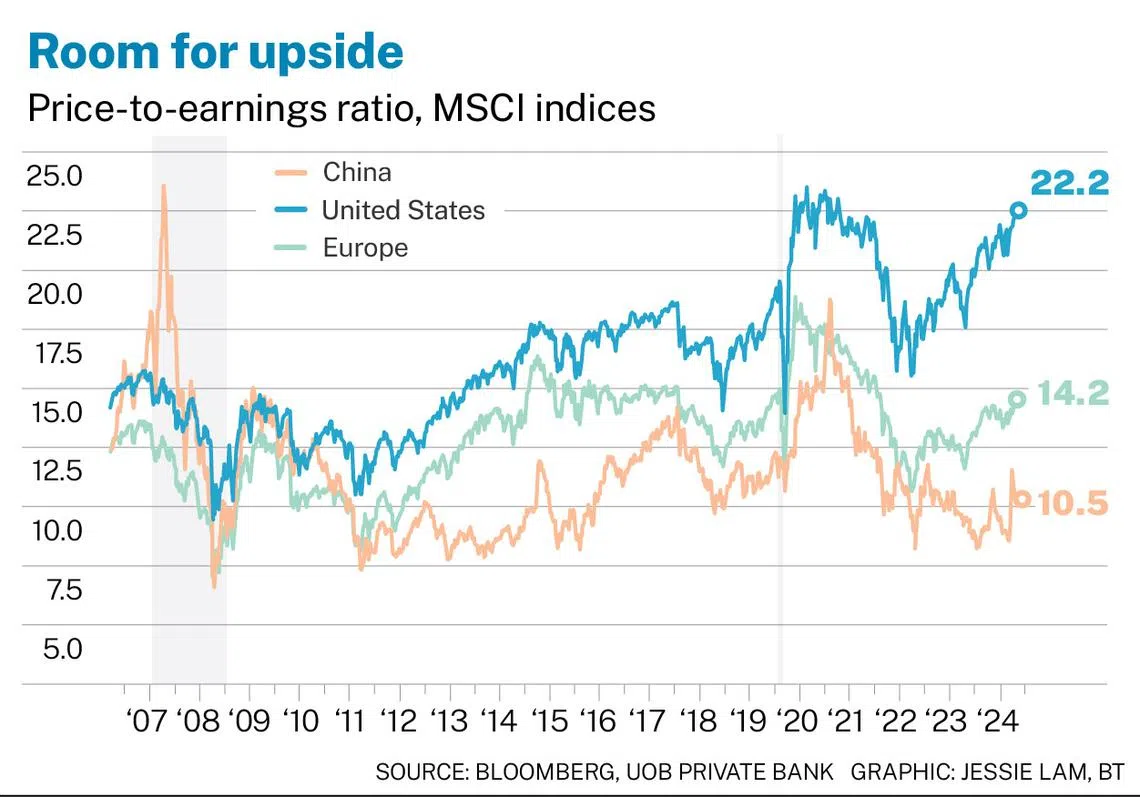
Chinese equities remain moderately valued compared to historical averages, even with the strong rally. The forward price-to-earnings ratio of MSCI China is currently close to 11 times, below that of most developed and emerging markets. This suggests there is room for further upside if economic growth picks up due to the policies.
The writer is chief investment officer, UOB Private Bank