

Boutique firm’s mission to compound wealth through equities is off to a strong start
Arkenomics Capital’s sole fund generated a compound annual growth rate of around 16.8%, on a short track record of 38 months

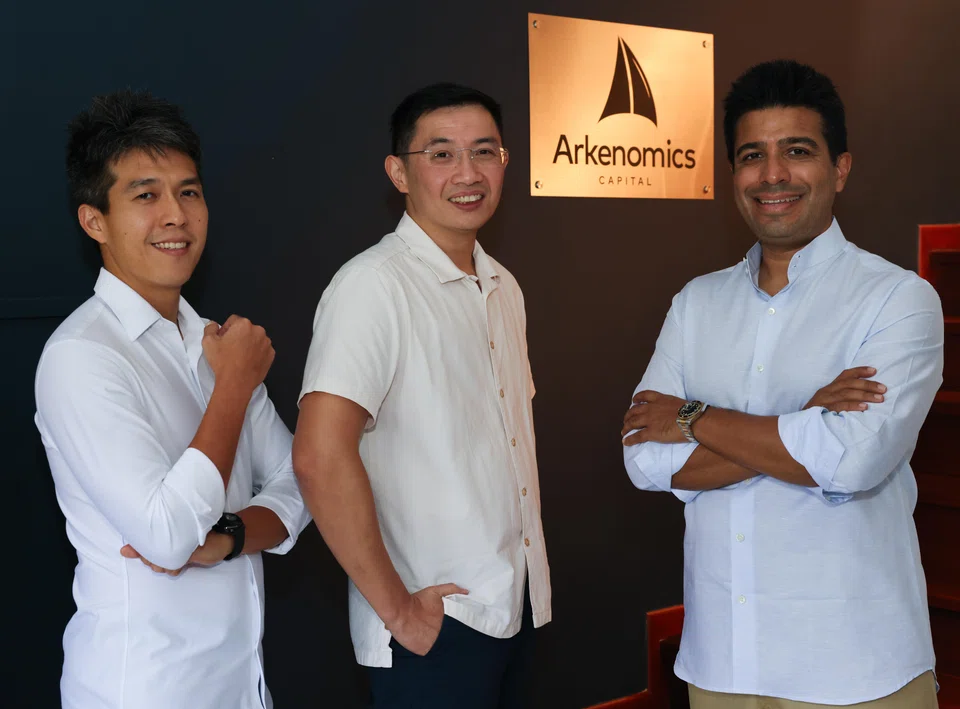
FOR the entrepreneurs behind boutique fund-management firm Arkenomics Capital, the investing rulebook seems simple: Buy stocks that show the hallmarks of value – strong balance sheets, low price-earnings multiple, high cash flow, good dividends.
Then, hold and let compounding do its magic. This, however, is a challenge for most individual investors.
Arkenomics’ founders Dinesh Advani and Peter Lum pursue a single strategy for their sole fund, the Arkenomics Provident Fund, seeded in October 2022 with S$10 million of their own capital.
Until end-November, the fund had generated a compound annual growth rate of around 16.8 per cent, albeit on a short track record of 38 months.
Both are executive directors in the firm, Lum for investments and Advani, for operations. A third partner, Reynold Tan, focuses on research and investments.
Skin in the game
Together, the three shareholders own just under 30 per cent of the fund’s assets under management (AUM) of roughly S$60 million. This gives them skin in the game and ensures alignment of interests with those of their investors. The fund is open only to accredited investors.
Despite an “unconstrained” investment mandate, the fund is currently focused on equities in developed Asia.
It is structured as a variable capital company (VCC), domiciled in Singapore and investing in Singdollars, which is preferred by its client base of high-net-worth individuals.
Based on its fact sheet, the fund invests globally in “mispriced listed equities” and targets “low to mid-teen returns”.
Advani and Lum, who began his investment career at Lim & Tan Securities, speak with almost missionary zeal on the merits of investing in equities, an asset class which has a modest share of Singapore’s household balance sheet.
The latest official data in November shows that financial assets account for 70 per cent of Singaporeans’ total assets.
Of this, listed stocks’ share is around 7 per cent; currencies and deposits account for more than a third.
Advani said: “Rule No 1 is protect your capital, and Rule No 2, grow your capital. We’re not in the business of AUM growth. We’re in the business of making our capital work and doubling our net worth every six to seven years.”
Based roughly on the “Rule of 72”, this objective needs an annual rate of return of 10 to 12 per cent.
Lum said: “For stocks, it’s simple. Buy things below their intrinsic value and when they rise above intrinsic value, you rebalance. I’ve been doing this for close to 20 years.”
Property an inefficient asset
The partners believe Singaporeans need to be weaned off their love for property, where capital allocation is inefficient due to illiquidity and the high initial capital required.
Lum said: “Singapore real estate has served (many people) well. But continuing in this direction can be challenging for the next generation. If you aren’t born rich, real estate can be harder to access because you need significant upfront capital... Today, I can buy a house for, say, S$7 million. The person who sold this to me must have paid S$2 million to S$3 million. But I might as well give my son that S$4 million to S$5 million rather than enrich other people.”
“I can make money from property, but it’s modest compared to what I can generate in the stock market. Today, we have a platform to show investing in equities works, and we prove this by allocating alongside our investors.”
Stocks’ ability to compound wealth over a long horizon is also under-appreciated. Lum said: “With compounding, you can replace your (employment) income. Your passive income becomes meaningful relative to your salary. That’s why we left our jobs. The management fee is just gravy; it’s nothing compared to the wealth effect of compounding.”
Dinesh said: “What compounds over long periods of time is ownership of businesses. Stocks aren’t just instruments – they’re ownership stakes. That’s why a large percentage of our personal net worth is invested in equities.”
The Arkenomics Provident Fund has two fee structures. Class A has zero management fee and a performance fee of 20 per cent, subject to a high-water mark. This share class requires an initial investment of S$500,000.
Class B has a 1 per cent annual fee, plus a performance fee of 15 per cent. The minimum initial investment is S$100,000.
The fees are set to rise in January. The performance fee for Class A units will be 25 per cent, and for Class B, 20 per cent.
The firm uses value filters to screen the global universe of stocks, narrowing it down to around 100.
The portfolio itself holds fewer than 60 names. As at the end of November, the fund had 56 holdings.
The top 20 positions accounted for 72 per cent of the fund. To mitigate risk, the fund focuses on developed Asia large-cap stocks, and liquidity is a must.
Value filters
Lum said: “We have less than 5 per cent invested in the Magnificent Seven stocks. We like to be paid to hold, so a large percentage comprises dividend-paying stocks. We also want to be in countries with strong currencies… Based on the history of the stock market, you should make between 8 and 10 per cent in average annual returns. But we aim to do better than that.”
Dividends, which are reinvested, make up 60 per cent of the portfolio, and the yield now stands at 4 per cent.
Of macro factors, he pays the most attention to interest rates. “They effectively reflect the opportunity cost of capital and influence how we rebalance the portfolio. Beyond that, we let company fundamentals, rather than broad macro narratives, drive our decisions.”
Investors’ tendency to pile into a rising market – in gold, tech stocks or even property – is symptomatic of the “greater fool” theory, where investments are made regardless of fundamentals.
“Being expensive doesn’t mean things won’t rise further. It may rise even more because it’s a trending market. But for us to invest in a trending market doesn’t work.
“As value investors, we look at cash flow, dividend yield and the balance sheet. My passive income allows me to invest selectively. If the odds don’t look good, I don’t invest.”
The fund caps subscriptions when its compound annual growth rate (CAGR) exceeds a certain threshold. This happened in March, when its CAGR hit 20 per cent.
Advani said: “We wrote to our investors to say, ‘We welcome your capital – but not just yet’.”
In April, the market dropped.
Lum said: “It’s not that we had a crystal ball; it was based on our CAGR… Investors appreciate that because we’re also training them on how to allocate. We tell them – don’t just invest when the market is clear, invest when the market pulls back. They don’t get that signal from bigger funds.”
Advani believes volatility is not well understood. “For us, volatility is not risk – it reflects liquidity and market behaviour. We’re not afraid of volatility. We’re more concerned about the intrinsic value of the business we invest in.
“We tell our investors: First, invest only what you’re comfortable with. Second, if you’re unable to tolerate volatility, this approach may not be suitable.”
TRENDING NOW

Malaysian king buys stake in Singapore-listed mining firm expanding into rare earths

Grab CEO’s wife Chloe Tong on life with Anthony Tan and finding her purpose

Once staunchly pro-China, Malaysian Chinese businesses are now distancing themselves from Beijing

Longer wait times expected as S’pore healthcare institutions report system disruptions

