

How humanoids and robots could sustain China’s dominance in global manufacturing
The country has captured incremental market share of 50% globally in industrial robot-related segments
A DECADE ago, few would have taken seriously the notion that China would dominate the global auto industry. But today, China is widely acknowledged as the leader, producing more than half of the electric vehicles sold worldwide.
China has also overtaken Germany and Japan to become the world’s largest auto exporter.
This dominance is replicated across a broad swathe of industries. China has a market share of 47 per cent of global battery exports, 43 per cent of mobile phones and 36 per cent of semiconductor components, just to name a few.
Based on data from the World Bank, it is estimated that China has captured a 19 per cent incremental market share for the 15 fastest-growing export segments globally.
China’s export machinery shows no signs of slowing, and we project that its share of global exports will climb from 15 per cent today to 16.5 per cent by 2030.
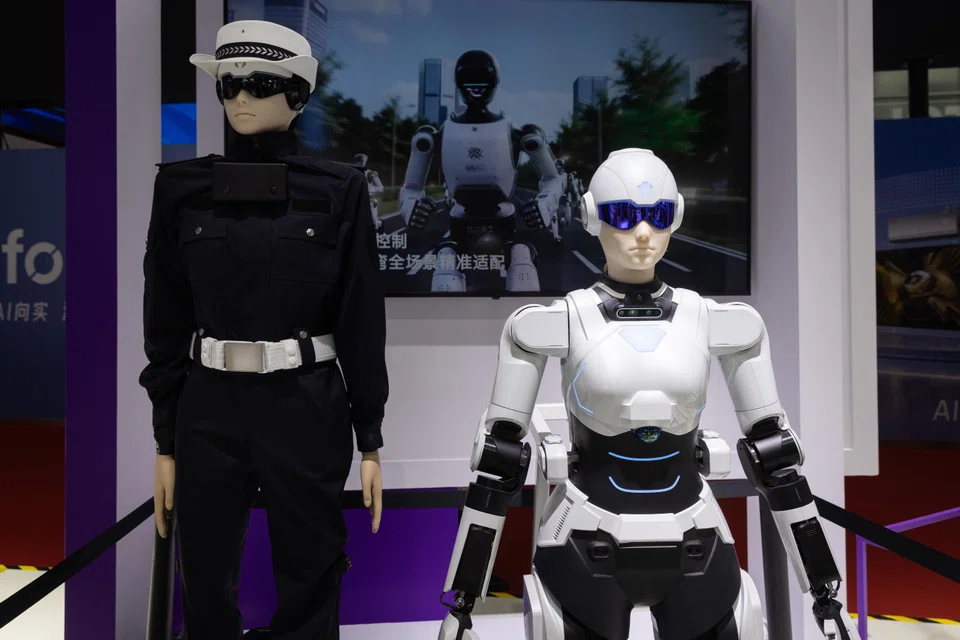
New sectors are constantly being identified and targeted, and humanoids and robots are showing initial signs of replicating the success of the EV industry.
The export data already echoes the early EV story. In the 12 months to March, Chinese humanoid and robot exports reached US$1.5 billion.
EV exports stood at that level in January 2020; within six years, those EV exports had surged to an US$86 billion annualised run-rate and continue to grow at close to 70 per cent year on year.
From 1,944th among China’s export categories in 2017, EVs now rank 10th, and we believe humanoids will retrace the same arc.
Humanoids’ potential
There are five key reasons China’s companies will likely continue to dominate global manufacturing.
First, they are early trend-spotters and take action quickly to target high-growth sectors.
As early as 2021, China had already identified intelligent robots as a priority. By 2023, the Ministry of Industry and Information Technology had framed humanoids as a strategic emerging sector. This has translated into an early and dominant lead.
According to estimates from Omdia, a technology research and advisory firm, and as reported by Bloomberg, Chinese manufacturers produced about 90 per cent of the humanoid robots that were installed globally in 2025.
Second, China’s companies execute with an integrated supply chain and ecosystem.
Local content in Chinese-made robots has jumped from around 30 per cent to over 50 per cent in the past five years. The country also produces roughly 90 per cent of certain rare-earth magnet types essential to a robot’s core hardware.
China also leads in terms of capabilities in manufacturing the final product as well as the key components, showcasing the depth of the build-out of the supply chain. That is something that we witnessed recently on our trip to Shenzhen.
Together with the associated categories, China has already captured incremental market share of 50 per cent globally in industrial robot-related segments.
Concerted efforts
Third, China has a financial system that is aligned to its strategic goals.
Local governments and banks provide incentives and funds to these high-growth sectors from the get-go, which enables firms to absorb early losses while they chase scale.
Fourth, these companies spend large amounts on R&D.
National R&D outlays reached 2.8 per cent of gross domestic product in 2025, or roughly US$550 billion, second only to the US, which spends 3.4 per cent of its GDP on R&D.
The 15th Five-Year Plan enshrined robotics and artificial intelligence as strategic emerging industries.
Fifth, China has been ensuring the adequate training of the workforce. Around 41 per cent of China’s tertiary graduates hold science, technology, engineering and mathematics degrees, double the US share of 20 per cent.
This successful approach is now targeted at the humanoids and robotics sector. Therefore, we believe it can become China’s next export dividend.
The country has scale, supply chains, engineers, policy support and a large domestic market. Those strengths have already transformed several global industries. We think they can now do the same in robots.
Asia’s industrial supercycle
At the same time, the onset of an industrial super-cycle in Asia will act as a catalyst for accelerating gains in China’s market share.
We see a structural rise in Asia’s capex, driven by increased spending on AI and AI-related infrastructure, energy transition, defence and a rise in industrial capex.
As global and Asian capex rises, Asia and China, as global production powerhouses, stand to enjoy a double benefit, as they have the production capacity to meet the structural increase in demand for capital goods from both within Asia and globally.
China has built its modern growth model around one core strength – that it scales new industries faster than most economies can respond – and now it leads in the innovation of the next generation of manufacturing.
That story has already played out in consumer electronics, solar products, batteries and EVs. We expect it will now play out in humanoids and robotics.
However, China’s greatest strength can also become a macro risk.
When too many firms rush into the same sector, capacity grows too fast. This causes prices to fall, margins to shrink and returns to deteriorate.
Excessive competition also tends to give rise to a deflationary backdrop and a continued reliance on exports, rather than encouraging domestic demand to drive its business cycles.
While policymakers have become increasingly alert to the challenges posed by excessive competition and excess capacity, we still need to gauge how rapid growth to achieve scale will be balanced against achieving sustainable profitability, and thereby ensure that the economy does not face deflation risks systematically.
The writer is chief Asia economist, Morgan Stanley
TRENDING NOW

S$8 billion wiped off OCBC value as shares slide 5.8% in heavy trade

Grab CEO’s wife Chloe Tong on life with Anthony Tan and finding her purpose

Brookfield denies accusation it cut Soilbuild out of Mapletree deal
8 public officers referred to police over property buys near unannounced MRT stations: Chan Chun Sing

