Tariffs, tensions and turbulence – it’s not business as usual
Long-standing trade relations among major trading nations have been upended, sending financial markets into turmoil from the tit-for-tat, on-again off-again nature of tariff announcements
IT IS not business as usual for countries, businesses and investors – not since US President Donald Trump’s announcement of a raft of baseline and reciprocal tariffs on “Liberation Day” unleashed tensions and turbulence globally.
Tariffs have upended long-standing trade relations among major trading nations, sending financial markets into turmoil from the tit-for-tat, on-again off-again nature of tariff announcements, and the recent exclusions by the US on imports of China-made smartphones and consumer electronics announced last Friday (Apr 11).
With almost daily developments, investors are justifiably spooked by how the proposed tariffs would weigh on economic growth, corporate earnings and the US dollar, while elevating inflationary risks and prices of safe-haven assets.
Watchful of macro shocks
We are watching two major macro factors:
1. Stagflationary risks rise: Given the scale of the proposed US import tariffs, a full-scale implementation along with retaliation by foreign countries would represent a growth shock that could spark a global recession. However, our base case is for bilateral negotiations between the US and affected countries on tariff and non-tariff matters to persist for several months through 2025.
Despite the 90-day reprieve announced last week by Trump, we expect tough negotiations to delay or roll back parts of the US reciprocal tariffs while its 10 per cent tariffs remain. Concurrently, inflationary risks have risen as US tariffs push up import costs. The net effect of slower growth and higher inflation lead us to expect two quarters of stagflation, rather than the worst-case scenario of a recession.
We lowered US gross domestic product growth forecasts from 2.2 per cent to 1.5 per cent, reflecting the drag from the tariff shock. Tariff-related policy uncertainties are weighing on business confidence and consumer sentiment, already reflected in recent soft economic data.
2. Central banks’ dilemma: On Apr 4, US Federal Reserve chair Jerome Powell warned of US inflationary risks with tariff uncertainties and the need for greater clarity before considering interest rate shifts. We expect the Fed to hold the fed funds rate steady at 4.25 to 4.5 per cent, before deciding between higher rates to curb inflation or rate cuts to avert a potential recession.
In response to weaker growth, we expect the European Central Bank to keep cutting interest rates from 2.5 per cent to 1.75 per cent over its next three meetings. The Bank of England may also make three quarterly rate cuts from 4.5 per cent to 3.75 per cent this year. Despite weaker growth and lower rates, the euro and the pound will strengthen against the greenback as global investors seek diversifiers from the US dollar on the back of US policy uncertainties.
Asia beyond the fog
Based on Chinese data, exports to the US were worth about US$525 billion in 2024, while US imports from China were US$440 billion in the same year. This implies that the 145 per cent tariff applied for a full year on China’s exports would result in an effective tax rise to US consumers of more than 2 per cent of US GDP alone. We believe this potential contractionary impact on US growth, combined with a sell-off of US assets, will prompt a US-China deal to avert an unsustainable market situation.
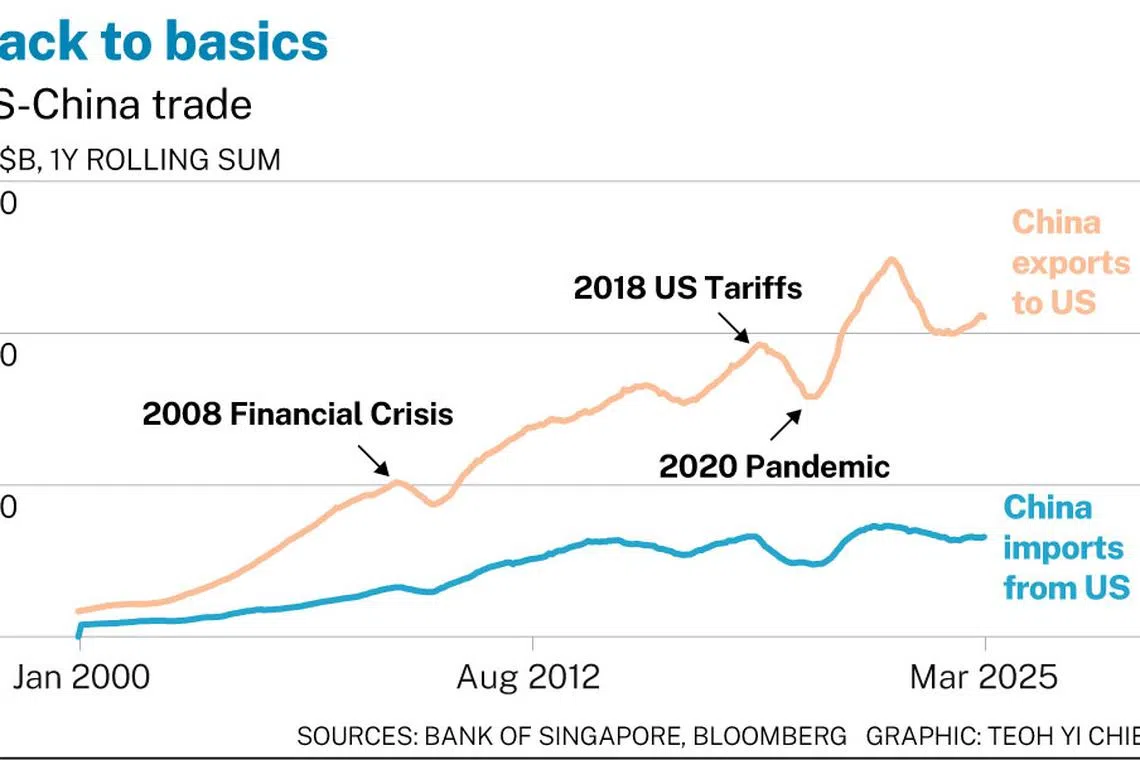
Export-oriented Asia is caught in the crosshairs of the US-China contest for economic hegemony. US plans to levy reciprocal tariff rates on major Asian markets – China at 34 per cent; India at 26 per cent; Taiwan at 32 per cent; and South Korea at 25 per cent, subject to further negotiations.
Asean markets (including Vietnam, Thailand and Malaysia), often seen as prime candidates for the China+1 strategy, will contend with potential tariff rates of 24 to 46 per cent. Our overall overweight call on Asian equities, is tilted in favour of Hong Kong, China, Singapore and the Philippines.
In equities, we focus on opportunities in domestic-oriented Asian sectors and companies (such as Chinese Internet platform companies, Asean utilities and telcos); quality yield stocks; policy beneficiaries; and businesses with well-diversified intra-Asia supply chains and flexible distribution nodes.
These companies will be relatively buffered from the shifting sands of global tariff and non-tariff trade barriers. However, the second order impact of economic slowdown and inflation will still hurt overall business growth.
In fixed income, sectors such as financials, utilities and telecoms could be more defensive and see smaller spread widening on a relative basis. We prefer quality credits with strong fundamentals such as issuers with a diversified business profile, stable cash flows and strong liquidity buffer, and sectors which are more defensive or systemically important that stand to benefit from government support.
Long-term investors’ playbook amid uncertainty
When the only certainty is uncertainty, stick to the process. To avoid crystal-ball gazing and getting whipsawed by short-term swings, we believe in the core principles of prioritising a long-term investment horizon and investment discipline of building diversified risk-aware portfolios.
The investment playbook for many investors that hinges on US exceptionalism – across US equities, global technology sector and a strong US dollar – now faces mounting challenges. Yet, in the midst of volatile markets, one’s starting position is critical in determining next steps. Here are some things to note:
1. For investors who have sat on the sidelines with cash, the current dislocation in markets has created opportunities for those with patient capital to access businesses with wide moats at attractive valuations. Focus on exposure to longer-term structural themes and super trends such as the changing world order, intelligence economy building on artificial intelligence, climate resilience and changing demographics.
2. For active investors, this is an opportunity to revisit asset allocation principles and actively rebalance portfolios to address potential risks and adjust expected return profiles. Diversification is key, across asset classes, regions, currencies and investment styles, combined with strategic use of gold, alternatives and derivatives (where appropriate).
In equities, we prefer value and quality stocks with pricing power and limited exposure to tariffs. In fixed income, we upgraded our positions in US Treasuries and developed markets’ investment-grade bonds from underweight to neutral to reflect rising recession risks. We downgraded emerging markets fixed income as credit spreads have not sufficiently priced in growth headwinds.
3. For leveraged investors, it is important to actively manage risk and maintain adequate liquidity buffers to weather the market volatility. With severe price swings, margin calls may force investors to liquidate positions at drastically unfavourable levels only to be caught out in violent rebounds. Create liquidity buffers to avoid having to realise mark-to-market losses on unfavourable terms.
4. Safe-haven assets will stay in demand until the trade impasse is resolved. The long-term outlook for US Treasuries remains challenging as inflation rises and the US fiscal deficit worsens further. Gold will continue to shine as an effective hedge amid tariff uncertainties and concerns over US long-term fiscal sustainability that weigh on the US dollar.
5. For investors narrowly focused on selected public markets, the risks of over-valuation and over-concentration may rise on unpredictable growth dynamics. Adding alternative asset classes (such as private equity, private credit, hedge funds, and infrastructure and real estate) can offer differentiated return streams, lower correlation to public markets and provide downside protection in certain instances.
The writer is global chief investment officer, Bank of Singapore