


Alternative investments, long seen as the preserve of institutions and ultra-high-net-worth individuals, are coming within reach of more individual investors.
Alternative investments are financial products outside traditional assets such as equities, bonds and cash. Besides physical investments such as art and jewellery, more common examples include private equity, private credit, private real estate and infrastructure, which are not traded on public markets, as well as hedge funds.
Minimum investments used to run into hundreds of thousands of US dollars. With the rise of innovative products and wealth management platforms, investors can now get started with as little as $1,000.
As entry thresholds fall, investor interest is growing. Mark Yeo, head of investment advisory at StashAway, told Lianhe Zaobao (LHZB) that the number of Singaporean clients investing in alternative assets on the platform more than doubled over the past year, while assets under management surged 133%. Private credit was the most popular choice.
Yuhan Tan, head of alternatives at Endowus, has also observed that demand comes mainly from mature investors aged 45 to 54 who are building their wealth. About 60% are seeking other sources of income, while 40% are investing as part of wealth succession planning.
However, lower investment thresholds do not mean private markets have become accessible to everyone.
Most private market funds in Singapore still cater primarily to accredited investors, who must meet one of three criteria: personal net assets exceeding $2 million, net financial assets exceeding $1 million, or an annual income of at least $300,000 in the preceding year.
Tan said retail investors currently have relatively limited choices, mainly listed private equity trusts, listed infrastructure vehicles or liquid alternatives that comply with regulatory frameworks. These offer exposure on par with private markets but are still traded on public markets.
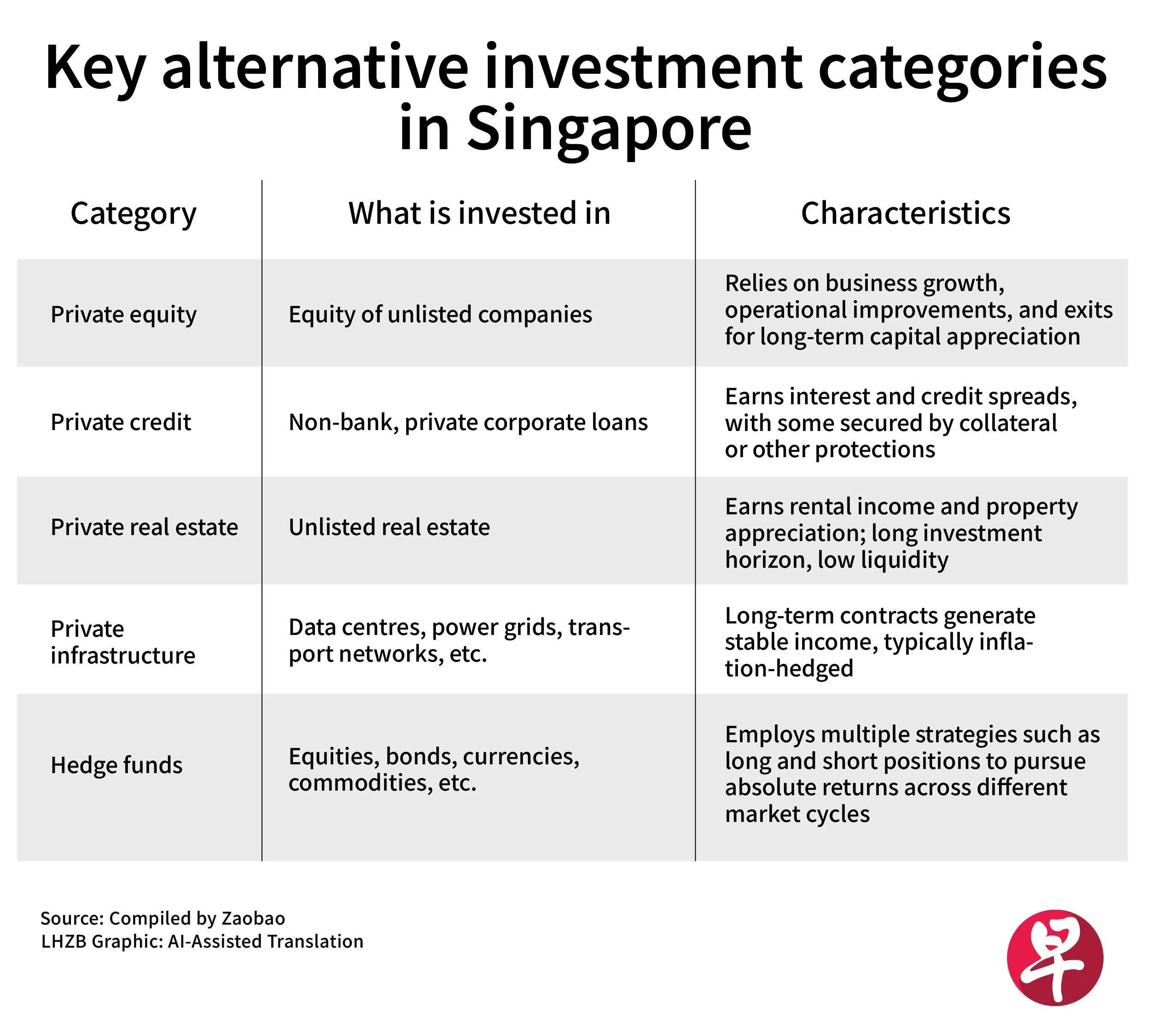
What gaps in public markets can private markets fill?
What advantages do alternative assets offer over financial products in public markets?
First, they broaden the investment universe, allowing investors to capture companies’ growth before they list. Yeo said about 87% of companies worldwide with revenue exceeding US$100 million (S$128 million) remain privately owned. Investing only in listed companies means missing out on that growth phase.
Chue En Yaw, who will take up the role of global head and chief information officer of global fund solutions at Seviora Group, also noted that “many high-growth businesses are choosing to stay private for longer, so a meaningful share of value creation happens before, or without a public listing.”
Second, private and public markets can complement each other. Private equity, especially venture and growth capital, can supplement listed equities in delivering growth, while private credit can complement traditional fixed income in generating income.
Alternative investments can also reduce a portfolio’s correlation with public markets and diversify risk.
Yeo cited historical data showing that for every 10% move in the S&P 500, the BarclayHedge Multi-Strategy Index moved by just 1.8% on average.
Henry Chui, co-head of Asia and head of Private Wealth APAC at Partners Group, added that public market indices are increasingly concentrated in a handful of large technology companies. Private markets, by contrast, offer more opportunities to diversify across industries and stages of business growth.
The trade-offs behind lower entry thresholds
Traditional private market funds mostly use closed-end structures. Investors commit a sum upfront, which the fund manager then calls on in stages. These funds typically require commitments of US$250,000 to US$1 million and have lengthy lock-up periods.
This usually leaves ordinary investors able to invest in only one or two funds. Various new structures are reducing these constraints.
Yeo explained that wealth management platforms pool smaller sums from many clients and invest in underlying funds as an institution. This can bring the minimum investment for some products down to about US$20,000.
A fund of funds (FOF) allows investors to gain exposure to several underlying products through a single investment, without having to meet each fund’s high minimum separately.
Evergreen funds have no fixed maturity date. Investors buy into an existing portfolio and can redeem their investments periodically.
However, Chue cautioned, “Any structure that broadens access comes with compromises. There are inevitably trade-offs between fees, liquidity and returns, and investors must be clear about what they are giving up.”
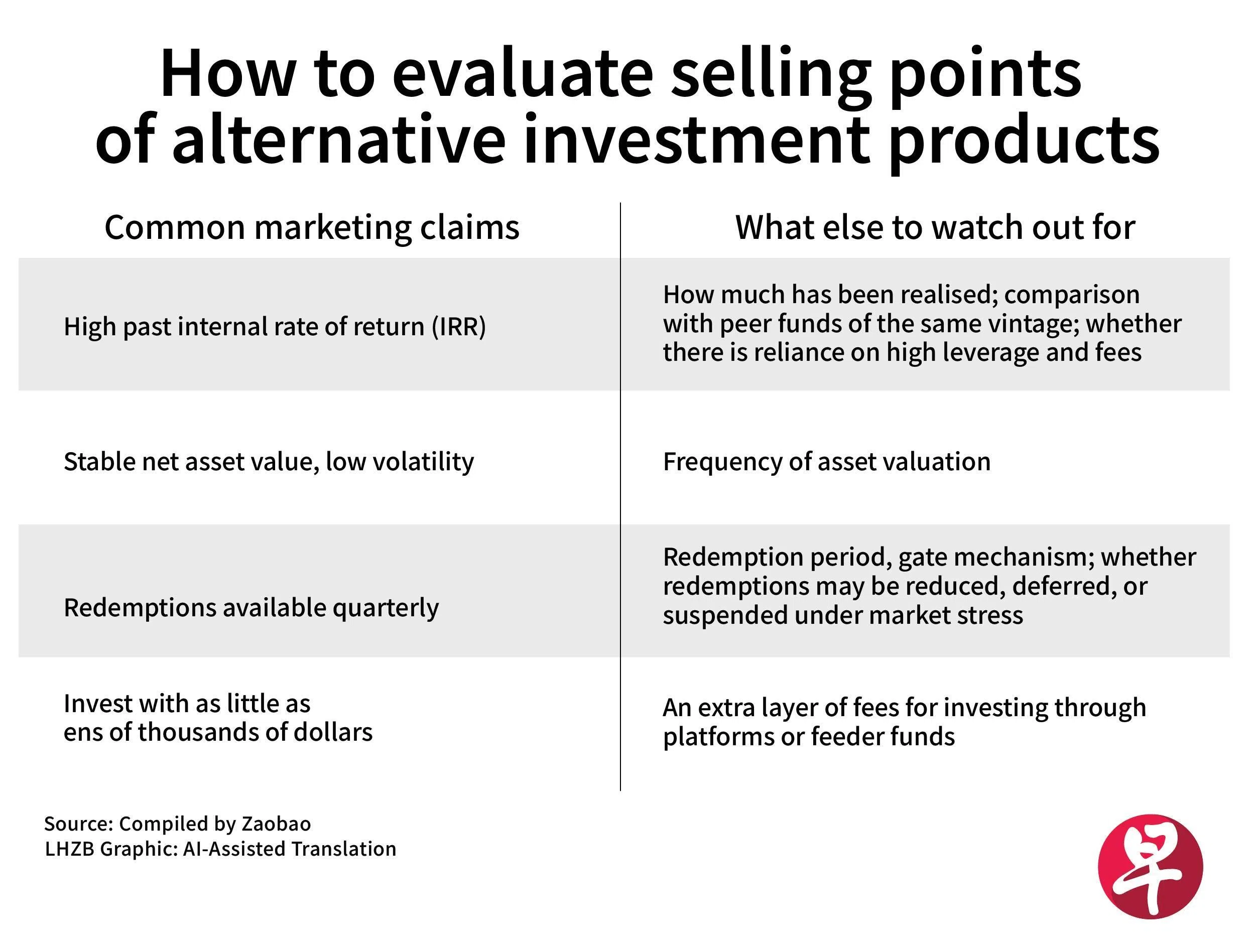
For example, investing through a platform, feeder fund or FOF is an indirect route that adds layers of management fees and offers less transparency. Some products may appear accessible but rely on a single strategy or manager, creating high concentration risk.
To meet periodic redemptions, evergreen funds usually hold cash or short-term, highly liquid assets, which lower overall returns.
Assessing investment returns: A higher IRR does not mean a bigger profit
Alternative investment performance is assessed using historical metrics, the most common of which is the internal rate of return (IRR).
IRR is essentially a discount rate that takes into account the size, timing and present value of invested capital to measure profitability.
Importantly, a higher IRR does not necessarily mean a bigger profit.
Regarding this figure, Yeo cautioned, “It can be engineered.” Delaying capital calls or exiting investments quickly can shorten the actual holding period, boosting IRR without creating additional value.
He said IRR favours smaller, quicker returns over larger, slower ones. For example, a return of 1.3 times the investment after one year gives an IRR of about 30%, compared with about 16% for a return of 2.5 times over six years. The latter has a lower IRR but creates more total value.
Use several metrics to assess fund performance
The experts interviewed therefore advised investors to assess returns using several metrics.
For example, distributions to paid-in capital (DPI) shows how much cash investors have actually received. Residual value to paid-in capital (RVPI), which represents unrealised book value, depends on the manager’s subjective valuations and may lag behind market conditions or be overstated.
Chui noted that a fund’s vintage — the year it begins investing — strategy, leverage and fees all affect comparisons. Comparing similar funds and examining whether a manager has delivered consistent performance across market cycles is more reliable than looking at return figures alone.
Choosing the fund manager is also crucial. Chui stressed that private market returns depend heavily on managers practising “active ownership”, directly helping to improve companies’ operating efficiency and develop their businesses.
Yeo also said that when assessing a manager’s track record, the key is to determine whether success came from the manager’s own capabilities. Investors should also look at the number of funds and deals involved, as a few exceptionally successful investments can mask otherwise mediocre performance.
Tan added that investors assessing whether a fund has generated excess returns, or alpha, can also use the public market equivalent (PME), which shows whether a private fund has outperformed public markets.
“Quarterly redemption” is no guarantee of liquidity
Another frequently misunderstood feature is the semi-liquid structure. Some evergreen funds offer quarterly or even monthly redemptions, but this does not mean investors will receive their money as soon as the redemption date arrives, because the underlying assets cannot be sold instantly.
Yeo cautioned that investors face an additional wait of four to six weeks from submitting a request through the calculation of net asset value to receiving their money.
Tan explained that evergreen funds generally cap quarterly redemptions at 5% to 10% of net assets. If market conditions deteriorate and requests flood in, redemption amounts may be reduced proportionately. Managers can tighten restrictions further or suspend redemptions when markets are under stress.
Chue said, “Quarterly redemption is an option, not a guarantee of liquidity.” Such products offer flexibility but remain long-term investments.
Unlike listed equities, private assets do not have daily market prices and are usually valued quarterly, making their reported volatility inherently lower.
Even so, Tan cautioned that private assets are not immune to macroeconomic conditions, and investors should consider overall volatility when deciding their allocations.
Assess your own circumstances before researching funds
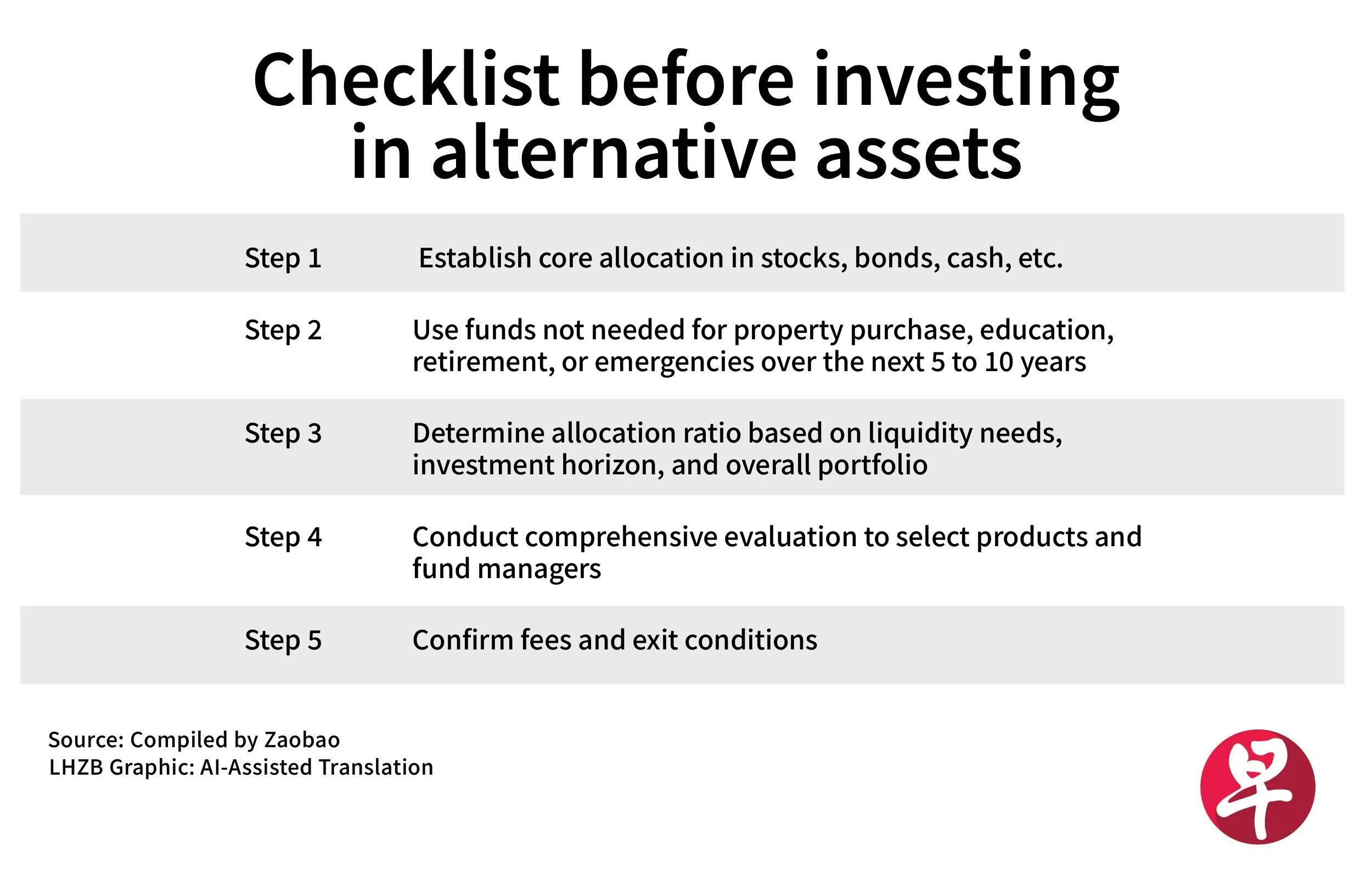
Individual investors considering alternative investments should first assess their own circumstances.
Tan said that despite their many advantages, alternative investments cannot directly replace equities and bonds. Individual investors should first build a public market portfolio, then add private market investments as a “satellite allocation”. They should also ensure they will not need the money for at least the next five to ten years.
Next, they should decide how much to invest based on their asset size, risk tolerance and liquidity needs. Industry practitioners generally recommend an allocation of 10% to 20%.
Yeo cautioned, “Even a strong fund with a well-run manager can be the wrong investment if your horizon is too short, your liquidity needs too high, or your allocation too large.”
Only then should investors choose a fund. Besides the metrics discussed earlier, he advised assessing whether past success can be repeated, and whether historical returns came from investment skill or favourable industry conditions.
Tan added that investors should examine whether interests are aligned, including the manager’s own capital commitment and the fee structure. They should also check whether the team responsible for the track record is still managing the fund, and whether there is independent administration and auditing.
Money Matters welcomes readers’ questions
If you face a financial dilemma in daily life or have hit a hurdle with your investments, email zbcj@sph.com.sg. We will invite experts to answer your questions.