


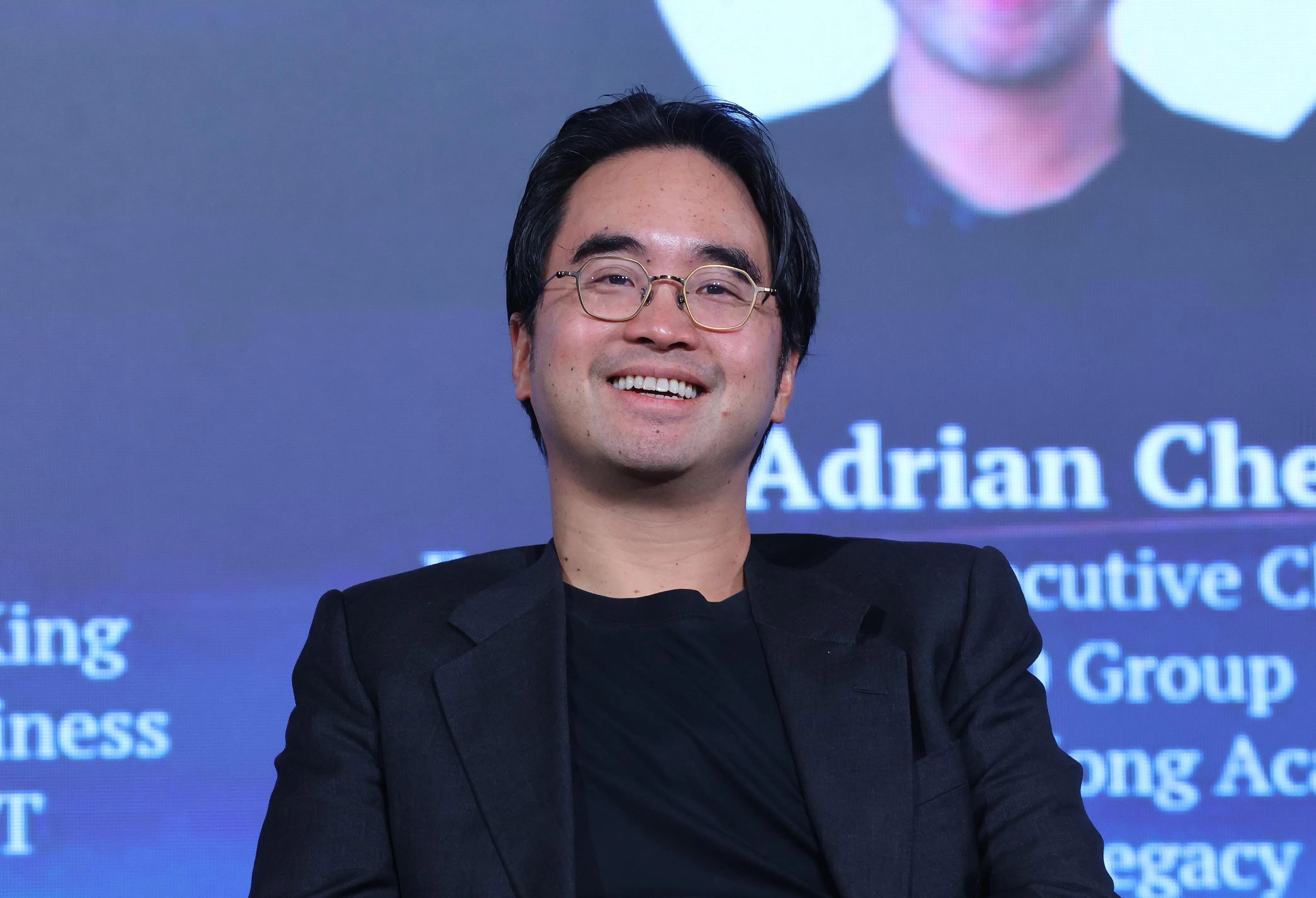
Two weeks ago, Adrian Cheng, once seen as the heir apparent to one of Hong Kong’s wealthiest families, spoke at a business and philanthropy forum in Singapore about the value culture brings to property. He spoke with considerable pride about how the newly opened K11 Select in Xiamen connects art, nature and urban life.
Cheng is the eldest grandson of legendary Hong Kong businessman Cheng Yu-tung. He was chief executive of New World Development until stepping down in September 2024. With businesses including Chow Tai Fook Jewellery, New World Development and Rosewood Hotel Group, the Chengs are one of Hong Kong’s most influential business dynasties. A third-generation family member, Adrian Cheng is known for founding the K11 brand and integrating art into commercial spaces. Great hopes were once placed on him to take over the family business.
Since leaving New World Development’s board entirely last year, it seemed as if little has changed for Cheng. He continues to champion the fusion of art and commerce, and K11 remains the subject he discusses at length. It is the signature creation into which he has poured years of effort, and the clearest expression of his personal identity. It could even be described as the only intellectual property (IP) he took with him when he left the family business.
Capital markets, however, have little room for such romantic ideals. Just over a week later, New World Development announced a rights issue that shook the Hong Kong market, seeking breathing space as it grappled with debts exceeding HK$100 billion. Shareholders would be entitled to subscribe for 11 new shares for every share held, raising about HK$24.9 billion (S$4.1 billion). The subscription price of HK$0.90 represented an 81.5% discount to the share price before trading was suspended. The amount to be raised was roughly twice the company’s market capitalisation at the time.
If completed, the rights issue will increase the total number of shares twelvefold. The scale of the issue and the funding required stunned investors. Since the announcement, New World Development’s share price has more than halved, falling over 50%.
The Cheng family had previously tried to bring in outside investment. Bloomberg reported that New World had held investment talks with Blackstone, but these collapsed over differences concerning control. Bain also withdrew after failing to agree on terms. Now, through entities including Chow Tai Fook Enterprises, the family has pledged to subscribe for its pro rata entitlement and participate in underwriting the issue. Its maximum funding commitment of about HK$18.7 billion is aimed at retaining control of New World.
New World’s urgency stems from having little room to wait. As of the end of June, the group’s net debt had reached about HK$126.3 billion.
The rights issue is tied to an extension of bank loans. The group plans to repay 10% of about HK$82 billion in loans covered by the arrangement ahead of schedule, in exchange for extending the maturity of the remainder by two years. Management said that if the plan could not be implemented, the company would have to sell assets at less favourable prices or delay development projects.
The Cheng family’s rise mirrors Hong Kong’s prosperity. New World Development founder Cheng Yu-tung began as an apprentice in a gold shop. Riding the post-war boom in Hong Kong’s manufacturing, trade and property sectors, he built a business empire spanning jewellery, property, infrastructure and hotels.
Adrian Cheng, from the third generation, stands out in Hong Kong’s business world.
An elite education is hardly unusual among heirs to wealthy families, but his cultural credentials are particularly striking. He studied East Asian literature at Harvard and Japanese art and culture in Kyoto. After joining the family business, he moved between the worlds of art, fashion and commerce, driving major landmark projects. He was seen as the future leader of the Cheng business empire.
In 2008, he founded K11. Explaining its distinctive name, he said it was “just a symbol, with no meaning, representing Generation Z’s cultural trends”. K11 subsequently expanded rapidly from Hong Kong into mainland China, making its name through art exhibitions, including a Monet exhibition. The brand and its young founder burnished each other’s reputations.
Rapid expansion meets an economic downturn, turning promising investments into heavy burdens
Few would deny Cheng’s foresight in bringing art into commercial spaces. At a time when online shopping is disrupting physical retail, distinctive experiences have become crucial to drawing visitors to malls and sustaining business. Earlier reports make his idealism plain: in K11’s early days, a single exhibition could cost millions, while its attention to spatial design and the presentation of art far surpassed that of most peers.
By 2024, however, New World had recorded its first annual loss in 20 years. Cheng resigned as chief executive and left the board the following year. A once-promising succession had taken a sombre turn.
The downturn in Hong Kong’s and mainland China’s property markets after the pandemic was a major cause of the difficulties. Home sales slowed, office and shopping mall rents came under pressure, and high interest rates increased borrowing costs. Yet many other companies had also invested in property in both markets and faced similar shocks. New World found itself in particularly deep trouble.
According to figures compiled by Bloomberg in 2024, New World’s net debt-to-equity ratio stood at 82.7% at the end of 2023. This compared with 41.4% for Henderson Land, founded by Lee Shau Kee, and 21.2% for Sun Hung Kai Properties, controlled by the family of Kwok Tak-seng.
Between 2020 and 2022, the group spent 4.1 billion RMB (S$800 million) on a site in Shanghai, more than HK$10 billion on developing Prince Bay in Shenzhen, and about 4.8 billion RMB on an urban renewal project in Guangzhou. It also planned to spend another 10 billion RMB on land. Together with projects such as K11 in Hangzhou and Guangzhou, and the HK$20 billion 11 SKIES in Hong Kong, these represented enormous capital commitments.
Excessive investment, overly rapid expansion and inadequate financial buffers collided with rising interest rates, weak consumption in China and a sharp property market downturn. Investments that had once been a source of pride became burdens the company could scarcely bear.
This reminds me of Seiji Tsutsumi, the second-generation heir to Japan’s Seibu Department Stores. A writer himself, he brought art museums, theatres and bookshops into retail, ushering in an era of consumption driven by sensibility. He also founded MUJI, which championed an unbranded, simple and environmentally friendly approach, leaving a cultural imprint on a generation of consumers.
But he also expanded into property and resorts during Japan’s bubble years. After he stepped down in 1991, the group remained mired in debt for years. Its property company collapsed in 2000, and Seibu Department Stores later underwent restructuring. Success in cultural branding did not shield the group from the consequences of failed expansion.
This comes down to business discipline. When markets are buoyant and banks are willing to lend, companies see no problem with expansion. Once conditions change, yesterday’s ambitions can become the weight that crushes a business.
If completed successfully, this rights issue will give New World some breathing space. But it comes at a cost, not least to its credibility with shareholders.
At the company’s annual general meeting on 19 November, shareholders voiced strong dissatisfaction with the rights issue. Management stressed that it was intended to preserve quality assets and avoid selling them cheaply, rather than exploit minority shareholders. Shareholders could also choose to take up only part of their entitlement or sell their rights.
For shareholders, however, it is a dilemma. Taking up the rights means putting more money into an already heavily indebted New World Development. Not doing so means accepting dilution and a sharp reduction in the value of their investment.
Family firms must test whether heirs’ ambitions merit continued investment from public shareholders
This is a severe test of trust. By putting up its own money to address the immediate crisis, the Cheng family also hopes to restore shareholder confidence. But without thoroughly examining how the company reached this point and how to prevent a recurrence, it may continue to erode market trust even if it preserves its assets.
This also raises questions about governance in listed family businesses. Heirs may have distinctive business ambitions, but listed family firms need mechanisms to assess whether those ambitions merit continued investment from public shareholders.
A 2025 analysis by the Asian Corporate Governance Association noted that while Adrian Cheng was chief executive, his father Henry Cheng continued to chair the board, executive committee and nomination committee. The association questioned whether directors’ long tenures and family ties had compromised independent oversight.
Governance is also a frequent topic of discussion in Singapore’s family businesses. National University of Singapore professor Mak Yuen Teen has repeatedly argued in his writings that family firms seeking to continue thriving must be willing to let outside professional managers run the business, whether permanently or as an interim measure when family members are not ready.
Family succession often focuses on an heir’s talent and ambitions. But attention must also be paid to the people around them: can they provide oversight, voice objections and demand a slower pace when expansion becomes too rapid? If these checks fail, a change at the helm may not change the way a business is run.
For now, New World’s shareholders can only keep waiting for the company to repay its debts and for their investment to recover in value. To preserve the business built over many years, the family must do more than raise the money needed today. It must also show shareholders how the next grand plan will face more rigorous scrutiny.
