


On 30 October this year, BP Plc announced that its third-quarter net profit had surged 283% year on year to US$8.46 billion (about S$10.8 billion), its highest quarterly net profit in 18 years.
The world’s five oil majors were subsequently reported to have all reaped huge “windfall profits”, with quarterly revenue reaching its third-highest level on record. This was largely because the unresolved Middle East conflict kept oil prices elevated and refining margins strong.
Suvro Sarkar, head of energy research at DBS, told Lianhe Zaobao (LHZB) that refining margins hit a record high in the third quarter this year and may have peaked. He expects them to ease but remain above pre-conflict levels.
This is mainly because tight supplies of middle distillates, such as diesel, jet fuel and kerosene, are expected to persist until 2027. Refined product exports from Persian Gulf refineries are also likely to recover more slowly than crude exports.
How have Singapore’s three refining giants fared?
With Singapore serving as a regional refining hub, some may wonder whether its three refineries have enjoyed similarly rich rewards. Years ago, these big companies paid their employees in Singapore bonuses of six months’ salary or more, much to the envy of many.
There is no straightforward answer. BP sold its stake in Singapore Refining Company (SRC) more than 20 years ago. Singapore Petroleum Company (SPC) and energy company Chevron now each own half of SRC. SPC, formerly a listed associate of Keppel, was privatised many years ago and became a subsidiary of PetroChina.
The Shell refinery on Pulau Bukom, together with its petrochemical plants on Pulau Bukom and Jurong Island, has been sold to Singapore-based Aster Chemicals and Energy. Aster is a joint venture between Indonesian group Chandra Asri and commodities giant Glencore, which hold stakes of 80% and 20% respectively. As a private company, Aster is not required to publish quarterly or half-yearly results.
The only operations still under their original parent company are ExxonMobil’s two refineries on Singapore’s main island and Jurong Island. ExxonMobil also has the largest capacity among Singapore’s three refining companies, at about 600,000 barrels a day. Energy majors, however, generally do not disclose results for individual refineries.
Experts: Soaring shipping and insurance costs may offset stronger refining margins
Brent Vasconcellos, Southeast Asia Energy, Resources & Industrials (ER&I) Industry Leader for Deloitte Asia Pacific, told LHZB that Singapore’s refineries stand to benefit from stronger refining margins, particularly as supplies of refined products such as diesel and jet fuel tighten.
Whether this translates into actual profits, however, depends on each refinery’s crude procurement and transport costs, its ability to process different grades of crude, operating costs, and the proportion of higher-value products it produces.
Asian refiners face significantly higher shipping and insurance costs, which could substantially offset the gains from stronger refining margins.
Priyanka Sachdeva, head of market insights at Phillip Nova, said higher refining margins are meaningful only if refiners can secure adequate crude supplies at commercially viable prices. Singapore’s well-developed refining infrastructure offers some flexibility, but high freight costs, premiums for alternative crude supplies and lower throughput will offset the benefits of stronger refined product margins.
Sarkar noted that Singapore’s operators may face greater constraints in raising utilisation rates than Western refineries, which rely mainly on crude from the Atlantic Basin.
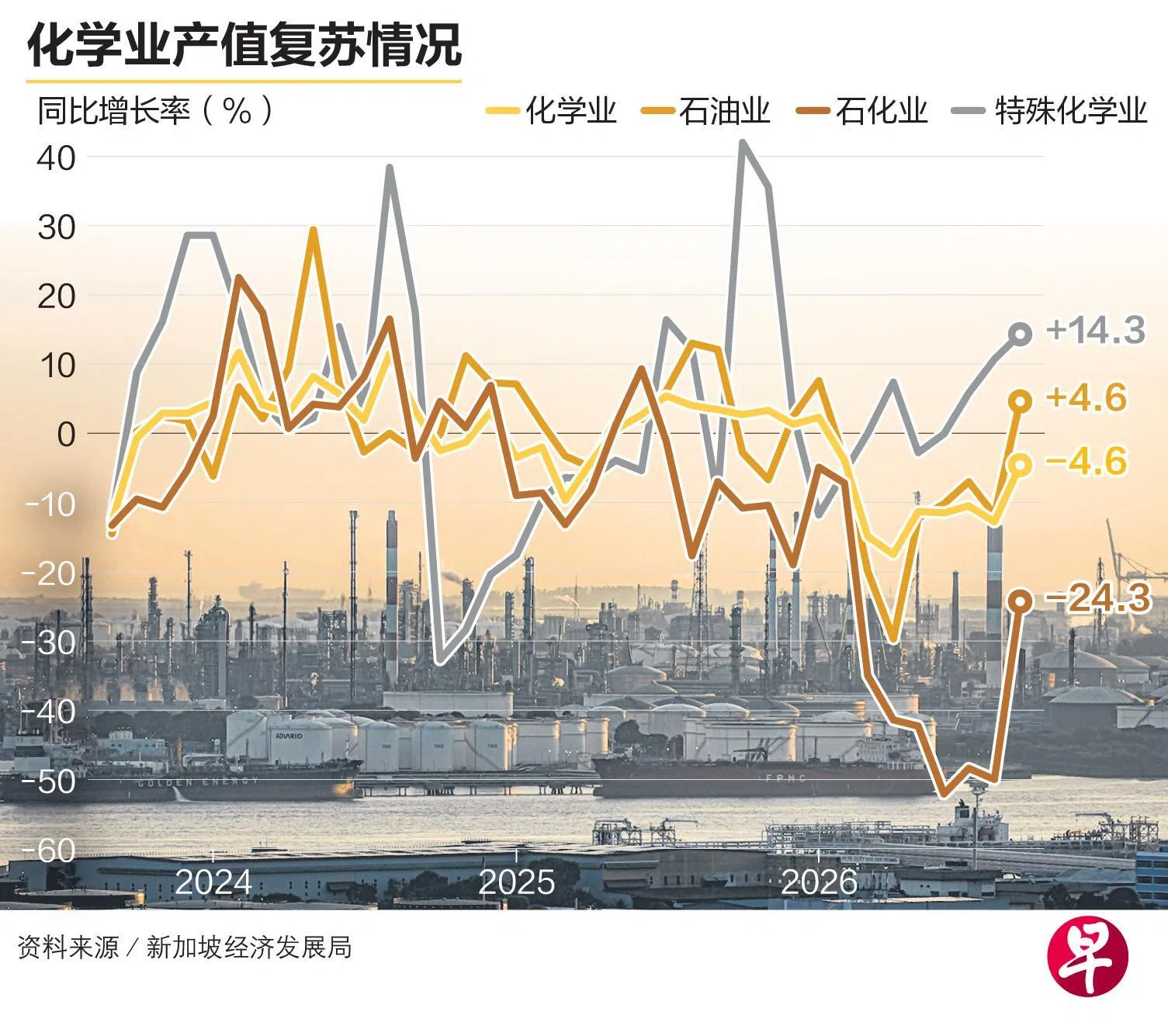
Operators in Singapore initially cut crude processing rates by 50%, before raising them again. As they found alternative sources of crude, petroleum output even returned to year-on-year growth of 4.6% in September. Across the third quarter as a whole, however, average refinery utilisation remained below the level a year earlier.
On the industry as a whole, Economic Development Board (EDB) executive vice-president Lim Wey-Len said in an interview that Singapore’s refineries are run by companies with diversified sourcing capabilities and strong trading networks, supported by global supply chains. “This enables them to respond flexibly to changing market conditions by sourcing crude supplies from around the world to sustain operations.”
Each company’s circumstances also differ. Lim said, “Given the evolving situation, we will continue to stay in close contact with these companies and have made clear that we stand ready to support them. We will also work with other government agencies to provide the necessary assistance as needed.”
Petrochemicals emerge from immediate supply crisis, but sustained margin recovery may take years
Compared with refining, Singapore’s petrochemicals industry clearly remains in difficulty. EDB figures show that petrochemicals output fell 24% year on year in September, though this was a marked improvement from the 50% decline in August. Output had fallen by 42.5%, 52.3% and 48.7% in May, June and July respectively.
The Asian ethylene-naphtha spread, which turned negative in March and July, has remained above US$100 a tonne since August and currently stands at US$221 a tonne.
The worst seems to be over for petrochemicals, but is the industry really out of danger?
Petrochemicals include the basic raw materials for everyday items such as plastic bags and food packaging, as well as industrial products such as synthetic fibres and fertilisers. The petrochemicals industry ranks second only to petroleum in output. The two accounted for about 30% and 44% respectively of the Singapore chemical industry’s S$88 billion in output in 2025.
Vasconcellos believes the most severe immediate supply shock has passed, but that does not mean the industry’s fortunes have turned.
It faces two major problems. The first is feedstock supply, which is expected to improve gradually as crude oil and naphtha supply chains recover. The second is the economics of petrochemical production.
Even before the Middle East conflict broke out, the industry faced serious challenges, mainly because of expanding global capacity, particularly in China, and persistent oversupply in some commodity chemical segments.
Vasconcellos said, “Lifting force majeure does not mean the entire production chain has returned to normal. Feedstock supplies, plant utilisation, downstream demand and contractual deliveries all need time to recover.”
Sarkar also believes the most difficult period for Singapore’s petrochemicals industry has passed. He expects utilisation rates at Jurong Island’s petrochemical plants to be recovering overall, though they remain below normal levels.
The decline in utilisation is structural. ExxonMobil permanently closed the older of its two Jurong crackers this year in response to excess capacity in China, reducing Singapore’s ethylene capacity by about a fifth. Utilisation at the remaining crackers is expected to return to near pre-conflict levels within one to two quarters of the gradual reopening of the Strait of Hormuz. Margins, rather than feedstock, will then once again dominate the discussion.
On this front, with new ethane-fed cracker capacity continuing to come on stream in China and the US, Sarkar expects Singapore’s petrochemicals industry to struggle to achieve a sustained recovery in margins before 2028/2029.
Companies build resilience and diversify supply sources
Since the Middle East conflict began, a number of overseas refineries and petrochemical plants dependent on Middle Eastern supplies have been forced to shut. Singapore’s refineries, however, have maintained uninterrupted production. Even petrochemical plants that declared force majeure were able to continue operating, reflecting Singapore’s resilience and strengths.
ExxonMobil’s website shows that it has recently been recruiting tertiary graduates, engineers and other staff in Singapore.
It is understood that ExxonMobil’s Singapore operations have never halted production because of supply shortages, thanks to its global supply network. Its Singapore facilities can produce chemicals directly from crude oil, or produce naphtha from crude and then use it to make chemicals.
Most of the Singapore operations’ output is exported. An agreement signed by Singapore and New Zealand in May this year included diesel supplies from ExxonMobil’s Singapore operations to New Zealand, underscoring Singapore’s importance as a regional petroleum production hub. With its output mainly serving international markets, however, the Singapore operations also face intense competition.
Aster’s Singapore petrochemical plant declared force majeure after the Middle East conflict broke out, before announcing its lifting six months later, in September.
Han Lih Kwong, Aster’s manufacturing director of refining and chemicals, said:, “Previously, more than 70% of the crude we used was transported through the Strait of Hormuz. Since supplies were disrupted, we have diversified our crude sources and begun bringing in crude from other regions. Processing different grades of crude is far more complex than simply finding alternative suppliers. Every crude has distinct properties. Its compatibility with the refinery’s configuration must be assessed, and it must be introduced carefully to ensure safe and reliable operations. We had invested in these capabilities before the supply disruption. This has enabled Aster to keep operating and continue serving our customers.”
Aster has also invested in upgrading its condensate splitter so that it can produce naphtha in Singapore and reduce its reliance on naphtha bought on the open market.
Han said, “These investments cannot eliminate the risks arising from global energy price volatility or geopolitical turmoil, but they give us greater flexibility in responding to these challenges.”
Vasconcellos said the current situation highlights the importance of a broader international sourcing network. It also underscores Singapore’s value as a major oil trading and logistics centre. These commercial relationships and trading capabilities can help refiners navigate supply disruptions.
Analysis: Energy and chemicals must transform, adding value while cutting carbon
The impact of the Middle East conflict also highlights the need to accelerate the transformation of Singapore’s energy and chemicals sector. The carbon tax is one measure driving this transition. Singapore’s current carbon tax is S$45 a tonne for 2026 and 2027, and will rise to between S$50 and S$80 by 2030.
Against this backdrop, refiners face a dual challenge: securing increasingly expensive feedstock today while investing to meet future decarbonisation targets. Sachdeva said, “Companies that can improve energy efficiency will be better placed to protect their margins.”
One strategic question for the industry is how to translate Singapore’s strengths in infrastructure, integration, logistics and access to regional markets into lasting competitive advantages in a low-carbon economy.
Thomas Luedi, a senior partner at consultancy Bain & Company, said, “As companies build their competitiveness for the next phase, they should look beyond expanding scale. They should focus more on improving energy and processing efficiency, achieving low-carbon operations, increasing feedstock flexibility, and prioritising products that can generate attractive returns in the region.”
Vasconcellos added, “Singapore’s industry cannot rely indefinitely on its existing advantages in scale, infrastructure and location. Competition will increasingly centre on productivity, technology, innovation, operational flexibility, and the ability to produce higher-value, lower-carbon products. The current upheaval is a reminder that resilience and competitiveness are closely linked. Companies and industrial hubs that can adapt their operating models and supply chains in time will be better positioned for the next phase of the global energy and chemicals industry’s development.”
Sanjiv noted, “Ultimately, competitiveness increasingly depends on how much economic value an asset can create for each unit of carbon it emits.”
The Middle East conflict may mark a turning point for Singapore’s energy industry — and, indeed, for the global industry. Sachdeva said, “Future competitive advantages may not come from processing more, but from processing more efficiently, building trading relationships to improve feedstock sourcing flexibility, and reducing carbon emissions.”
Singapore’s refining and petrochemicals industries face not merely a supply crisis, but a test of their entire operating model.
She believes the industry can remain competitive without abandoning refining altogether. “The key is to increase the value created from every barrel of crude processed while reducing carbon intensity.”
Singapore’s chemical industry also has several promising new areas of growth.
Experts and analysts see potential in specialty chemicals and advanced materials, sustainable aviation and marine fuels, circular and bio-based feedstocks, storage and logistics, as well as carbon management and emerging energy solutions.
