


Global capital spending related to artificial intelligence (AI) continues to boost Singapore’s economy. The Ministry of Energy, Trade and Industry has again raised its full-year economic growth forecast to about 6%, exceeding last year’s 5% and potentially marking the strongest annual performance since 2021.
This is Singapore’s third upward revision to its economic growth forecast this year. The previous forecast was 4.5% to 5.5%, up from earlier projections of 2% to 4% and 1% to 3%.
However, with investment in AI potentially slowing and growth momentum weakening in most major trading partners, the authorities expect Singapore’s economic growth to ease to between 2.5% and 4.5% next year.
Singapore’s economy grew by 6.1% year on year in the third quarter, slightly slower than the previous quarter’s 6.4%, according to the third-quarter Economic Survey released by the Ministry of Energy, Trade and Industry on Tuesday (24 November).
Third-quarter economic growth was driven mainly by wholesale trade, manufacturing, and finance and insurance. AI-related demand fuelled growth in the machinery, equipment and supplies segment of wholesale trade, as well as the electronics and precision engineering clusters within manufacturing. Growth in finance and insurance was supported by strong bank lending and robust fee-based activity.
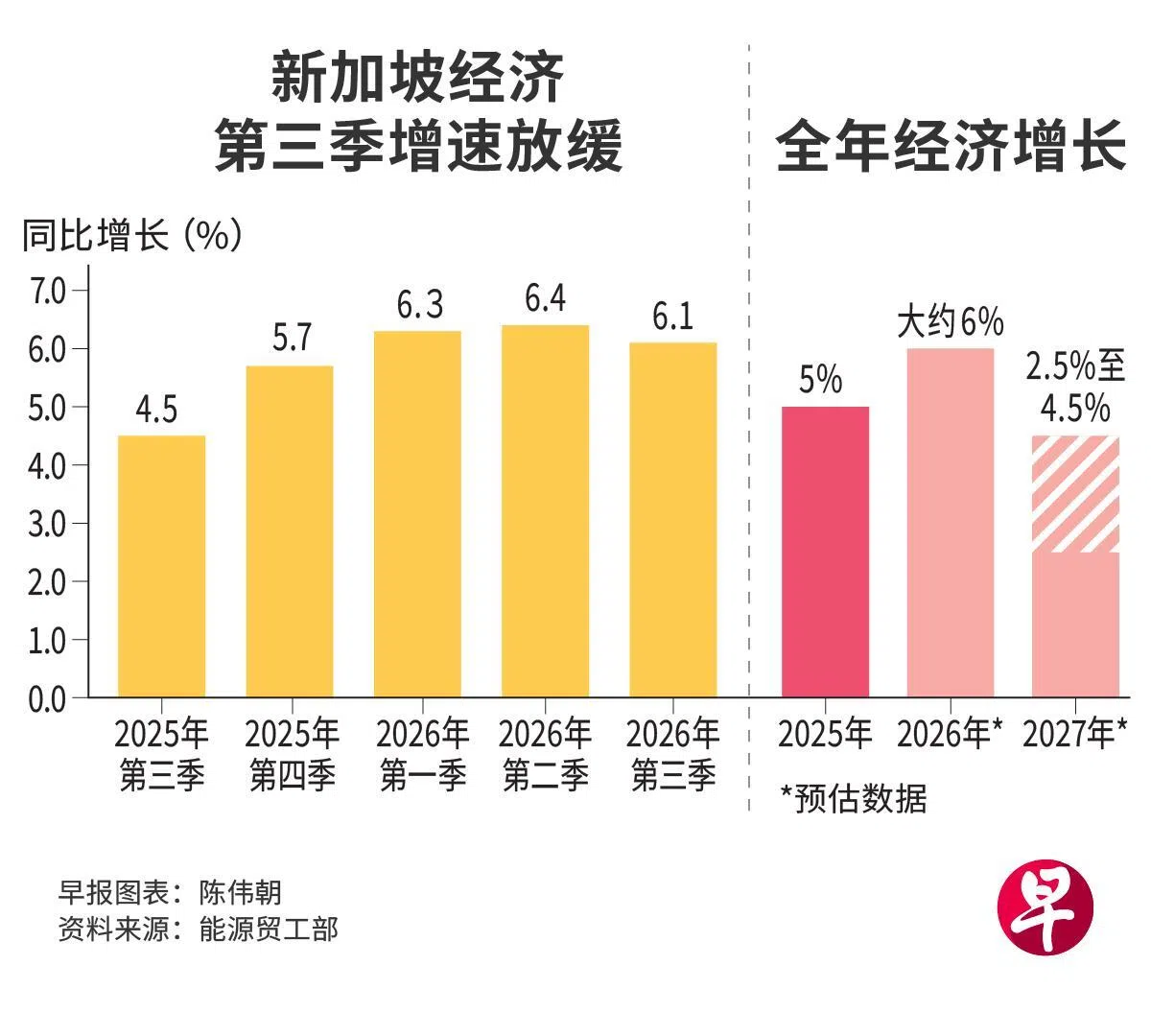
On a seasonally adjusted quarter-on-quarter basis, the economy grew by 1.5% in the third quarter, down from 1.8% in the second quarter. Singapore’s economy expanded by 6.2% year on year in the first three quarters.
Dr Beh Swan Gin, Permanent Secretary (Trade & Industry) for the METI, said at a press conference that production and exports of AI-related products continued to accelerate. Strong global AI investment was expected to continue through the end of the year, keeping Singapore’s economic outlook robust this year.
Dr Beh addressed the market’s increasingly cautious stance towards AI investment. He said: "we also have to monitor how the financial markets are reacting because if the correction is even sharper there could be spillover effects on the broader economic activity."
Impact of tighter US chip controls expected to be manageable: Ministry of Energy, Trade and Industry
After Nvidia co-founder Jensen Huang became embroiled in a scandal, the US last week introduced tighter export controls on advanced chips and designated five countries, including Singapore, as high-risk transshipment countries. The US also imposed new requirements on overseas data centres that provide substantial computing capacity to Chinese companies.
The Ministry of Energy, Trade and Industry said it was still studying the potential impact of the new rules, but expected it to be manageable.
Dr Beh noted that Singapore had paused approvals for new data centre investments over the past few years and now approved new investments only through a Request for Proposal process. These projects were relatively small compared with investments elsewhere in the world.
He added that the vast majority of data centre operators in Singapore did not provide remote access services.
Looking ahead to next year, Dr Beh said demand from committed investments and confirmed orders would remain strong, but new orders could slow.
Growth to remain robust but ease next year
In the labour market, Singapore’s overall unemployment rate remained low at 2% in the third quarter, while employment growth rose from 14,700 in the second quarter to 32,000 in the third. The resident and citizen unemployment rates edged up to 3% and 3.1% respectively, while retrenchments reached 4,800 in the third quarter.
Selena Ling, Chief Economist & Head of OCBC Group Research, said Singapore’s strong overall economic growth did not mean that all sectors, businesses and households were doing equally well. However, the unit labour cost index had fallen for four consecutive quarters, which could be good news for businesses, especially small and medium-sized enterprises.
Chua Han Teng, Senior Economist at DBS, maintained his 2027 growth forecast at 3.5%. He expects Singapore’s economy to remain robust over the coming quarters, even as overall growth gradually returns to a more normal pace.
Jonathan Koh, Senior Economist and FX Analyst, ASEAN, Standard Chartered, said a sharper-than-expected slowdown in the AI sector was a downside risk for next year. The implementation of US chip export restrictions, concerns over returns on AI investment, project delays or a sharper financial market correction could all weaken the growth outlook, he said.
Separately, the third-quarter Economic Survey included a study by the Infocomm Media Development Authority (IMDA) on the Industry Digital Plan initiative.
Following the launch of these plans, businesses’ adoption rate for the relevant digital solutions was 8.95 percentage points higher than before. Businesses that adopted digital solutions recorded average revenue gains of 12.2%, while average wages for their local employees rose by 3%.
