

From producing charts and reports at work to planning travel routes and suggesting ways to save money in everyday life, artificial intelligence (AI) makes our lives easier. Tasks that once took hours can now be completed in seconds simply by feeding the parameters into AI, which may even cover more ground than a human would.
This has prompted debate over how much of our daily work we should let AI do for us. The technology is not yet fully mature. The text and other output it generates may still contain falsehoods, inaccuracies or information that does not reflect reality, so there is still good reason for humans to act as gatekeepers. But if AI can one day consistently deliver results that are 100% accurate, should we “outsource” to it every task it can handle?
The temptation is considerable. If clients, audiences and consumers accept AI products despite formulaic or unnatural phrasing, or unnatural expressions on characters’ faces in films and videos, there is even less incentive to spend time on human checks and reviews. The job can simply be delivered with minimal input and at the lowest cost.
Besides, once competitors start doing this, holding firmly to high standards on your own may not only make you seem inflexible, but also leave you at the mercy of market forces.
However, whether or not technology advances to the point where it can replace human work, basic skills should not be neglected. Relying too heavily on AI for basic writing, calculation and thinking means these abilities do not get enough exercise. In everyday life, we will gradually lose the ability to form complete sentences and think logically, as well as our feel for numbers.
Speaking about AI use at the DBS Asia Future Forward Conference on 12 October, Prime Minister Lawrence Wong likewise noted that some basic tasks may seem tedious but are valuable learning experiences. As we use AI, we must also take care not to let automation deprive us of opportunities to learn.
Few would dispute AI’s benefits. AI and human skills should complement each other. The stronger our grounding in knowledge and skills, the better we can judge whether AI’s output is useful, and the more help we can get from it. Conversely, if we place complete trust in AI because it appears capable of everything, we are more likely to accept it blindly, increasing the risk of errors in the information we use.
A lack of knowledge and skills does not mean we should keep our distance from AI, either. Some might even ask: if AI can already do things better than humans, why should we still do them ourselves?
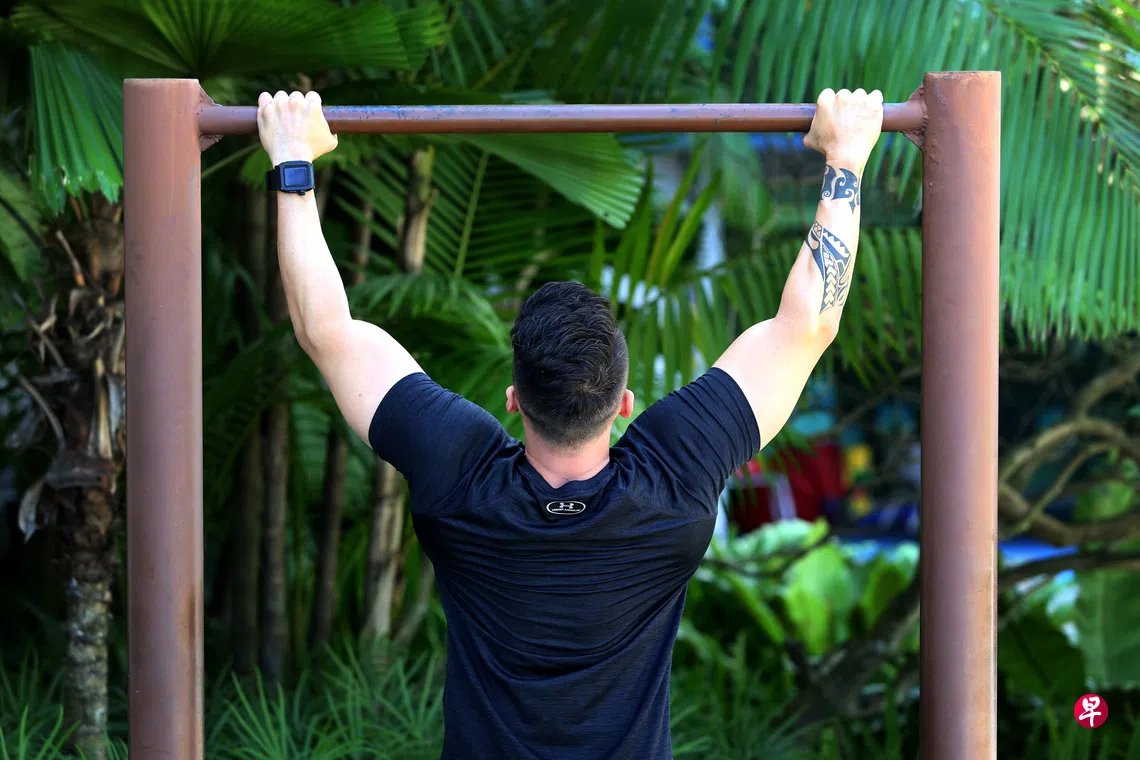
I prefer to think of AI as an assisted pull-up machine at the gym. For someone attempting pull-ups for the first time, getting from zero to one is extremely difficult because the relevant muscles have not been trained. Often, they give out halfway through.
The machine uses a counterweight to provide upward support, reducing the weight our arms have to bear. As our muscles grow stronger through training, the counterweight can gradually be reduced until the exercise can be completed without assistance.
The key question is: how much counterweight should we use? More support from the machine makes exercise easier and quicker, but deprives our muscles of a proper workout, rendering the effort pointless. Used properly, the counterweight should be set at a level that still allows our muscles to stretch and work.
The same applies to AI. There is nothing impressive about outsourcing all our work to it; that is an unimaginative way to use it. The smart approach is to use AI to assist us and take our work further while ensuring that our own skills still get a workout. Rather than “artificial” intelligence, AI’s greater value lies in “assisted” intelligence. The better we know how to use it, the more it can do for us.
Some friends of mine have also begun using AI to improve the way they work, even trying to build their own AI tools despite having no programming background. They tell me that getting these tools tailored just right to their needs often takes days or even months of observing, testing and revising instructions.
This may be AI’s version of the saying that a minute on stage takes ten years of practice behind the scenes. Spending so much time just to simplify a workflow may sound counterintuitive. Yet this process is precisely what reveals the human ability to identify and question problems as we think. That is the precious asset of the human mind.
(The author is Lianhe Zaobao’s Jakarta correspondent.)
