


At a reverse vending machine outside a supermarket, you can insert an empty drinks bottle and follow the steps to reclaim a 10-cent deposit. The machine appears to need only a quick scan of the barcode. But many bottles of the same drink carry the same number. How does the machine establish that the barcode it reads belongs to the bottle it accepts?
Lianhe Zaobao (LHZB) recently reported a case of suspected misuse of a reverse vending machine. A spokesperson for scheme operator BCRS Ltd said it had worked with the return point operator to calibrate the machine after the incident. The report did not establish whether the actions had actually resulted in an improper refund; a single video is also insufficient to determine how widespread such incidents might be.
Barcode for identificaton, bottle for verification
Singapore’s Beverage Container Return Scheme (BCRS) covers eligible pre-packaged drinks from 150 millilitres to 3 litres in plastic bottles and metal cans. Containers must carry the local deposit mark, and participating products use newly registered barcodes. The type of plastic alone does not determine eligibility for a refund.
A bottle’s barcode works like an index entry in a product catalogue. After reading the number, the machine still has to look up the registered information. Small and large bottles of the same brand have different specifications and must be identified separately, but two bottles of the same product and size can share a number. Marking a product code as “already refunded” would therefore not solve the problem: the next customer might have another eligible empty bottle with the same code.
After retrieving the product information, the machine must check whether the bottle matches it, and confirm that this particular bottle has actually been accepted.
Scanning from multiple angles
A barcode encodes information using dark bars and light spaces of varying widths. When illuminated, the dark and light areas reflect different amounts of light. The scanner decodes the number from the sequence of light and dark areas and their widths. The blank spaces on either side of the barcode, known as “quiet zones”, provide clear boundaries for the scanner. Graphics that encroach on these spaces, or creases in the label, can make the barcode harder to read.
Local barcode specifications therefore also set requirements for print placement: preferably on a flat section of the bottle’s main label, away from the neck and base. The label design, bottle shape and scanner position must be coordinated. Even when the correct number is printed, the machine needs a clear view to read it reliably.
How the bottle enters the machine is also an engineering question. Tomra, an equipment supplier that operates some local return points, modified one of its machines years ago to take containers lying down, addressing the tendency of lightweight plastic bottles to topple during returns. Cameras are then used to identify the bottle’s shape. Thus, a mechanical change in orientation also changed how the machine perceives the bottle.
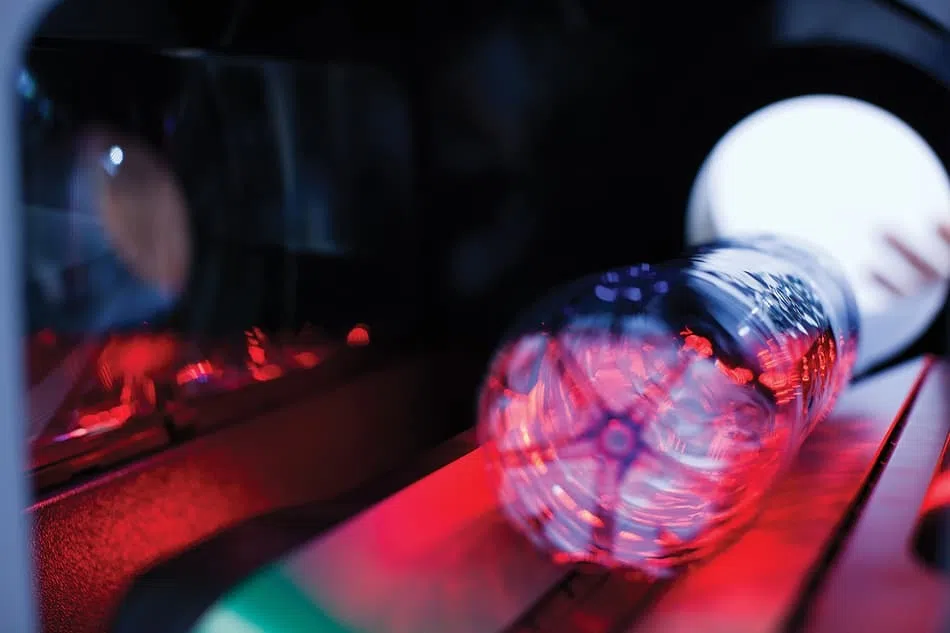
Barcode reading must also account for orientation. If the barcode faces the other way, it may be hidden from a single viewpoint. One manufacturer’s designs arranges cameras around the inlet to view the container from multiple directions, so it need not stop and rotate to locate the barcode. These are technical examples from the manufacturer’s models; the configuration of local machines may differ. The bottle’s path and the cameras’ views must be designed together.
The Singapore version of Tomra’s B5 Mix machine uses cameras, weight sensors and a metal detector alongside barcode scanning to identify containers.
Think of it as receiving a parcel: what the label says must match what you are holding. The barcode provides the registered identity, while the shape and other measurements provide physical clues, each serving a different purpose. Only through checking the multiple “clues” would it give the machine a basis for detecting a mismatch between the number and the actual object.
This also explains why bottles must retain their original shape before being returned. Crushing changes their shape and may fold the barcode along with the label, while leftover liquid adds weight. To a person, it is still the same bottle. To the machine, however, the clues available for comparison have changed. Hence, the local return scheme requires emptying containers, keeping their shape intact and ensuring their barcodes are clear.
Tracking movement to prevent double-counting
Checking the barcode against the physical object helps establish whether a container qualifies for a refund. Confirming that the machine has accepted the very container it just identified is a separate step. Even if two bottles of the same soft drink and volume share a barcode, they must be counted separately when returned.
As cameras take images continuously, a bottle may appear in several frames. The system must link these repeated observations to the same physical object and track its movement to reduce double-counting. Reading a number shows only that the machine has seen a barcode; the handover must still be confirmed separately.
Tomra says its equipment tracks containers as they move. Based on a bottle’s shape, size and speed, the system estimates when it will reach the next position, then checks whether the actual movement matches. This links the information read earlier to the physical object further along.
In reality, not every bottle will be in perfect condition, and even a slight dent can change how it moves. The manufacturer says the software allows a window for the expected arrival time. If, for instance, the user touches the bottle again, the system recalculates. Think of waiting for an object coming along a conveyor belt: you expect it to arrive soon, but allow it to appear a little earlier or later, while continuing to watch for changes along the way.
There is an engineering trade-off here: the system must identify anomalies while accommodating variations between containers. Treating every bottle as an identical model, with exactly the same shape and movement, would make it difficult to handle the empty bottles people actually return. How much variation can be tolerated depends on the equipment and settings.
The B5 Mix also has a compactor. Once a container has been confirmed as accepted, it is crushed, making it difficult to return in its original form for another refund.
Despite these checks, machines can still make errors in practice. The scheme operator says it also checks transaction records for unusual transactions across the return network. The machine must correctly identify the bottle in front of it; comparing multiple transactions may then reveal anomalies that are difficult to spot from a single return.
Did you know?
If barcodes can be copied and printed, how do Germany’s reverse vending machines identify eligible packaging? Besides using product barcodes specific to the local scheme, Germany’s deposit system for single-use drinks containers requires packaging to carry a deposit mark. The mark uses special ink that only certified label printers and beverage can manufacturers are authorised to use. Machines or sorting systems can combine these clues to check packaging, much as banknote verification involves checking both the printed numbers and security features.
Many bottles and cans of the same drink share a product number. A number that looks correct does not necessarily establish that the packaging itself complies with the local scheme. The special ink adds another identifying feature to the mark. Singapore’s refund scheme also uses a local deposit mark and newly registered barcodes, but its published specifications do not require this special ink.