


With instability in Europe and the familiar sights of Japan and South Korea losing their appeal for some travellers, mainland China has become an alternative destination. Chongqing is particularly popular with young people. But paying by QR code in China takes some know-how. How can you avoid the 3% service fee and save money?
When travelling in China, buying coffee, taking transport or shopping at markets often requires nothing more than scanning a QR code with your phone. For Singapore visitors, however, convenience does not mean there are no extra costs. Foreign visitors can currently link eligible international bank cards to Alipay or WeChat Pay, or use selected overseas e-wallets to make QR code payments. The catch is that payments made with linked international bank cards typically incur a 3% platform service fee when a single transaction exceeds 200 yuan (about S$38.50). The card-issuing bank may also charge a foreign currency transaction fee. Together, these charges can add to the cost of a purchase.
For example, some Visa or Mastercard cards issued by Singapore banks charge foreign currency transaction fees of up to 3.25%. Add the payment platform’s 3% service fee, and a purchase above 200 yuan could attract two separate charges. Actual fees depend on the card, transaction channel and applicable terms, so there is no single rule that applies to all cards.
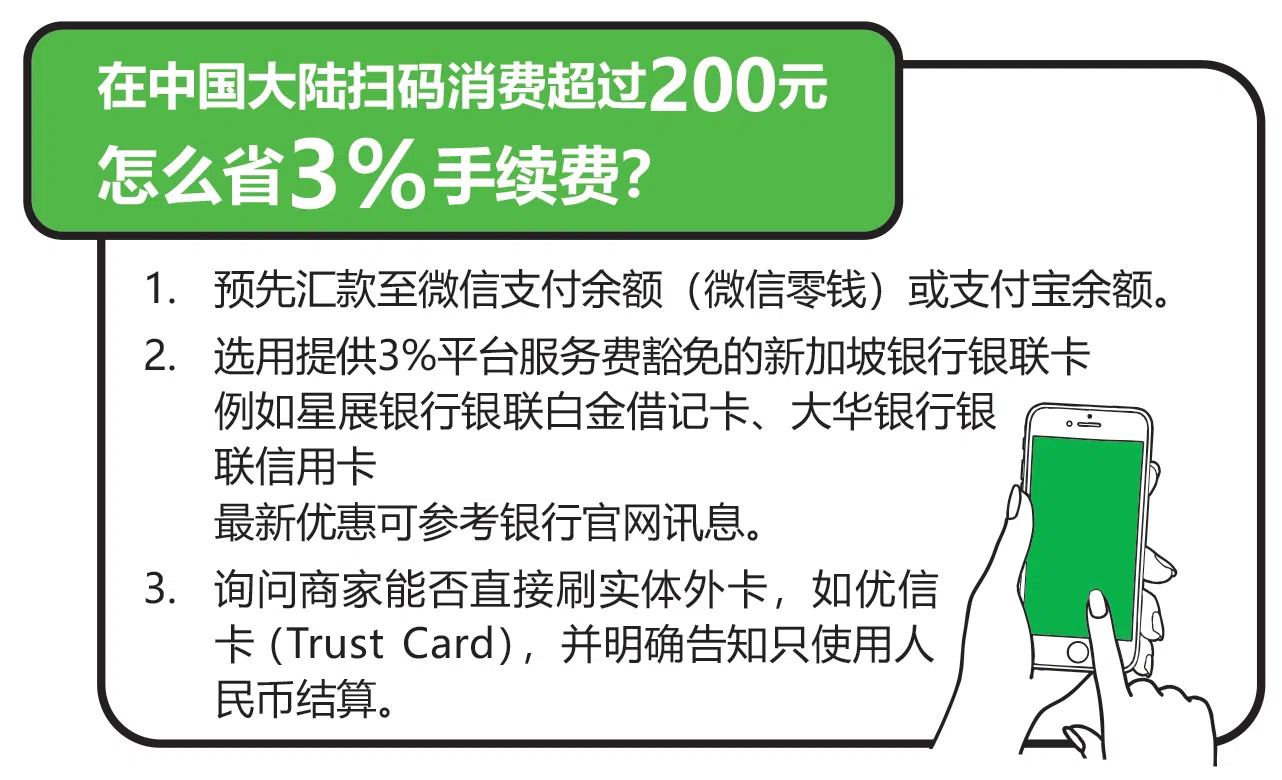
Save with UnionPay card offers
Multi-currency travel cards such as YouTrip can be linked to Alipay or WeChat Pay, or used directly at merchants that accept Mastercard. YouTrip itself does not charge foreign currency transaction fees. But payments made through an international bank card linked to Alipay or WeChat Pay may still incur the platform’s 3% service fee. Travellers should therefore look beyond a travel card’s promise of zero foreign currency transaction fees and check whether QR code payments attract a separate charge.
The DBS UnionPay Platinum Debit Card offers a waiver of the 3% platform service fee for eligible Alipay and WeChat Pay transactions, along with cashback on spending in yuan. Consumers should still check the bank’s own fees, cashback conditions and promotional period. UnionPay cards from other banks may offer similar benefits, but do not assume that all UnionPay cards automatically waive these fees.
UOB UnionPay credit cards offer similar benefits: eligible Alipay and WeChat Pay transactions above 200 yuan qualify for a waiver of the 3% platform service fee, as well as spending rewards. Readers should consult UOB’s official UnionPay credit card product page for details.
Another option is to transfer money to your WeChat Pay balance in advance. DBS has launched a service that allows eligible users to transfer funds to a WeChat Pay balance through DBS Remit using the bank’s app, with no Singapore-dollar remittance fee. However, zero remittance fees do not mean zero currency conversion costs. Travellers should still compare the bank’s yuan exchange rate and check that their account can complete the required verification and receive the funds.
Consider direct card payments for larger purchases
Many Singapore residents also have a Trust card. It can be used in China and offers zero foreign currency transaction fees (FX fees), potentially saving readers a substantial amount on currency conversion costs. For a Trust card, the most recommended way to use it is to link it to Alipay or WeChat Pay. However, if a single purchase exceeds 200 yuan, the Alipay or WeChat Pay platform typically adds an international card processing fee of about 3%. For expensive purchases, ask whether the merchant accepts direct payments with a physical foreign-issued card. At checkout, make sure the merchant’s terminal supports Visa and explicitly ask the cashier to charge you in the local currency, yuan. Avoid using DCC (dynamic currency conversion) and incurring hefty additional currency conversion charges.
When you pay directly with a physical, foreign-issued Trust card or a physical credit card from another bank, the 3% service fee does not apply, whether the purchase is 200 yuan, 2,000 yuan or more. But remember to check the details first to avoid the DCC trap.
Before departure, download and set up Alipay and WeChat Pay, link your bank cards and complete the required identity verification. When paying in China, check the amount and fees displayed by the platform. If the merchant accepts direct card payments, compare the cost with paying by QR code.
It is also worth carrying a small amount of yuan in cash as a backup in case your phone runs out of battery, the network is unreliable, or a merchant cannot accept e-payments. Whether you choose to link a travel card, use a UnionPay card or transfer funds to WeChat Pay, doing your homework before departure can make spending more convenient and help you avoid unnecessary costs.
Experience brings an appreciation of how fulfilling midlife can be. Follow Zhuangling go! content and join the Zhuangling go! community to make the most of life’s second half together.
