


Last weekend, I watched street walkabouts and rallies for the Democratic Progressive Party’s (DPP) Taipei mayoral candidate Puma Shen in Taipei’s Neihu district, and his party colleague Su Chiao-hui, who is running for New Taipei mayor, in Luzhou, New Taipei. The former was decidedly festive, the latter warm and welcoming. Supporters tied “Puma O’Shen Wave” ribbons and assorted accessories to their wrists, hair and bags, as though attending a carnival.
Apart from the occasional green vest worn by local councillors attending the events, the sea of orange and pink flags offered little reminder of the DPP’s signature green. Gone, too, were the mournful music and appeals to past suffering that once characterised its campaigns.
A print designed by printmakers Yang Chung-Ming and Huang Chun-Yuan was both beautiful and ingenious, proving even more popular than the “Puma O’Shen Wave” ribbons. It depicts a cross-section of Taiwan from north to south, with a lighthouse standing where Taipei and New Taipei are located. After making a print, members of the public could stamp a beam of light, representing a ballot paper, onto the lighthouse — symbolising the people themselves lighting the beacon of democracy.
Yang told Lianhe Zaobao (LHZB) that he was moved by Shen’s proposal at a “Citizens’ Soapbox” event to make aesthetics part of his policy agenda. He spent ten hours overnight completing the original design. “With such joy, positivity and goodwill, Taiwan is more than capable of becoming a beacon of democracy for the entire Chinese-speaking world.”
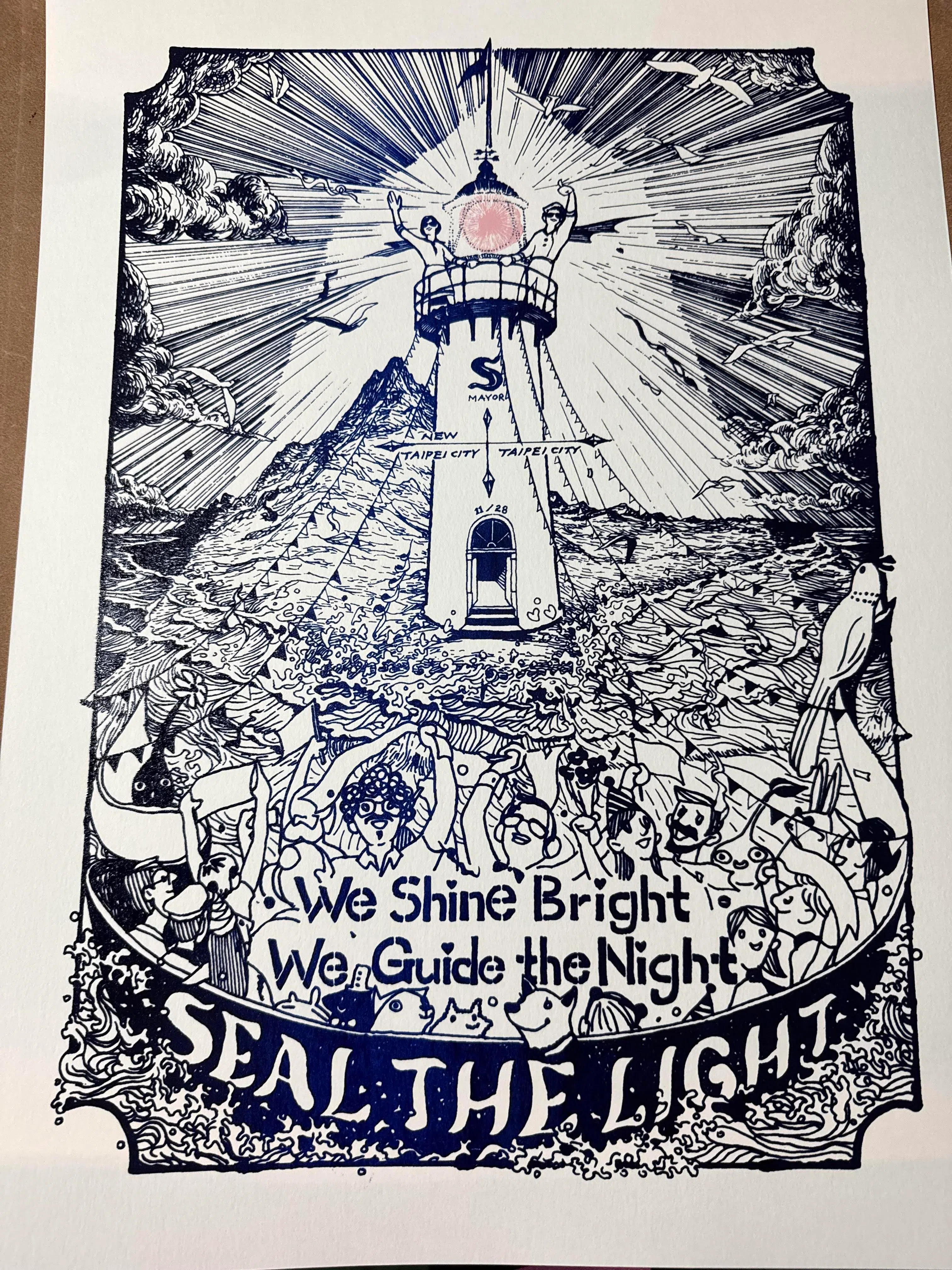
As the crowd around him grew, Yang added: “We must never forget that the threat we face is always there.” He also urged those present to remember that Taiwan’s democracy was hard-won, secured through the sacrifices of many who came before them. His words echoed those of DPP legislators speaking on stage, who rallied the crowd with cries of “we must protect our homeland”, as they accused the opposition Kuomintang (KMT) of slashing the military procurement budget and weakening Taiwan’s ability to defend itself.
The momentum generated by Shen has been dubbed “Puma O’Shen Wave”, and his supporters call themselves its “crew”. A resident surnamed Wu, carrying a Bluetooth LED scrolling badge displaying the words “crew boarding”, candidly told me that he had joined only on 4 October, after being struck by the huge turnout for Shen’s campaign motorcade. All he knew about Shen was that he founded Kuma Academy and was a criminology professor; beyond that, he knew little.
He had heard a Shen volunteer known as “Sister Little Droplet” say that the KMT wanted to shorten the residency period required for mainland Chinese spouses to obtain citizenship and allow them to stand for election, among other proposals. “Once the rules for family reunification are relaxed, we’ll be the ones paying their health insurance premiums. There could potentially be 1.5 million immigrant spouses in future. They would completely change local elections. I was frightened.” The figure he cited was far removed from the actual 160,000 immigrant spouses settled in Taiwan.
Shen was initially seen as “cannon fodder” in the Taipei mayoral race. Yet through a series of technological and online campaign tactics, his team has woven together a seemingly unstoppable tide with extraordinary online presence, crowds at street walkabouts and rapidly improving poll numbers. This has set alarm bells ringing for Taipei Mayor Chiang Wan-an, who is seeking re-election and is regarded by the KMT as the young leader who could revive the party’s fortunes. Shen’s supporters call it a model of “new politics”.
The KMT had not expected Shen to undergo such a transformation after just five months of image-building. It is desperately trying to remind voters of what it portrays as his “vicious” conduct during last year’s mass recall campaign. Ordinary voters, however, either know little about it or do not wish to dwell on it. DPP Secretary-General Hsu Kuo-yung even offered the glowing endorsement that “it is in Puma Shen that we truly see the ideas of [our founding father] Sun Yat-sen”.
Tu Sheng-tsung, associate professor and head of Ming Chuan University’s Department of Radio and Television, told LHZB that his research team collected about 10,000 videos in Taiwan in October, where around 4,000 concerned political issues, of which as many as 84% to 85% focused on the Taipei election. The attention generated was “simply overwhelming”. From July to October, views on the Green camp’s main video channels were about 3.5 times those of the Blue camp. During certain periods or the final campaign push, the gap widened to four to five times or more.
In an article published in late October, Lo Shih-hung, head of National Chung Cheng University’s Department of Communication, argued that Shen’s campaign was using the very mainland Chinese “cognitive warfare” tactics that Shen had denounced against Taiwanese voters. These included framing, emotional mobilisation, repeated exposure and group identification to shape audiences’ perceptions, leading them to accept particular narratives without realising it.
Citing a TVBS poll released on 8 October, Lo noted that Chiang led Shen by 49% to 41%, a gap of eight percentage points, or about 120,000 votes. The core support mobilised by the “Puma O’Shen Wave” was the same as that behind last year’s mass electoral recall campaign. He said that this group alone could not secure victory, hence the campaign had turned to narratives of a “joyful election” and a “warm, caring man”, softening the radical image associated with last year’s mass recall drive to win over swing voters and those leaning towards the Blue camp.
Shen countered that “cognitive warfare is primarily waged between countries”. He said mainland China used “content farms” to conduct information operations, maintaining he does not use such tactics and dismissed Lo’s remarks as mere labelling.
Yet, so-called “cognitive warfare” is widely used in commercial competition and democratic elections. It concerns human psychology and consciousness — and psychology includes emotion. Human behaviour is first influenced by cognition: do we like or dislike something? Does it make us happy or angry? These cognitive-driven psychological reactions then translate into action.
In elections, this means using strategies to influence voters’ rational perceptions and emotional preferences, thereby manipulating how they vote. All political parties employ such methods. The difference lies only in whether they rely primarily on deception and misdirection, or on facts.
Green-leaning academics, including Soochow University political science associate professor Chen Fang-yu, swiftly launched a series of criticisms against Lo, accusing him of failing to understand Shen’s ideas in depth. Pro-unification academics, including Huang Te-pei, rallied to Lo’s defence. They argued that the society-wide mobilisation, from coordinated government policies to media integration, amounted to a mobilisation for “fascist social control” that went beyond the mass recall campaign, and urged those whose consciences had remained silent to speak out.
This is precisely why KMT supporters have been caught in a spiral of silence in various opinion polls. It has also severely constricted the space for discussion in civil society.