


The public service is increasingly using artificial intelligence (AI) to improve efficiency, but most people still want to experience the government’s human touch when giving feedback or seeking help. Minister for Digital Development and Information Josephine Teo said the government’s next steps would focus on redesigning work with AI, rather than automating individual tasks, while ensuring agencies use AI responsibly without eroding public trust.
In conjunction with the Digital Services Awards, the Government Technology Agency released some survey findings from the State of Singapore Government Digital Services Report 2026 on Friday (20 November).
A survey of 450 citizens conducted in April this year found that 92% of respondents rated government digital services as on a par with or better than those offered by the private sector. However, respondents also wanted government agencies to provide more seamless and consistent online services, allowing them to find the information and services they need easily without switching between multiple websites.
Although 87.6% of respondents felt reasonably comfortable using AI-powered government chat services, only 50.9% agreed that AI could provide useful information. Nearly seven in 10 said being able to contact a human officer would increase their trust in AI-powered government online services.
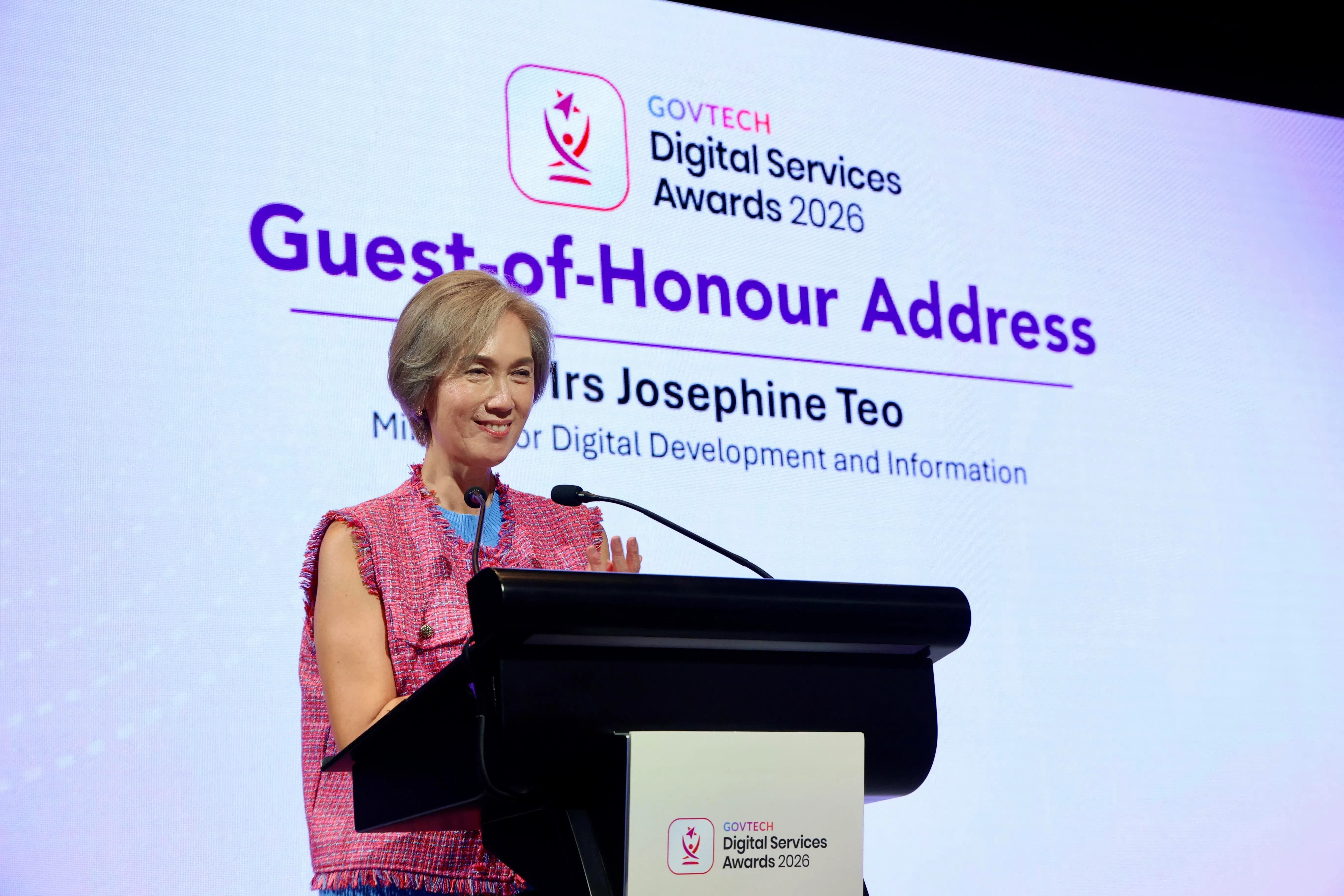
In her speech, Teo said the public was confident that AI could improve efficiency, but did not necessarily believe it would uphold public service values. Citizens want to experience the government’s human touch, whether they are giving feedback on issues they care about or seeking help with problems they encounter. They want to know that behind the screens and clicks are real people who care and understand that government actions have a tangible impact on people’s lives. “In other words, efficiency is not a substitute for empathy, and effectiveness must include the citizens’ sense of fair treatment.”
As AI is used more widely in public digital services, Teo said the government should make it easier for Singaporeans to get help, feel more heard and understood, and be more confident that they will be cared for.
She outlined two priorities. On redesigning work, she said that people whose problems involve several agencies should not have to repeat their account, submit the same information and wait for referrals between agencies. “Instead, we must look at the full process from the citizen's perspective, and use AI to help officers work better together.”
As AI takes on more routine tasks and saves time, the government must make a conscious effort to adjust officers’ responsibilities so they have greater capacity for work requiring a human touch.
Teo also said agencies should use AI responsibly. Besides providing officers with tools, training and support, and protecting the public’s personal information, agencies should put safeguards in place that are proportionate to the risks. AI use can advance quickly in low-risk settings, while higher-impact applications should face stricter scrutiny. With AI agents becoming increasingly capable, the government must make clear which stages require human approval.
More than half of civil servants use AI for work at least once a month
Teo said more than half of the 150,000 civil servants already use AI for work at least once a month. She believed they would soon be as comfortable using AI at work as they are sending emails.
Launched in 2021, the Digital Services Awards are now in their sixth year. This year’s awards, themed “Engage, Empower, Evolve”, recognise 43 government agencies, organisations and individuals.
The Government Technology Agency developed WebSG, an AI-powered website-building platform that allows officers to create websites quickly simply by describing their needs, without writing any code. It also accommodates government-specific requirements and system integration needs.
Setting up an official website used to take three to six months, but one can now go live in as little as two days. WebSG has supported more than 47 government initiatives to date, with websites on the platform receiving more than 85 million visits in total.
