


Work has officially begun on Phase Two of Tuas Port, which is expected to begin operations progressively from 2028. All 21 deepwater berths are expected to be operational by the mid-2030s, further enhancing Singapore’s capacity to handle large container vessels.
Speaking at the groundbreaking ceremony for Tuas Port Phase Two on Friday (20 November), Minister for Transport and Second Minister for Finance Jeffrey Siow said this phase would span nearly 400 hectares of reclaimed land, making it the largest of the port’s four main development areas.
He said: “Phase Two at Tuas Port will equip us to handle the world’s largest container vessels for the next decade.”
According to PSA Singapore, Phase Two will have 21 large berths with a water depth of 23 metres and a total quay length of 8.6 kilometres — the longest of Tuas Port’s four development phases. It will be able to accommodate the world’s largest container vessels.
Tuas Port, which covers more than 1,330 hectares and costs more than $20 billion to develop, is being built in four phases. It officially opened in 2022 and has already handled 25 million twenty-foot equivalent units (TEUs) to date.
When the entire port is completed in the 2040s, all of Singapore’s container operations will be consolidated at Tuas Port, making it the world’s largest fully automated port. It will have 66 large berths and be capable of handling up to 65 million TEUs a year.
Siow said that, as a small island nation without natural resources, maritime connectivity is Singapore’s lifeblood. Its seaport connects it to over 600 ports worldwide, supports over 140,000 jobs, and powers its wider manufacturing and services economy.
However, as other international maritime hubs actively expand their port facilities, invest in technology and develop maritime services, Singapore must also plan ahead to maintain its competitive edge. Siow stressed that building Tuas Port was not just about meeting demand over the next decade, but also about securing the long-term development of Singapore’s maritime sector.
Maritime Singapore Master Plan to be unveiled next April
Siow said the Maritime and Port Authority of Singapore would unveil the Maritime Singapore Master Plan next April. It will focus on three areas: expanding capacity across the port and maritime ecosystem, leveraging technology and innovation, and investing in maritime talent.
He said that, besides increasing the port’s container-handling capacity, Singapore must further improve the reliability of port operations and create value for shipping lines and cargo owners.
For example, PSA’s new Supply Chain Hub at Tuas Port will put logistics and warehousing facilities close to the port, allowing goods to be stored, processed, consolidated and distributed to regional markets more quickly.
Singapore also hopes to evolve from a hub that brings maritime companies together into a “hub of flows” for global maritime trade.
This includes attracting more maritime companies across areas such as ship financing, insurance and data to establish their global and regional headquarters in Singapore, so that more key decisions and transactions involving global shipping operations and supply chain management take place here.
Siow said success in Singapore’s maritime sector was not measured just in container volumes. It was also seen and felt in the global reach of local companies, the strength of the maritime ecosystem and the good jobs it creates for Singaporeans.
Intelligent guided vehicle fleet to grow to 1,000 to boost port efficiency
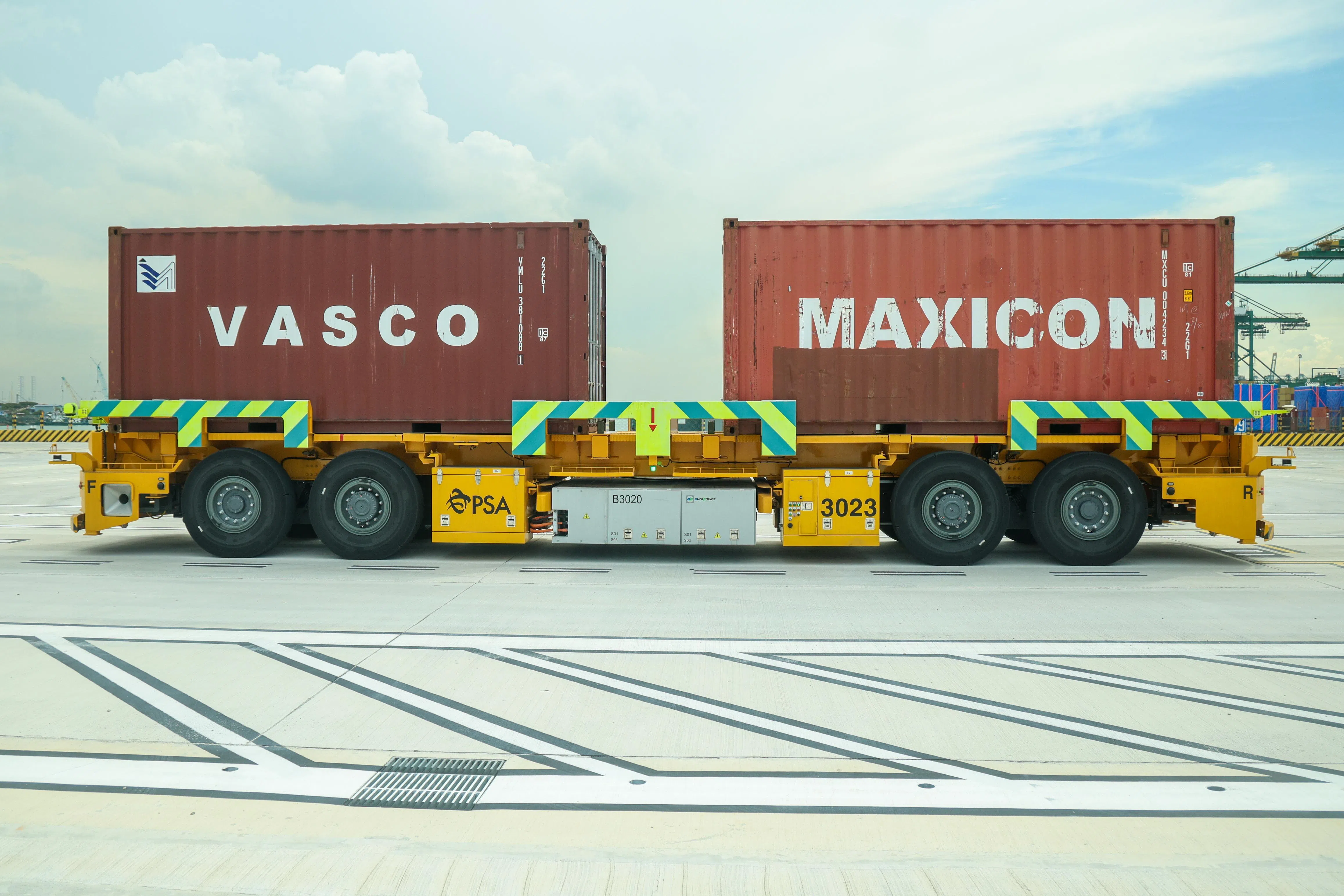
On technology and innovation, PSA will scale up its fleet to around 1,000 next-generation Intelligent Guided Vehicles (IGVs). These vehicles transport containers within the port, further improving operational efficiency, safety and reliability.
Unlike the earlier automated guided vehicles, which are bound to fixed routes, these new IGVs, equipped with artificial intelligence (AI), can calculate and optimise their own routes on the go, adjusting to traffic in real time while operating safely alongside manned port vehicles.
The authorities are also trialling the use of drones to ferry urgent spare parts and fuel samples, reducing reliance on boats. They are also exploring ways to deliver fresh food and supplies by drone from shore to ship, which will improve crew welfare.
Siow said that, over time, the aim was for AI, digital twins, autonomous systems and real-time data to enable the entire port to operate as one integrated system.
To advance decarbonisation in the maritime sector, Singapore will also prepare for a future in which ships use a range of fuels. This includes scaling up liquefied natural gas (LNG) bunkering, licensing new clean-fuel suppliers for LNG and methanol, and running live trials and developing safety standards for alternative fuels such as ammonia.
Tripartite cooperation helps port workers acquire new skills
Siow noted that, as the port continues to develop, successive generations of port workers have had to adapt to change and learn new skills. Their success in navigating each transition has depended on close cooperation between the Singapore Port Workers Union, the Port Officers’ Union, PSA and the government.
He stressed that strong tripartite cooperation was an important foundation for the port’s success. It also allowed workers to share in the gains from development through better pay and safer working conditions. The authorities will invest further in port workers and recognise their contributions to the port’s development and success over the years.
In his speech, PSA International Group Chairman Peter Voser said that, in breaking ground on Phase Two at Tuas Port, PSA was not simply adding capacity, but laying the foundations for a more integrated port ecosystem that delivers greater value for its customers, partners and the wider supply chain.
