

DFI CEO Scott Price sticks to ‘underpromise, overdeliver’ playbook for latest financial targets
Beyond opening more stores or selling more products, a new ‘shadow’ P&L engine could also drive earnings

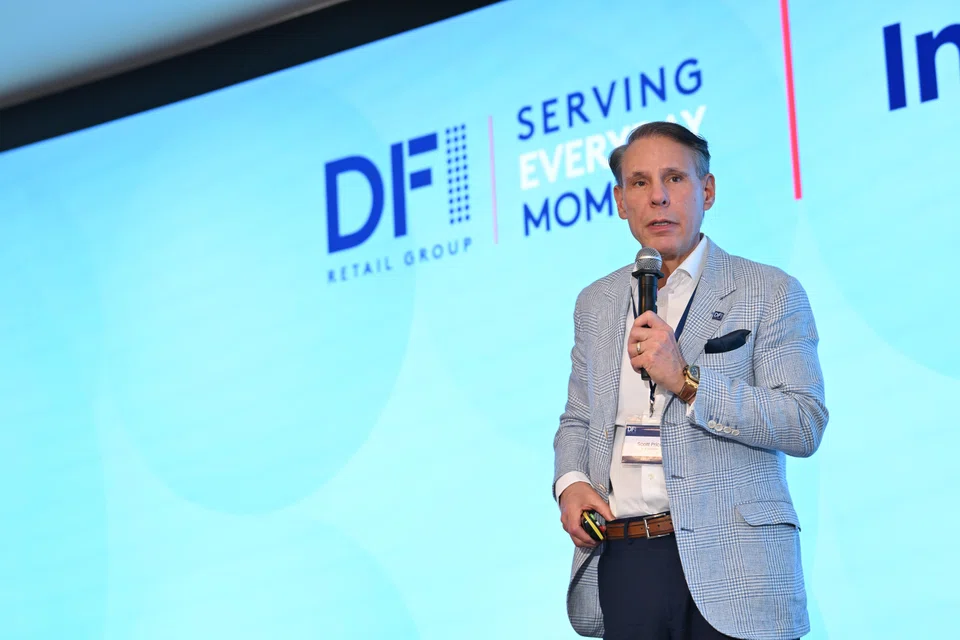
[SINGAPORE] The next time you step into a 7-Eleven store in Singapore, you might notice digital screens flashing advertisements as you browse for ready-to-eat food – a mala onigiri, perhaps?
On the way to the cashier, you might pass an aisle of blind-box collectible toys exclusive to the chain, featuring your favourite boy band or cartoon character.
You might even open the box while sitting at tables inside a brightly lit, newly renovated store – one that resembles outlets in Japan or Taiwan more than those traditionally seen in Singapore.
If DFI Retail Group’s group chief executive Scott Price has his way, that could soon become the typical experience for shoppers – and offer a glimpse of where the retailer expects its next phase of earnings growth to come from.
After more than a year of restructuring and portfolio trimming, the Asian retail group in December issued a new set of financial targets through 2028.
These include inflation-beating organic revenue growth of 2 to 3 per cent annually on a compounded basis, and underlying profit of between US$310 million and US$350 million by 2028.
That compares with underlying profit of US$270 million for the year ended Dec 31, 2025, up 35 per cent year on year, while revenue was flat at US$8.9 billion.
If the FY2028 targets appear somewhat modest to investors, that may be intentional.
“I’m not somebody who puts ambitious targets up there and then fails; we underpromise and overdeliver,” said Price in a recent interview with The Business Times.
Beyond opening more stores or selling more products, a new “shadow” profit-and-loss (P&L) engine could also drive earnings in the coming years – one built on data and digital platforms.
“A couple of years ago, when our stock price was at U$1.77, the breakup value of DFI was higher than our market cap at that time. Today, we trade at a 25-multiple at (roughly US$4.30), with an increasing consensus on target price,” said Price.
“The reason for that is… the value of the data that we can mine from our digital ecosystem, the value of the retail media access of screens in store – plus selling advertisements in all of our apps – are such that we now have this shadow P&L (that is) a very high-margin, digitally enabled business,” he added.
DFI has guided that revenue from its digital ecosystem will contribute at least 1 per cent of group revenue by 2028, with incremental margins of 60 to 70 per cent.
Expansion runway
Another growth lever lies in markets where the retailer still sees significant room to expand.
For example, in China, where DFI owns the 7-Eleven franchise in Guangdong province, the chain operates about 2,000 stores but is present in only 13 of the province’s 21 major cities.
“There’s huge upside to go from 2,000 stores upward,” said Price.
In the health and beauty segment, where DFI operates Mannings in mainland China, Hong Kong and Macau, and Guardian in South-east Asia, expansion into smaller cities remains largely untapped.
“We’ve got a lot of opportunities to grow these markets into (these) Tier-2 cities. For the most part, I think the growth comes in areas where we still have not penetrated,” said Price.
Growth is also expected to come from new product categories in 7-Eleven stores, particularly ready-to-eat meals and collectible merchandise.
The push comes as cigarette sales decline, following tighter tobacco policies in several of DFI’s key markets.
Convenience store sales totalled US$2.3 billion in FY2025, down 2 per cent year on year, which the company attributed to lower-margin cigarette volumes after tax increases in Hong Kong in February 2024.
Singapore similarly raised tobacco excise duties by 20 per cent in the latest Budget.
A pack of cigarettes costing S$16 in Singapore yields a margin of about S$1.50, Price noted, lower than that for a S$4 ready-to-eat sandwich.
“A combination of the megatrend of reduced smoking meant that our stores needed to find a new shopper mission, and what we’re finding is that we can offer affordable meals – including hot meals – because Asians like their hot food,” he said.
The retailer is also tapping the “kidulting” trend, dedicating store space to collectible merchandise targeted at youths and young adults.
In Hong Kong, DFI recently partnered South Korea’s Hybe to sell exclusive merchandise for Seventeen, a K-pop boy band managed by the entertainment company.
“We sold them in 7-Elevens for about six weeks, and it just flew off the shelf,” said Price.
Appealing to shoppers through “fun, affordable” treats can help “reposition and offset” declining tobacco revenue while improving margins, he added.
Third phase
DFI’s renewed focus on growth and profitability marks what Price described as the retailer’s “third phase”.
The first phase, he said, centred on restructuring and “fixing the basics”, including moving away from a centralised decision-making model where “everything was decided in Hong Kong”.
“We had to restructure our business and rethink our talent profiles to get decision makers close to the country and all of our markets,” he explained.
The second phase involved reviewing DFI’s portfolio and exiting businesses where the group saw limited prospects.
This led to the divestments of Yonghui Superstores in China, Robinsons Retail in the Philippines, as well as Cold Storage and Giant in Singapore.
Investors have certainly welcomed the changes.
The stock gained 71 per cent in 2025 and delivered total shareholder returns (TSR) of 103 per cent for the year, including a US$600 million special dividend.
On a TSR basis, DFI was the top-performing counter on the benchmark Straits Times Index in 2025. In the year to Wednesday (Mar 11), it has risen 20.3 per cent, making it the index’s fifth-best performer.
Asked whether DFI’s share price can continue to hold up, Price returned to his earlier philosophy.
“I’m a big believer of underpromising and overdelivering,” he said.
“I think there are people who wish they bought shares at US$1.77... A couple years from now, I bet there’ll be people who wish they’d bought at US$4.33.”
TRENDING NOW

Malaysian king buys stake in Singapore-listed mining firm expanding into rare earths

Grab CEO’s wife Chloe Tong on life with Anthony Tan and finding her purpose

Once staunchly pro-China, Malaysian Chinese businesses are now distancing themselves from Beijing

Longer wait times expected as S’pore healthcare institutions report system disruptions

