COP30: Adopting an outcome on climate adaptation is a start for financing to flow towards Asean
Climate finance and nationally determined contributions will also be on the table at this year’s talks


[SINGAPORE] Climate adaptation has often been seen as the poorer cousin of climate mitigation.
Measures aimed at helping society prepare better for, and reduce vulnerabilities to, climate impacts are often underinvested. This is as governments and private investors focus more on designing policy and deploying capital towards containing such effects through the reduction of greenhouse-gas emissions.
But that could soon change at the United Nations climate change conference in Belem, Brazil, where adaptation will take centre stage at this year’s talks.
The other major topics expected to be discussed at COP30 are how higher levels of climate finance can be mobilised through various sources, and the submission of countries’ 2035 climate goals – known as nationally determined contributions (NDCs).
Responding to queries from The Business Times, a spokesperson for the Ministry of Sustainability and the Environment (MSE) said Singapore looks forward to working with partners at COP30, to send a strong signal of commitment to multilateralism and implementing the Paris Agreement.
The spokesperson added that Singapore will focus on achieving progress in the “submission of more 2035 NDCs from parties; progress on implementing the Global Stocktake decisions; adoption of the adaptation indicator framework to enhance adaptation action and support to developing countries; early delivery of the US$300 billion from developed countries to support developing countries; and strengthened cooperation on low-carbon technology solutions”.
BT looks at what these big-ticket items could mean for Singapore and the rest of South-east Asia.
Climate adaptation
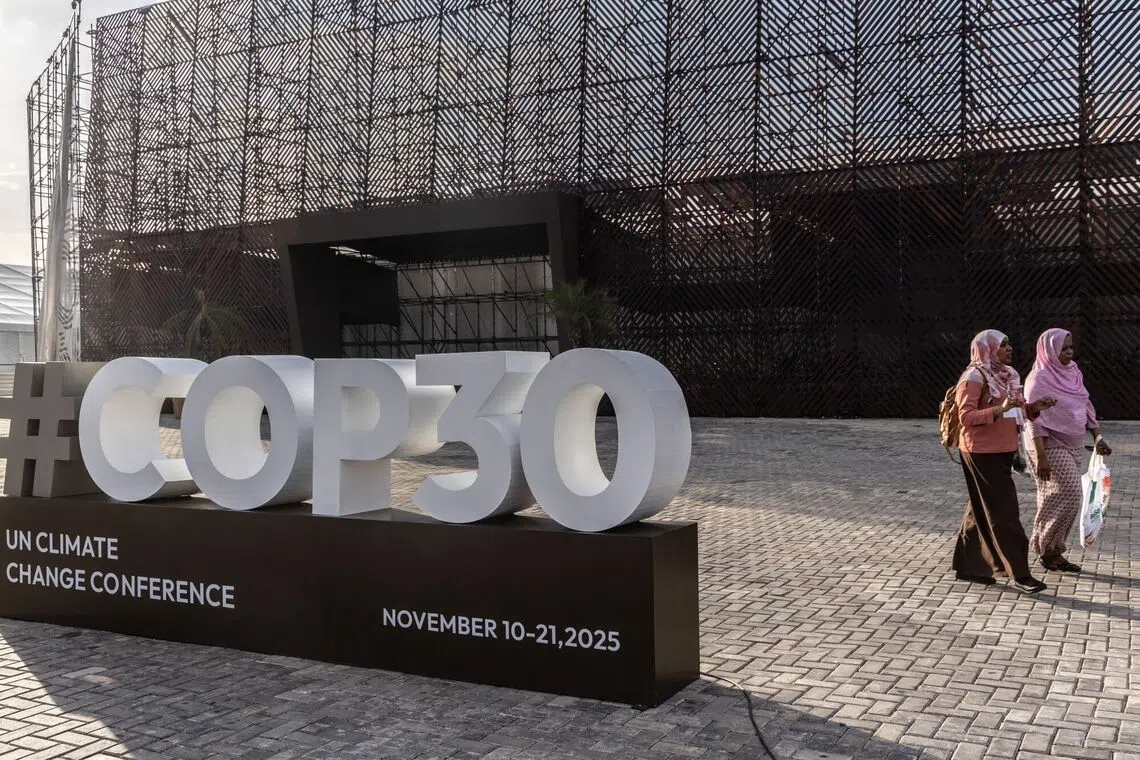
From Monday (Nov 10) to Nov 21, parties to the UN Framework Convention on Climate Change will gather in a port city on the edge of the Amazon rainforest to hammer out indicators for measuring and tracking progress towards the Global Goal on Adaptation (GGA).
Established under the Paris Agreement, the GGA provides a collective vision and direction on climate adaptation for the international community.
However, unlike its mitigation-focused counterpart – where states work towards limiting temperature rises to 1.5 deg C, though several indicators have shown that threshold has been breached – there is no north star for climate adaptation.
Observers told BT that setting out a list of indicators that can monitor adaptation outcomes at this year’s COP is critical, as this would enable countries to start reporting on such efforts.
This would also allow them to develop common metrics to understand how current attempts are working and find where the gaps are, as well as identify the resources and investments needed to accelerate action.
“If these metrics begin being tracked as a result of the negotiations, it may become clear that there is a lack of funding flowing to countries in South-east Asia – and this could spur capital providers to direct money there, said Danielle Falzon, an assistant professor at Rutgers University.”
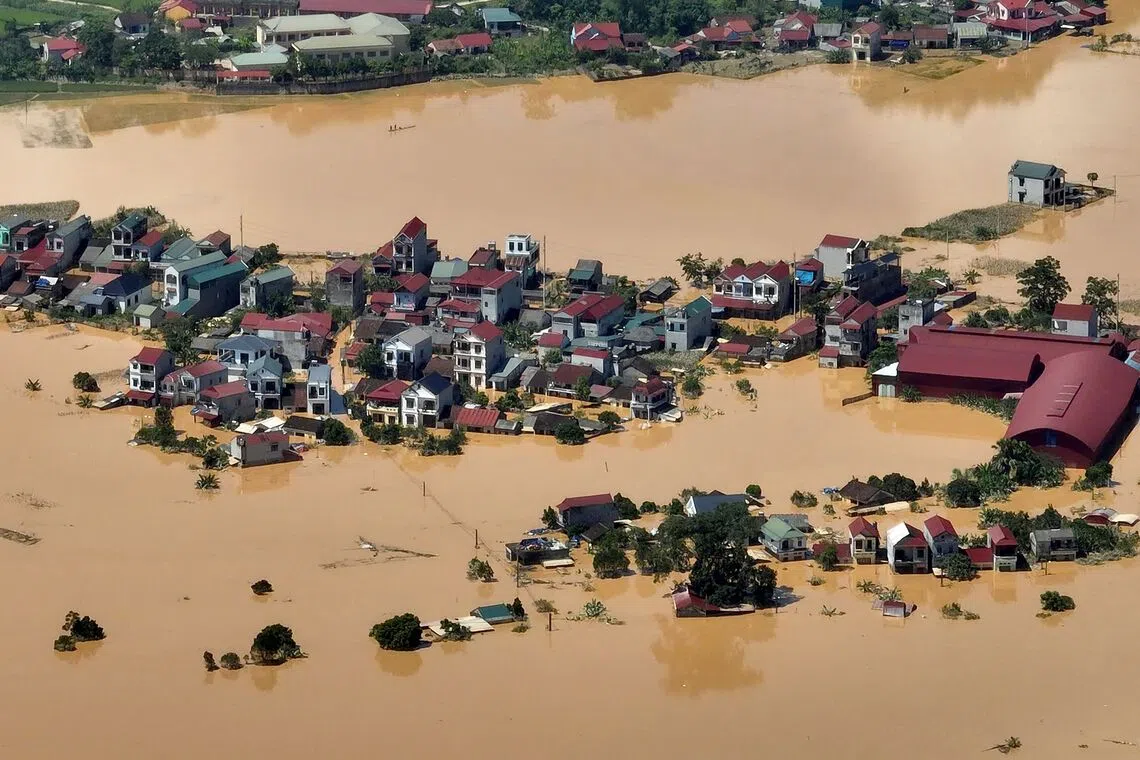
Settling on a framework is especially important for South-east Asia, as the region is one of the most vulnerable to climate risk.
Nithi Nesadurai, director and regional coordinator of environmental non-profit Climate Action Network Southeast Asia, said that reaching a consensus at COP30 could drive Asean to step up its adaptation activities.
“The absence of an agreement on adaptation indicators will be the missed opportunity of an institutional framework for mainstreaming and addressing adaptation globally, including the provision of finance required for adaptation,” he added.
This is because many of the proposed indicators are designed to track public and private finance flows, as well as national budget allocations for adaptation.
If these metrics begin being tracked as a result of the negotiations, it may become clear that there is a lack of funding flowing to countries in South-east Asia – and this could spur capital providers to direct money there, said Danielle Falzon, an assistant professor at Rutgers University.
Such providers include those from the private sector, which typically shun adaptation projects as they usually do not have present as many revenue-generating opportunities as their mitigation counterparts, such as solar farms.
A spokesperson for sustainability consulting firm ERM said that clearer indicators would help Asean countries attract evidence-based funding for climate-resilient infrastructure, resulting in a more attractive investment environment across emerging markets in the region.
“An agreement on adaptation indicators would likely lead to more capital flows from the private sector and investors. They would help reduce uncertainty around adaptation outcomes, making it easier for investors to assess risks and returns,” the spokesperson added.
“They would also signal political commitment and create a more transparent framework for tracking progress, which in turn can build trust and confidence.”
However, many recognise that finalising such a framework would be challenging, given the unique climate change risks and impacts – as well as circumstances – that each country faces, said Dr Theresa Wong, head of science for the technical support unit at the Intergovernmental Panel on Climate Change.
Prof Falzon added that there will be differing positions on whether the 100 indicators currently being proposed are sufficiently relevant for adaptation, as well as the extent to which the list should be adopted in whole or in parts, or implemented in stages.
Out of the 100 indicators, the most contentious ones relate to how adaptation should be implemented, observers noted.
Specifically, they relate to finance, capacity-building and technology transfer – and have been a topic of dispute between developed and developing countries in adaptation negotiations over the years.
An outcome where the indicators point to the need for further support from wealthy nations would be a win for South-east Asia, as they could ensure the region has both the ability to adapt and collect data on its progress, Prof Falzon said.
Nonetheless, there are expectations that the indicators being developed under the GGA will be imperfect and give only a partial view of adaptation progress. However, they still provide a necessary start for tracking adaptation globally, Prof Falzon added.
The MSE spokesperson said that ideally, the final framework should strike a balance between ambition, feasibility and relevance.
Utilising existing indicators, such as those from the UN Sustainable Development Goals, for example, can significantly reduce reporting burdens for developing countries.
“We need to understand that adaptation indicators need to be continually updated and evolve with new science, and the package that would be adopted at COP30 is not a ‘be all and end all’ package,” the spokesperson noted.
Besides adaptation indicators, states will assess their progress on their national adaptation plans at COP30 – one of the outcomes that arose from the first Global Stocktake in 2023.
That review examined the progress governments made in cutting emissions, and made recommendations on what else needed to be done.
Anjali Viswamohanan, director of policy at the Asia Investor Group on Climate Change (AIGCC), noted that while indicators measure and track progress on adaptation, national plans are where countries assess climate risks, establish adaptation strategies and integrate them into national policies, as well as develop the budgets to build climate resilience.
In a report, AIGCC noted that even though these plans are key to enabling investment in climate adaptation and resilience – as investors are keen to understand the types of projects and solutions required – there is a lack of clarity among Asian regulators on adaptation planning.
“To activate the private sector, governments must place stronger emphasis on adaptation and resilience planning and implementation within government and across sectors,” Viswamohanan said.
“This includes comprehensively assessing present and future risks of climate change, identifying investment and financing opportunities, and implementing and scaling adaptation initiatives through policies.”
Climate finance
Meanwhile, climate finance will likely remain a contentious topic at COP30 – despite parties agreeing last year to raise the minimum amount that developed countries must provide to developing countries to US$300 billion.
This is because that sum was deemed inadequate by developing countries, and a road map detailing how US$300 billion can be scaled to US$1.3 trillion will be another point of discussion.
The ERM spokesperson said businesses in Asia are looking for predictable, transparent and scalable financing mechanisms from this road map – especially ones that blend public and private capital and reduce investment risks in emerging markets.
“They want to see alignment between climate finance and national transition plans, including sector-specific pathways for energy, transport and infrastructure.”
The MSE spokesperson said that there is a need to consider innovative financing mechanisms, such as first-loss instruments and blended finance, to address the gap between climate financing needs and finance flows – particularly in developing countries – beyond public finance.
A first-loss instrument is a tranche of capital that takes the first portion of losses if the underlying investments underperform. Blended finance refers to a capital-raising approach that leans on investors with higher risk appetites – such as multilateral development banks, development finance institutions, philanthropists and governments – to provide concessional or catalytic capital to pull in more commercial investors.
The spokesperson added that multilateral development banks and international financial institutions need to evolve and strengthen their roles to become more effective in delivering sustainable finance.
National climate targets
Countries’ national climate targets will also be a central focus at COP30, as they reflect how they are responding to the findings of the 2023 Global Stocktake.
Parties were expected to present their second set of NDCs, which lay out their climate targets for 2035 and plans to achieve them, earlier this year. However, only about 60 countries have submitted them.
Viswamohanan noted that investors are looking forward to a consensus on an ambitious implementation path in the five years from 2030 to close the emissions gap and establish clearer accountability mechanisms.
“While the target is important, it’s the detail in policy implementation plans that will give investors the most useful and actionable information that allows them to allocate capital with confidence,” she said.
“Clear climate ambition and decarbonisation strategies provide a basis for us to facilitate collaboration with other countries and the private sector to advance the implementation of the Paris Agreement.”
Ministry of Sustainability and the Environment spokesperson
The ERM spokesperson added that ambitious and actionable NDCs could unlock significant capital flows, spur innovation and accelerate the shift towards low-carbon, climate-resilient business models across Asia.
“The expectation is that the 2035 NDCs will provide policy certainty, helping companies align their environmental, social and governance strategies and decarbonisation targets with national goals and sector road maps.”
Meanwhile, Singapore hopes that more countries will submit their NDCs, the MSE spokesperson said. This is because the city-state relies heavily on technological developments and international collaboration in its mitigation efforts, given its limited access to alternative energy.
“Clear climate ambition and decarbonisation strategies provide a basis for us to facilitate collaboration with other countries and the private sector to advance the implementation of the Paris Agreement,” the spokesperson added.