


Foreign money fuels Thai stock rally as SET chief vows governance reset
The exchange is also looking to introduce new investment products to broaden market participation

[BANGKOK] A return of foreign money has helped power Thailand’s stock market from regional laggard to outperformer, with inflows reaching close to US$2 billion this year, before Middle East tensions cooled sentiments, said Stock Exchange of Thailand (SET) president Asadej Kongsiri.
The rebound has been stark. After failing to catch the regional rally in 2025 amid trade and tariff pressures and political uncertainty, the SET Index is up nearly 20 per cent so far this year as political clarity and hopes of stimulus help to revive investor appetite.
“The tailwind from a more stable government improves the prospects for policy execution,” Asadej told The Business Times. “That’s important for Thailand, to make structural changes to grow at higher rates than in the last five to 10 years.”
Another draw is valuation.
Thai-listed companies remain relatively cheap compared with regional peers, limiting downside risk, Asadej noted. Dividend yields are also attractive, with Thailand’s market yield at about 4.46 per cent at end-April – among the highest in Asean.
However, he is quick to add that sustaining the rally will require more than low valuations and renewed foreign interest. The exchange is seeking to rebuild investor confidence through stronger governance, clearer disclosure and a broader range of investment products.
“We want our products, our derivatives market, our reporting structures and our governance standards to be at the highest level – to be trusted again,” he said.
The focus on trust follows a series of corporate governance lapses among Thai-listed companies that have dented investor confidence.
The SET and the Market for Alternative Investment (MAI) had a combined market capitalisation of 19.17 trillion baht (S$760 billion) as at Friday (May 8).
Of the 868 listed firms, 639 were listed on the SET and 229 on the MAI. (*See amendment note)
Asadej said that the exchange is working closely with Thailand’s Securities and Exchange Commission (SEC) to strengthen oversight and governance standards.
Governance push
Recent cases have underscored the challenge.
JKN Global Group, owner of the Miss Universe Organization, came under regulatory scrutiny after the SEC alleged in December 2025 that executives falsified accounting records and disclosed misleading financial information. SET later moved to delist the company.
Stark Corp, once seen as a fast-growing industrial firm, also became one of Thailand’s biggest corporate fraud cases after investigations uncovered fabricated revenues and other financial irregularities.
“There have been concerns in the past about whether we’re regulated enough. We are now reviewing the market regulatory structure holistically. We understand investors value certainty, and we are committed to providing that certainty,” added Asadej, a veteran investment banker and finance executive who assumed the position in September 2024.
One of the exchange’s flagship initiatives is the Jump+ programme, inspired by similar market development frameworks in Japan and South Korea. While it initially targeted between 50 and 100 listed firms, the programme had already attracted 142 participating companies by the end of March this year.
Under the programme, companies develop three-year road maps to improve governance, operations and long-term value creation. It also signals a more hands-on approach by SET, with closer engagement with listed companies at the board level.
Technology is also part of SET’s governance push, with artificial intelligence being used to strengthen market surveillance and detect misconduct.
“We’ve been using technology to improve market surveillance for the past eight to 10 years,” Asadej said. “We don’t want bad behaviours in our markets.”
A balanced participation
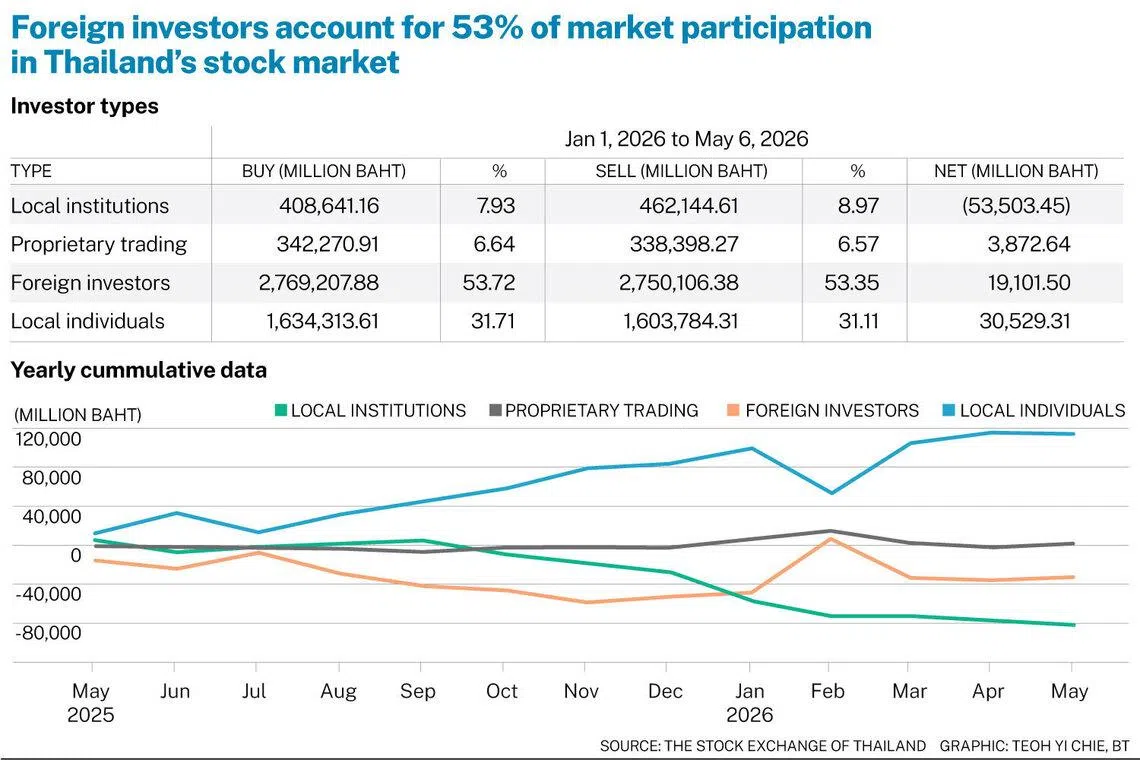
Foreign investors accounted for about 53 per cent of market participation between Jan 1 and May 6. Meanwhile, retail investors remained an important liquidity base, making up around 42 per cent of trading activity. “We want to maintain that balance,” Asadej noted.
The SET also wants to expand its products.
Under its 2026-2028 road map, the exchange plans to grow its depositary receipt offerings from 65 securities to more than 360 (*see amendment note), introduce leveraged and inverse exchange-traded funds, improve bond-market access and support the launch of the Thailand Individual Savings Account to encourage long-term domestic investment.
Over the next 12 to 24 months, SET and the Thailand Futures Exchange (TFEX) are expected to roll out a series of reforms and new investment products aimed at broadening market participation and improving risk-management tools.
Among the most anticipated launches is Mini Gold Online Futures sometime this month (*see amendment note).
The new contract will reduce the size of gold futures trading from 10 ounces to one ounce, significantly lowering capital requirements for retail investors seeking to hedge against gold-price volatility.
TFEX is also exploring future mini silver contracts and perpetual-style derivative products tied to popular underlying assets.
Other planned initiatives include short-dated SET50 options, spot-like hedging products, strategy-building tools for derivatives investors and a major revamp of the Streaming mobile application to improve the trading experience across multiple asset classes.
Some return to stability
“I’ve been SET president for about one year and seven months, and I’m already on my fourth prime minister,” he joked.
Thailand has also faced unexpected disruptions, including an earthquake that temporarily forced market closure, something he described as unprecedented in his lifetime.
“We’ve had many surprises,” he reflected. “Middle East tensions, energy price surges, political changes – more surprises than challenges.”
Yet, despite the turbulence, Asadej remains focused on long-term institution building.
“Our priority is building seamless infrastructure,” he pointed out. “Technology-wise, markets are not simple.”
Amendment note: The article has been edited for clarity.
TRENDING NOW

Mooted COE changes will solve category issues, but higher premiums likely: observers

Grab CEO’s wife Chloe Tong on life with Anthony Tan and finding her purpose

Once staunchly pro-China, Malaysian Chinese businesses are now distancing themselves from Beijing
Cliff Tan has 7 million followers and a 4-month waitlist. Why won’t he expand his business?

