


Malaysia leads Asean to peace, trade and unity with Trump in the room
Despite the progress, the bloc remains fragmented, Washington’s protectionist stance continues to loom, and much work still lies ahead

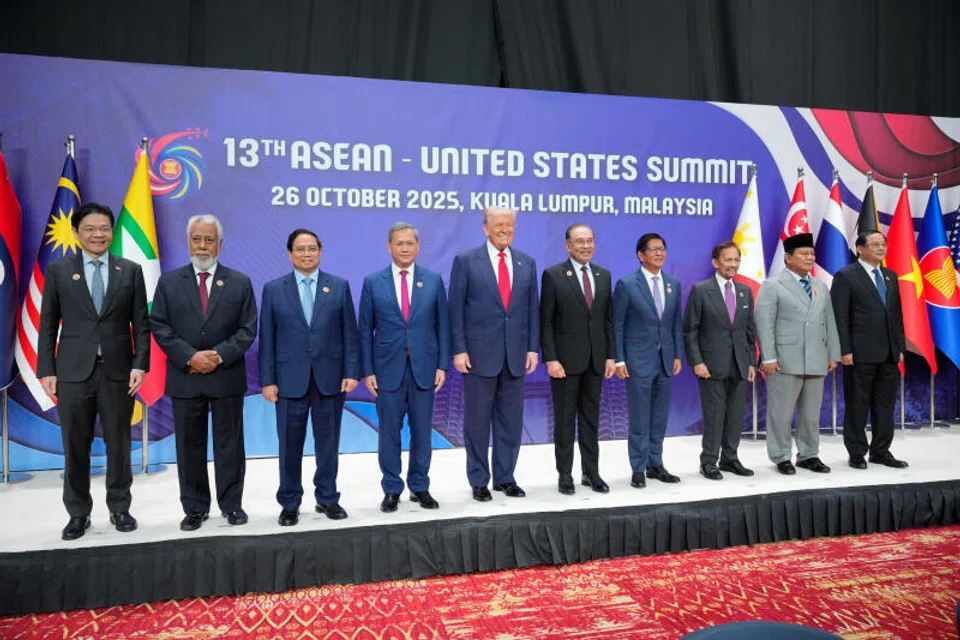
[KUALA LUMPUR] Once dismissed as a “talk shop” of cautious consensus, Asean this year found its voice, with Malaysia giving it a stage at the Kuala Lumpur Convention Centre.
Under Prime Minister Anwar Ibrahim’s chairmanship, the regional bloc delivered long-overdue results, including expanding its ranks, mediating peace and reaffirming its centrality in a world fractured by rivalry and protectionism.
Chief among them was the formal admission of Timor-Leste as Asean’s 11th member, fulfilling a decade-old commitment and reflecting the grouping’s continued inclusivity.
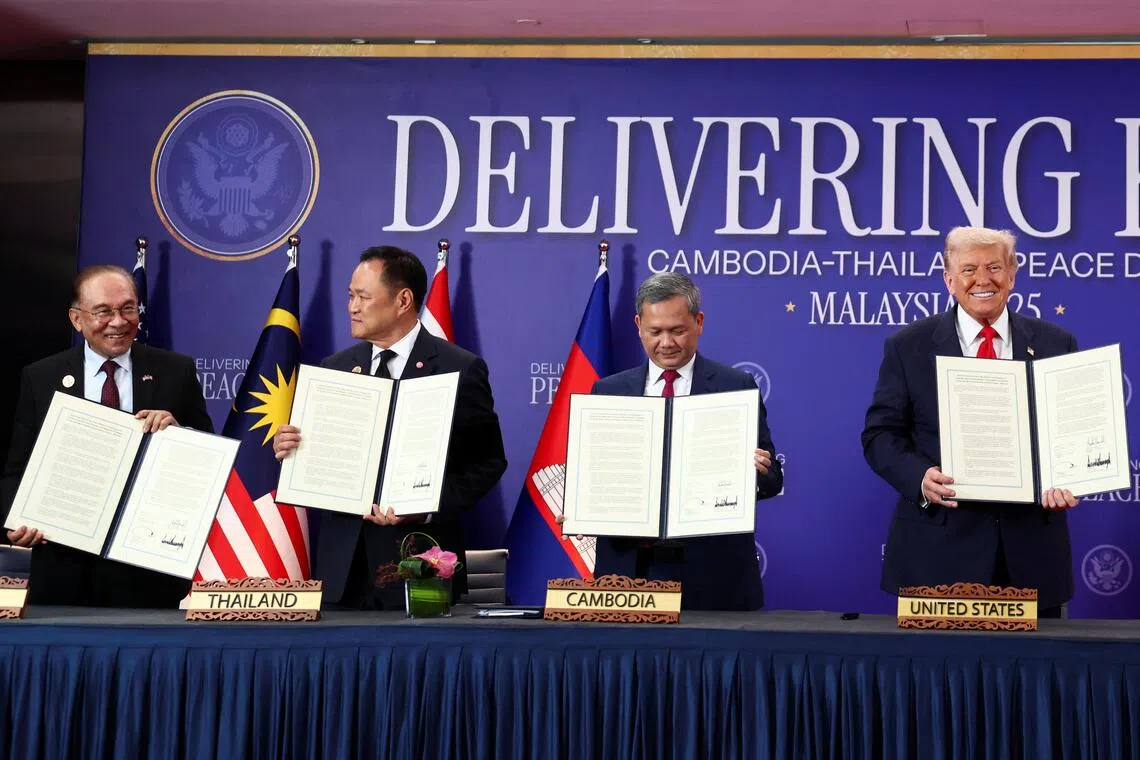
The Kuala Lumpur Peace Accord between Thailand and Cambodia – a landmark agreement witnessed by US President Donald Trump – further showcased the bloc’s capacity to facilitate peace talks and maintain regional stability.
Malaysia hands over chairmanship to the Philippines
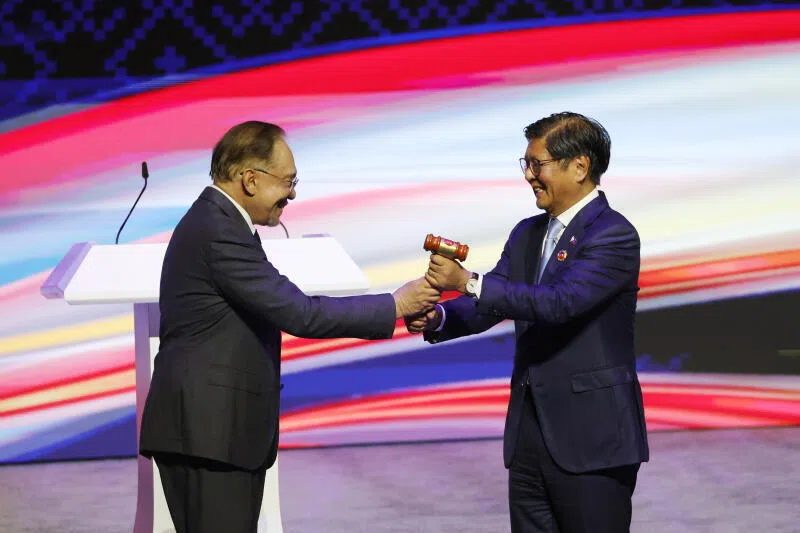
On Tuesday (Oct 28), Malaysia formally handed over the Asean chairmanship to the Philippines. Speaking at the closing of the 47th Asean Summit, Anwar noted that despite global turbulence, the bloc’s unity “has held firm”.
“History seldom leaps. It bends, slowly, through the will, labour and sheer stubbornness of those who refuse despair… Centrality, while not soaring above the skies, is still alive and well. Things are not falling apart and the centre still holds,” he said.
Philippine President Ferdinand Marcos Jr, accepting the chairmanship gavel, praised Malaysia for steering Asean “with clarity and conviction”.
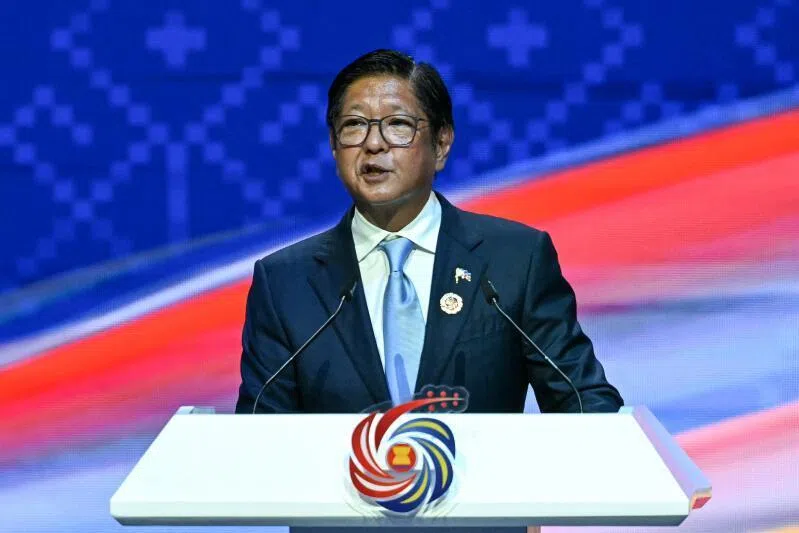
“The Philippines is honored to take on the responsibility of leading Asean from 2026,” he said. He pledged to advance the Asean Community Vision 2045 and to support the further integration of Timor-Leste in the bloc.
He announced the Philippines’ 2026 theme, “Navigating Our Future Together”, promising a focus on peace, prosperity corridors and people empowerment.
“Asean is our ship and in 2026, we set full sail together,” he added.
Peace as priority
In a press conference after the summit, Anwar said Malaysia’s priority was to reinforce Asean as “a zone of peace and one of the world’s fastest-growing economic regions”.
“Asean is considered one of the most peaceful regions in the world. In terms of investment, trade and economic growth, it is one of the fastest-growing. That is why the whole world is looking at us – because it is peaceful,” he added.
Malaysia also used its chairmanship to expand Asean’s diplomatic and trade reach beyond traditional corridors.
“Why must we ignore Africa and Latin America?” Anwar asked. “We consider Brazil and South Africa great friends, and we believe these partnerships should grow.”
From symbolism to substance
Economists agree that Malaysia’s chairmanship demonstrated Asean’s true strength lies not in the volume of its declarations, but in its ability to translate dialogue into binding agreements and promises into tangible economic growth.
Dr Wong Chin Yoong of Universiti Tunku Abdul Rahman’s business and finance faculty said it is “beyond dispute” that Anwar has done a remarkable job of bringing together leaders of major powers with Asean nations.
“Asean is arguably the most effective and productive regional trading bloc after the European Union. What makes Asean distinctive is its open regionalism,” he told The Business Times.
While such openness was once viewed as a weakness given that intra-Asean trade comprises only about one-fifth of the regional total, Dr Wong noted it has become a strength in today’s era of fragmented globalisation.
“By remaining open to all countries and trading blocs pursuing a ‘minus US’ strategy, Asean represents the last hope for a dying multilateral trade arrangement in the global economy,” he added.
Centrality reinforced
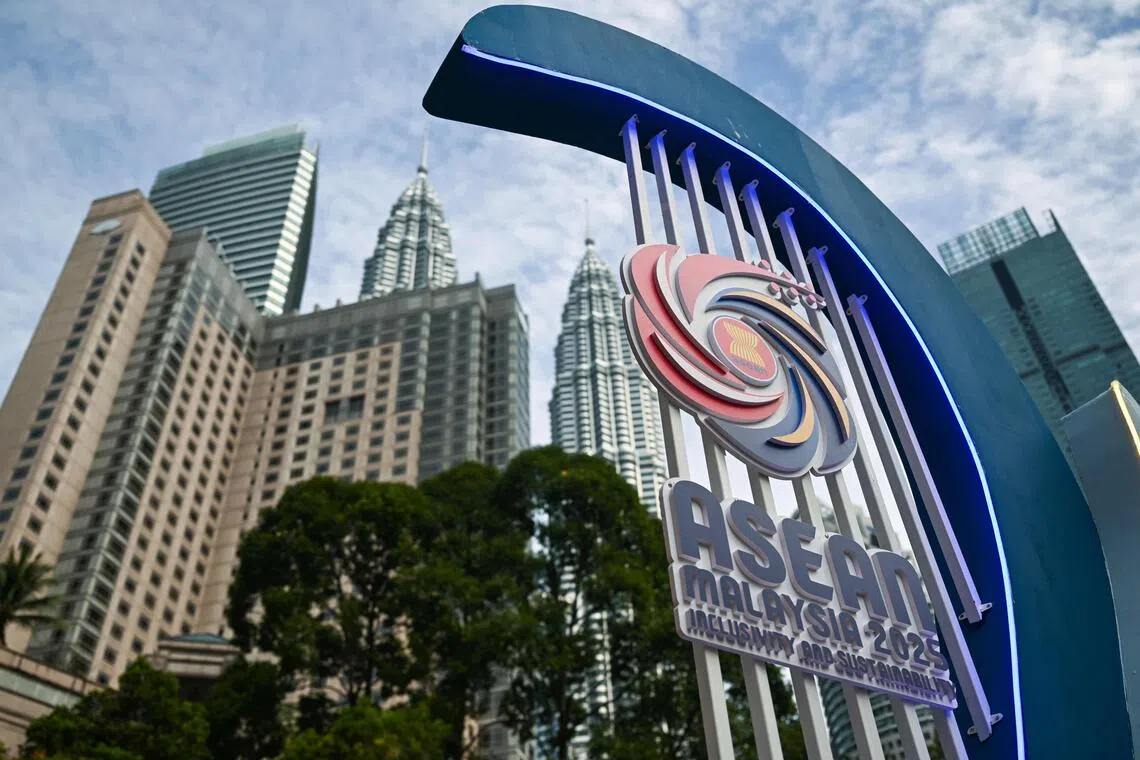
Suhaimi Ilias, chief economist at Maybank Investment Banking Group, said a key takeaway from the 2025 Asean Summit was the affirmation of the grouping’s centrality, underscored by the attendance of leaders from the world’s major powers.
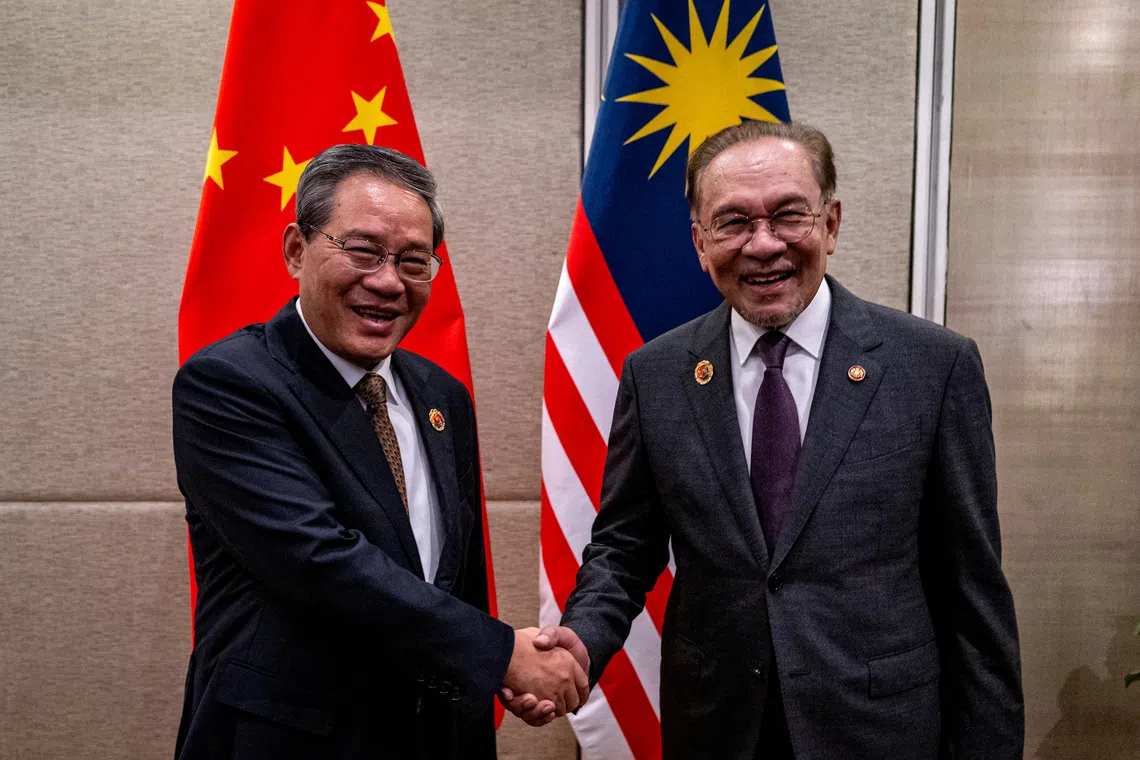
He said: “The presence of President Donald Trump and (Chinese) Premier Li Qiang, alongside leaders from Japan, South Korea, Canada, Australia, New Zealand, Russia, Brazil and South Africa, reflected Asean’s determination to maintain centrality and friendly relations with all countries through steady engagement and continuous dialogue.”
He noted that the summit went “beyond handshakes, photo ops and talk shops”. Instead, it became “about business – especially in strengthening regional trade deals, whether bilateral or intra-Asean”.
During the meetings, several major trade outcomes were unveiled. The US-Malaysia reciprocal trade agreement, covering more than 1,700 product lines worth US$5.2 billion in zero-tariff access, stood out as one of the most significant.
Similar reciprocal trade pacts were signed by Trump with Thailand, Cambodia and Vietnam, highlighting a renewed US economic push into South-east Asia.
Meanwhile, China, New Zealand and Canada expressed strong interest in diversifying trade partnerships with Asean, signalling an evolving global supply chain landscape.
Notably, Asean and China signed the Asean-China Free Trade Area 3.0 Upgrade Protocol, expanding cooperation into emerging sectors such as the digital economy, green transition and supply chain resilience. The upgraded pact also promises improved market access in agriculture and pharmaceuticals.
Within the regional bloc itself, the 11 member states signed the upgraded Asean Trade in Goods Agreement, a long-awaited step towards deepening intra-regional trade.
Suhaimi said the revamped pact strengthens market access through deeper tariff cuts, lowers business costs, enhances supply chain resilience, and modernises the agreement by incorporating digital trade, sustainability and green trade practices.
Progress was also seen in broader trade diversification, including the conclusion of Malaysia-South Korea free trade talks, which spanned goods, services, investments and customs facilitation. Sanitary and phytosanitary measures, digital trade, green economy and bioeconomy cooperation were also on the table.
Asean’s balancing act
Beyond economics, Asean’s political balancing act remains delicate. The bloc’s ability to maintain neutrality amid the US-China rivalry was on full display in Kuala Lumpur.
Dr Wong noted that Asean’s neutrality needs a balanced presence of major powers. By drawing in Trump and the US “back into the fold”, Asean strengthened its “hedge against China’s presence” while continuing to do business with Beijing, he said.
Dr Oh Ei Sun, senior fellow at the Singapore Institute of International Affairs, said that within the constraints of consensus-based diplomacy, Anwar skilfully positioned Malaysia as a driving force in signalling that Asean remains a relevant and credible platform for both conflict resolution – as seen in the Thai-Cambodian crisis – and regional economic development.
“Trump’s appearance, of course, gives us a sense of (optimism) that the US has not abandoned us after all – although we all have to pay dearly for the American love and affection from now on,” he told BT.
Reality check: Gaps between rhetoric and results
Despite these advances, deep-seated challenges remain. Dr Wong cautioned that “when the show ends, reality sets in”. “Asean unity remains largely rhetorical, as national interests continue to override regional ones.”
For instance, the Five-Point Consensus on Myanmar remains only partially implemented. While Malaysia’s diplomatic outreach, led by Foreign Minister Mohamad Hasan, has helped reduce violence and improve humanitarian access, instability persists – exposing the limits to Asean’s current approach.
Economically, non-tariff barriers and uneven implementation continue to hinder true integration.
“Asean markets remain fragmented and far from fully integrated. Meanwhile, Trump’s protectionist trade stance casts a shadow over the region’s prospects. There is still much work to be done,” Dr Wong said.
TRENDING NOW
Companies still in search of AI use cases with worthwhile ROI, says Broadcom’s CEO

Malaysian king buys stake in Singapore-listed mining firm expanding into rare earths

Once staunchly pro-China, Malaysian Chinese businesses are now distancing themselves from Beijing

Singapore’s wealth management success should extend to everyday families

