


Political shake up: Vietnam elects new president, parliament chair after high-level exits
The latest key appointments are unlikely to mark big shifts in the country’s economic policies, say observers

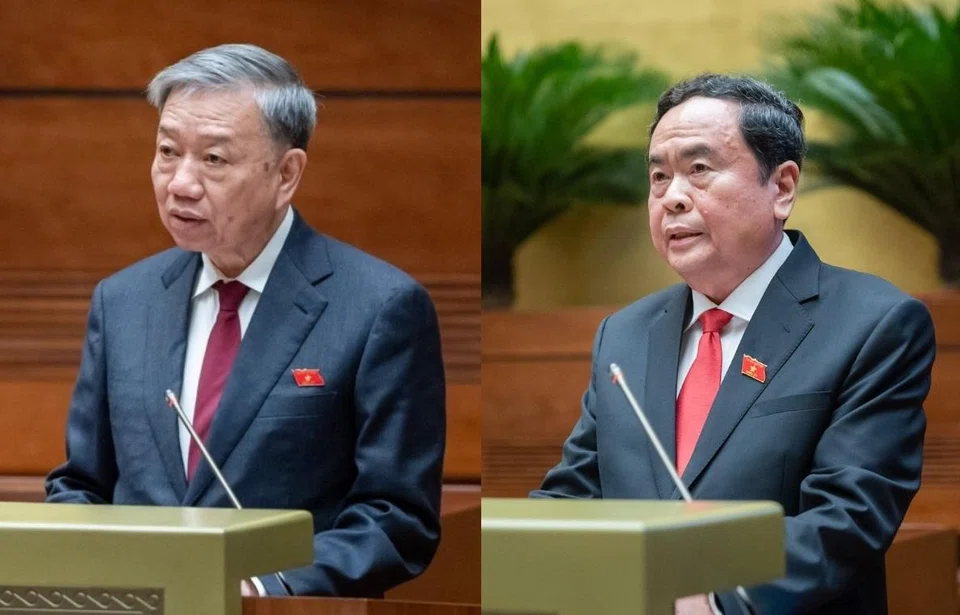
VIETNAM’S National Assembly elected top security official To Lam as the new president on Wednesday (May 22), filling the second-highest political post after his predecessor resigned amid an anti-corruption campaign.
General Lam, 66, is viewed as a hardliner aligned with Vietnam Communist Party chief Nguyen Phu Trong. He also serves as the deputy head of the committee dedicated to fighting corruption and is known for enforcing the “blazing furnace” anti-corruption campaign led by Trong.
Although the presidency is largely a ceremonial role, this latest appointment significantly elevates General Lam’s standing and influence in the country.
It also follows the appointment of Tran Thanh Man as the National Assembly chairman on Monday during the seventh session of the legislature’s 15th tenure in Hanoi. Man now holds one of the four most influential political posts in the country, part of the “four pillars” where collective political power is vested.
The other three positions are held by the general-secretary of the Communist Party, Trong, General Lam, and Prime Minister Pham Minh Chinh.
Their appointments follow an unprecedented series of high-level resignations, including the departures of two state presidents and a parliament head in less than 18 months following unspecified “violations” and “shortcomings”.
Since 2022, a total of six top officials have been purged from the Politburo, the country’s highest decision-making body, amid the ruling party’s anti-graft crackdown.
The fluid political backdrop has risked undermining one of Vietnam’s key selling points – that it is one of the more politically stable countries in South-east Asia.
“Despite that churn, which does rattle the markets, the Communist Party is still in charge, and there is policy consistency,” noted Professor Zachary Abuza at Washington-based National War College, where he focuses on South-east Asian politics and security.
Brian Lee, an economist at Maybank Investment Banking Group, has not ruled out the possibility of continued “political jockeying”. As a result, investors may be cautious about potential unforeseen political personnel changes ahead.
He added: “Nonetheless, FDI (foreign direct investment) investors tend to take a long-term approach to their investments. I don’t think recent developments signal major shifts in economic policy or the stance towards foreign investors.”
General Lam and Man are set to hold their latest positions until the next party congress in 2026 when leadership posts are renewed.
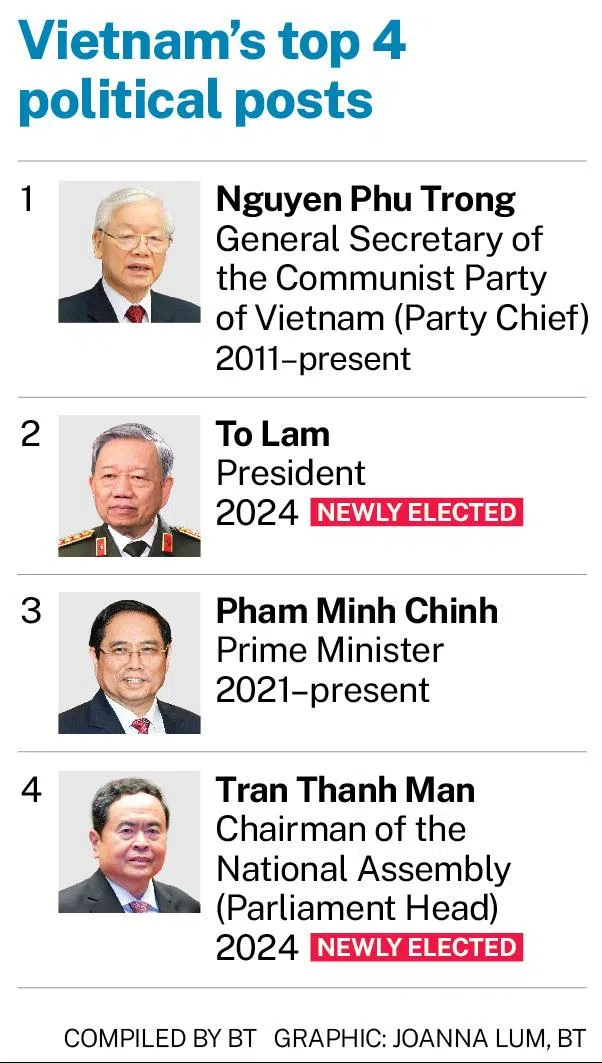
General Lam is the third president of the South-east Asian country in less than two years and will be relieved from his role as the minister of public security.
Man, 61, steps up from his position as the standing vice-chairman of the National Assembly, which he served since 2021.
During the three-day working session last week, the Central Party Committee also added four new members to its Politburo organ, expanding the powerful group to include 16 figures who would be eligible to hold leadership roles in the single-party state.
General Lam: Strong contender for top job
General Lam hails from the northern province of Hung Yen and has served in the police since graduating from the People’s Security Academy in 1979.
His rise shared some resemblance with Prime Minister Chinh, who also started out as a security official and eventually climbed the ranks in the public security ministry.
As the police minister since 2016, General Lam’s work to weed out corruption led to the discipline of almost 1,000 party members in 2022 and 2023.
During his term, Vietnam climbed by 30 places in the Corruption Perceptions Index, landing at 83 out of 180 countries ranked last year.
General Lam and Chinh are seen by observers as the two strongest candidates for the country’s top job in two years.
As both of them will be over 67 years old by then, the duo will have to secure an exemption from the age limit requirement to be considered for the general-secretary position.
Under party rules, no person shall hold the top leadership role for more than two consecutive terms, but the ageing Trong was re-elected for an unprecedented third term in 2021 as party leaders failed to reach a consensus on a replacement.
The previous president Vo Van Thuong, who quit in March after just over a year in office on the accusation of violating party rules, was once seen as a close ally of Trong and a contender to take over the latter’s post.
Analysts do not expect General Lam to change the country’s overall direction in terms of the economy or foreign policies, as these decisions are made by consensus within the communist party’s top leadership bodies – the Politburo and the party central committee.
Man: A leader from the south
Man hails from the Mekong-Delta province of Hau Giang and was admitted to the Politburo in 2021. He majored in business administration and holds a doctorate in economics.
Having served as the chairman of the People’s Committee of the southern city of Can Tho and head of the Vietnam Fatherland Front Central committee, Man is perceived as a low-key leader who has not attained widespread popularity within the system.
His appointment, however, brings some balanced regional representation to the top four positions as the other three hail from the northern part of Vietnam.
His predecessor, Vuong Dinh Hue, was viewed as a rising star in Vietnam’s political sphere and also a possible candidate for the country’s top job. Hue then resigned from office after his assistant Pham Thai Ha was arrested in April this year over allegations of power abuse for personal gain. THE BUSINESS TIMES
TRENDING NOW
Prima to move out of historic Keppel Road flour mill building in 2028
Temasek-related Azalea, SeaTown, Seviora Capital to merge in 2027
Family offices see more tailored products, leverage ‘collective firepower’ for direct deal access
Singapore room rates soar, but hotels seeing mixed demand from F1 race and events

