A stronger ringgit is unleashing Malaysians’ demand for premium travel destinations, experiences
Travel platforms and money changers say the firmer currency is loosening residents’ purse strings for trips abroad
[KUALA LUMPUR/JOHOR BAHRU] As the ringgit climbs, Malaysians are dreaming bigger, widening their travel horizons from Paris and London to Istanbul, even as traditional favourites such as Bangkok, Tokyo and Bali remain strong.
Travel platforms and money changers said the stronger currency is unleashing a surge in overseas plans, with Expedia logging a 50 to 60 per cent jump in searches over the past three months.
Japan and China are leading the rebound, while Europe is edging back into itineraries.
Lavinia Rajaram, Expedia Group’s Asia head of public relations, said: “Premium destinations such as Paris and London are gaining traction because they are now more affordable.”
Search data from Nov 1 to 20, compared with the same period last year, showed the biggest jumps in these destinations:
- Paris: up 400 per cent
- Seminyak, Bali: up 165 per cent
- Istanbul: up 150 per cent
- Dubai: up 60 per cent
- Ubud, Bali: up 55 per cent
Countries such as Thailand, Japan and Indonesia remain attractive to tourists due to their proximity and favourable exchange rates, but long-haul destinations are rising as affordability improves.
Rajaram said Malaysians are also spending more on international trips. Travellers now commonly budget RM5,000 (S$1,574.90) to RM8,000 for short-haul, and RM12,000 or more for long-haul trips when bundling flights, hotels and activities.
Premium additions such as cruises, cultural tours, and curated experiences are becoming more popular. “Travellers are prioritising value and experiences over price alone,” she said.
“They remain price-sensitive but are willing to splurge on quality and convenience when the ringgit stretches further,” she told The Business Times.
Bundled bookings – inclusive of flight, hotel and activities – are trending because they offer transparency and cost efficiency.
While 30 to 40 per cent of bookings are done at the last minute, Expedia data showed Malaysians now spend up to 45 days researching and browsing more than 140 pages of content before confirming a trip.
Johor Bahru resident Aera Donz, who travels with her mother, said: “I’m happy the ringgit is strengthening. It makes travel easier. For 2026, I plan to visit Korea, China, and Vietnam.”
Shifting travel mindset

Beyond air travel, the ripple effects are also showing up on the ground.
At the Puteri Harbour International Ferry Terminal in Iskandar Puteri, operators and retailers said foot traffic has picked up sharply since early November.
The terminal – Johor’s gateway to Batam and the Riau Islands, and a useful barometer for short-haul travel – has seen a clear jump in passengers moving through its departure hall, workers told BT.
Eifa Abdul Aziz, recently back from umrah, is reconsidering another pilgrimage.
“I wasn’t planning to go again so soon, but if the ringgit continues to rise, I may consider another trip next year,” she said.
She added that rates vary by season and can be cheaper during the less-crowded hot months.
On the hospitality front, the currency boost presents a mixed picture for Johor hoteliers.
A firmer ringgit is broadly positive as the state positions itself for growth from the Johor-Singapore Special Economic Zone and the RTS Link, said Yvonne Loh, secretary of the Malaysian Association of Hotels’ Johor chapter.
But she cautioned: “The gains for hotels are not automatic.”
A significantly stronger ringgit could make Malaysia more expensive for foreign visitors, especially price-sensitive Singaporeans, who form the bulk of Johor’s arrivals.
Loh added that unregulated short-stay platforms such as Airbnb remain a challenge.
“The key is moderate, steady strengthening rather than big jumps.”
Capitalising on ringgit gains

While many Malaysians are eager to travel, others are reallocating their ringgit gains elsewhere.
Lai Raiyu, a mother of two, said she has channelled her stronger purchasing power into online shopping instead of travel.
“The strengthening ringgit allows me to buy more things at cheaper prices. However, the currency exchange rate is unpredictable, so I’d better save the money for my children’s education,” she said.
Foreign visitors feel the currency shift from the opposite angle.
Finasari, an Indonesian traveller and IELTS instructor, said the stronger ringgit has made her more cautious about spending in Malaysia.
“The stronger ringgit really affects my intention to shop because I know prices will feel higher,” she said.
Even so, Malaysia’s outlet malls remain attractive.
“In places like Genting Premium Outlets, you can get up to 50 per cent off… For us Indonesians, that can still be cheaper than buying the same brands at home,” she added.
Mixed sentiments for travel agencies
For travel agencies, the stronger ringgit holds promise, but also uncertainty. Go Holiday 360 founder Gwen Tang said agencies benefit when the ringgit strengthens against the US dollar because many overseas travel components – local guides, car rentals, transport – are priced in US dollars.
“If the US dollar is depreciating, it offers Malaysian travel agencies room to lower the prices of travel packages,” she said.
But agencies are not adjusting prices yet. “Replanning packages is a long-term exercise. We’re observing the trend. If the strengthening persists or stabilises at a certain level, then we will decide whether to make changes,” she added.

Johor-based tour operator Yatie Ramli expects the momentum to build.
“It hasn’t happened yet, but I expect more enquiries from local travellers if the ringgit stays strong. Car rentals and air ticketing to Batam, Hatyai and Singapore are expected to increase,” she said.
Money changers: Crowds thicker, transactions rising
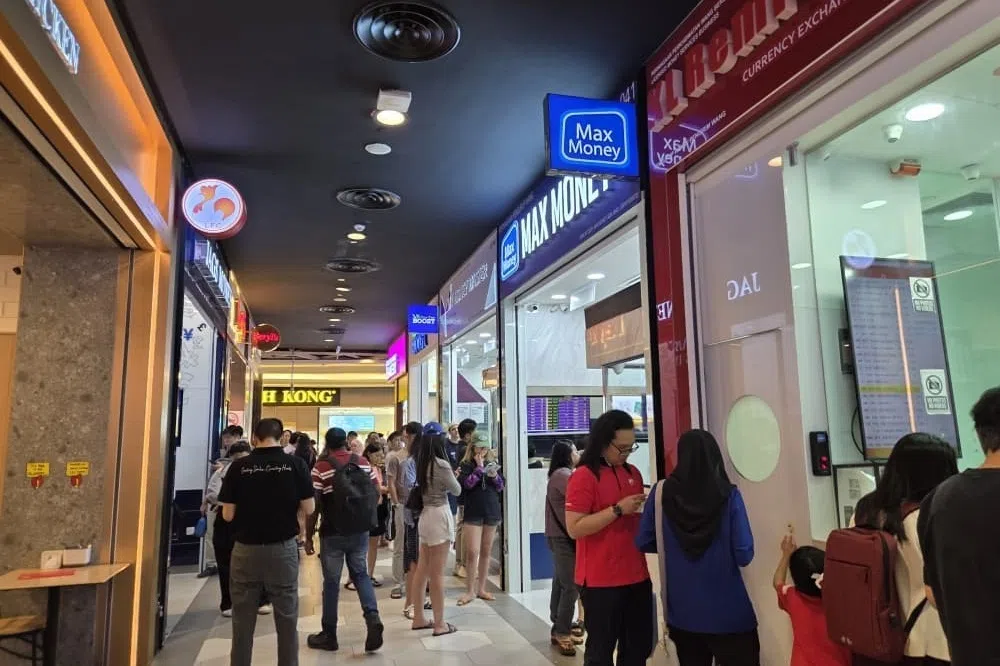
While online platforms are capturing future intent, money changers offer a snapshot of near-term behaviour.
Malaysian Association of Money Services Business president Jajakhan Kader Gani said year-end has always been busy, but this year’s crowds are noticeably larger and more confident.
Money changers in busy hubs such as Mid Valley Megamall saw November transactions rise by 10 per cent year on year, often ranging from RM3,000 to RM10,000 per transaction.
“Since September until mid-November, money changers at prime locations saw roughly 500 transactions a day, and the crowds keep increasing as we approach the year-end,” he told BT.
He said the jump happened after Prime Minister Anwar Ibrahim noted in Parliament that the ringgit was trading at RM4.16 against the US dollar on Nov 11, making it Asia’s best-performing currency at that point.
“The strengthening ringgit is definitely fuelling demand. Consumers are exchanging currency ahead for next year, hoping to lock in a better rate,” he added.

Japanese yen, Indonesian rupiah and Vietnamese dong are the top three currencies exchanged, followed by Thai baht, Chinese yuan, and South Korean won, – underscoring Malaysians’ continued preference for Asian destinations such as Tokyo, Osaka, Bali and Seoul, said Jajakhan.
Across Malaysia, over 250 licensed money service providers offer wide access to currency services via 3,000 exchange points.
Regional behaviour, however, varies. In Johor Bahru, Jajakhan noted no major spike in currency exchange because many travellers change money in Singapore.
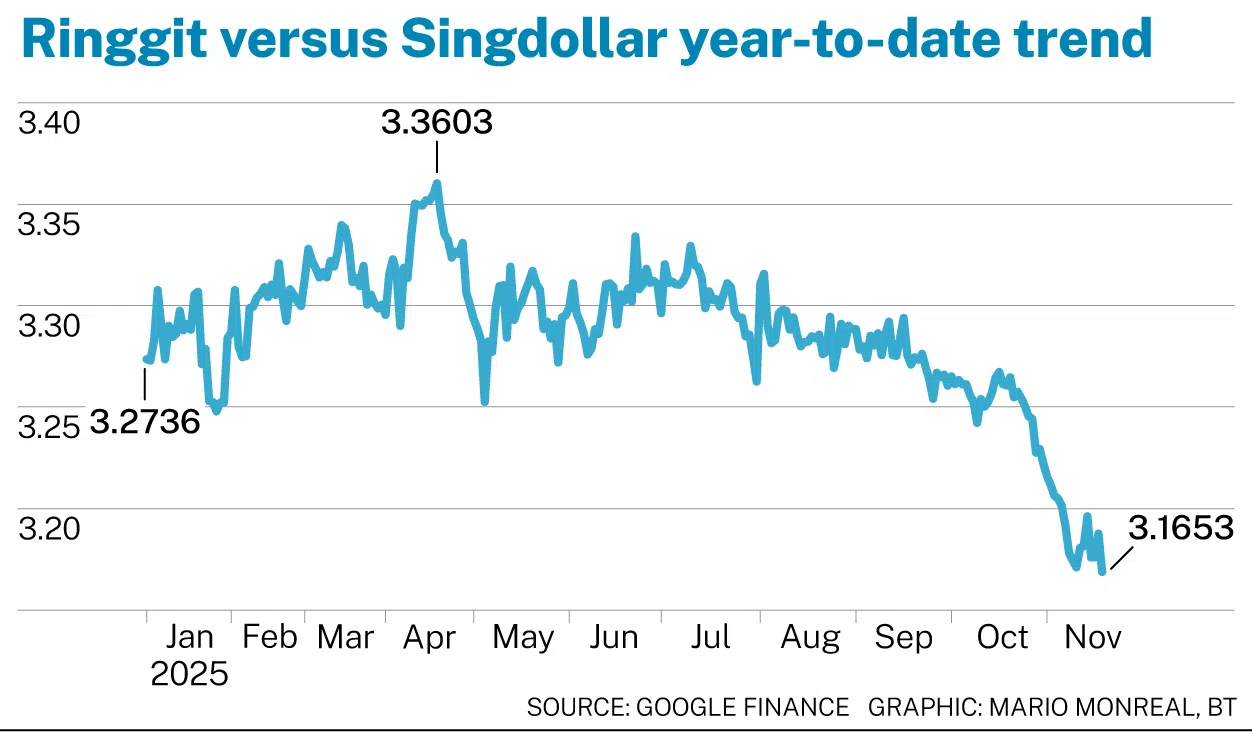
The ringgit strengthened from 3.3603 on Apr 17 to 3.1653 at midday on Nov 24, against the Singapore dollar. However, the less-than-6 per cent gain is not big enough to shift behaviour dramatically.
Notably, behaviour today contrasts with April, when the ringgit weakened to 4.4966 against the US dollar. Then, Malaysians exchanged money cautiously and minimally. “Now, the current crowd is at least 30 per cent higher than in the second quarter,” he said.
Banks’ projection
Banks are generally upbeat about the ringgit’s trajectory. Hong Leong Bank expects the currency to strengthen to 4.05 per US dollar by mid-2026.
Maybank Investment Bank said the ringgit’s recent outperformance pushed the SGD/MYR to a low of 3.1642, and if the rate stays below 3.20, further strengthening is possible.
Maybank said that the trend reflects optimism about Malaysia’s economy, not weakness in the Singapore dollar.