

Issue 198: UBS cuts Asia ESG staff; S-E Asian renewables assets face high climate risk
This week in ESG: Swiss bank sheds four of seven Asia sustainability team staff; Zurich Insurance finds 75 per cent of assets at high risk of severe climate impact by 2030

Green economy
Green jobs outlook depends on where you stand
South-east Asia’s green-jobs market could face an uneven landscape marked by tension between supportive policy and near-term economic realities.
The latest negative headline comes courtesy of UBS, which has cut its seven-person Asia sustainability team to a headcount of three, Bloomberg reports. The move is part of a global reduction in the environmental, social and governance (ESG) functions at UBS following its acquisition of Credit Suisse, with the chief sustainability office now staffed with only about 35 employees from more than 100 in mid-2023.
However, the UBS cuts may not reflect wider demand for green employees, particularly in Singapore. Hiring analysis platform foundit Insights Tracker (fIT) tells ESG Insights that Singapore’s green hiring market remains robust, with January-to-May green job postings in 2026 up 12 per cent against the same period in 2025. For the full 2026, fIT expects Singapore green job postings to improve 18 per cent from 2025.
The different directions of those developments reflect a heterogeneous market for green jobs, with demand that can vary substantially depending on market and industry.
Financial pullback
UBS is not the only bank trimming its ESG functions. ABN Amro and Standard Chartered have also made headlines for cutting ESG headcounts. Furthermore, banks that include Barclays, HSBC and Wells Fargo have downgraded top sustainability positions, typically also a sign of lower hiring interest for functions that would have been overseen by those positions.
These pullbacks are part of the financial sector’s broader retreat from sustainability amid pressure by US conservatives. An exodus led by major Wall Street banks has effectively halted global initiatives by the financial sector on decarbonisation, most notably the neutering of the Net Zero Banking Alliance.
But while the sector’s demand for green staff may look weak on a global level, the picture is more complex at local scales.
Singapore growth
Singapore’s green jobs market is “firmly on an expansion trajectory”, fIT says.
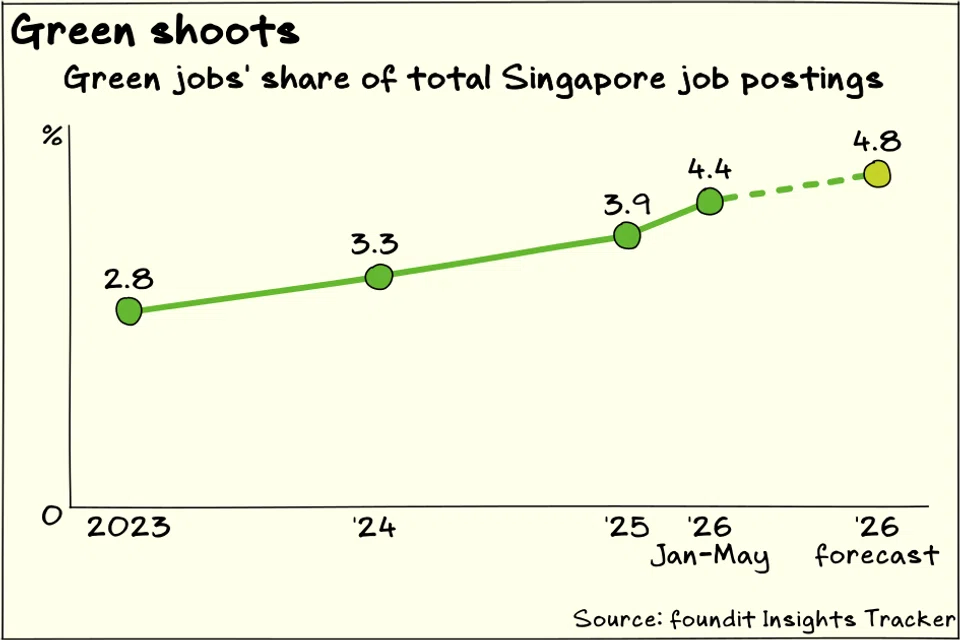
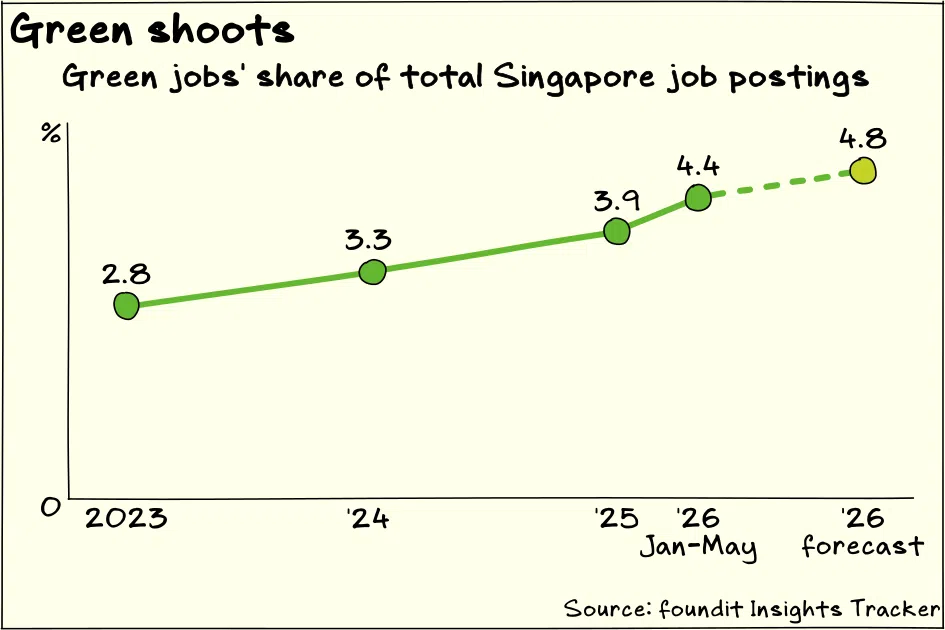
Green job postings rose 19 per cent in 2023, then hit a peak growth of 24 per cent in 2024 as sustainability reporting requirements and Singapore’s Green Plan 2030 milestones catalysed hiring, the firm says. Growth moderated to 15 per cent in 2025, and is likely to reach 18 per cent in 2026 based on pipeline analysis and hiring intent signals that fIT tracks.
Green job postings in Singapore are even growing relative to the rest of the market. In the year-to-May 2026, green jobs accounted for 4.4 per cent of all job postings, compared to 2.8 per cent in 2023.
What’s notable is that the largest share of green jobs in Singapore are not from the banking, financial services, insurance or sustainable finance sectors. Energy and utilities have been the biggest contributor of demand since at least 2023, accounting for 15 per cent of green postings in the first five months of 2026. Next is research and technology, followed by engineering and infrastructure.
It’s clear that Singapore’s green economy extends beyond the financial sector, which is an important buffer against industry-specific volatility.
Policy matters
Policy choices help to drive the depth of Singapore’s green economy.
The top green skills in demand in Singapore are carbon accounting, ESG reporting, sustainable finance, climate risk assessment, green building and urban planning, renewable energy systems, energy auditing and sustainable supply chain management. Climate data analytics and carbon markets and trading are the fastest emerging specialisations, fIT says.
Many of these skills are related to key thrusts in Singapore’s decarbonisation strategy, such as green buildings and urban planning, and sustainable finance. A good portion are also beneficiaries of regulatory or policy pressure, particularly those that have to do with ESG-related reporting as Singapore has set timelines for large companies to align with international reporting standards.
The policy signal in Singapore and South-east Asia has been relatively resilient in the wake of the war in the Middle East, with decarbonisation seen by the region’s policymakers as an important strategy to improve energy security. Green jobs have been part of those plans since the beginning.
One initiative comes from the Asean TVET Council, which seeks to coordinate and develop Technical and Vocational Education and Training among member states of the Association of Southeast Asian Nations, including for the green economy. Such collaborations are important, because they help to build supply. Having enough of the right green workers allows green employers to continue growing the market. WIthout sufficient supply, demand for green employees could fizzle out or shift elsewhere.
Short-term pressure
Yet governments’ climate strategies and ambitions have to reckon with the real world. The current business climate is fraught with uncertainty and volatility, which can slow down business activity.
For instance, South-east Asian sustainable finance issuance slowed in 2025 and underperformed the rest of the world, LSEG data shows.
For some businesses – such as those in renewable energy – the current environment can be supportive of growth, which would also benefit green hiring. But for the substantial numbers of businesses for which current conditions are challenging, sustainability investments and hiring may be put on the backburner.
Alignment between the business climate and policy tends to support green hiring across the board. But in times of misalignment, the outlook for green hiring becomes more opaque and unpredictable. Which force prevails – green policies or economic turmoil – is highly dependent on circumstances.
However, times like these are when stable policy matters even more. An unwavering policy signal for the green economy helps to limit the downside when conditions are not so favourable. Just as importantly, when conditions turn positive, that underlying policy support allows green hiring to recover more quickly.
Sustainable finance
Putting renewable assets on a sound footing
One of the looming issues in the energy transition is post-construction risk of renewable energy assets.
For example, end-of-life treatment is a common – and well-discussed – issue. There are big, unanswered questions about how to deal with the onslaught of used photovoltaic panels, wind turbine blades and batteries in the coming decades, especially given the rapid build rate we have seen in the past few years.
Add sub-optimal climate protection to those risks. A study by Zurich Insurance finds that about 75 per cent of renewable energy generation sites in South-east Asia are at high risk of severe impact from climate-related events by 2030. A high-risk rating reflects an at least 20 per cent chance of experiencing a major climate event by 2030. The analysis assesses 1,380 solar, onshore wind, hydropower and geothermal projects in the region, including those that have been planned or are under construction.
Zurich Insurance estimates US$165 billion of value at risk, but reckons that an upfront investment of just US$13 billion could help to avoid US$82 billion in losses.
The insurer recommends improving site selection as a relatively straightforward way to mitigate the risk. Developers should incorporate forward-looking models about climate risk into assessing the suitability of a site instead of using historical data, Zurich Insurance says.
As with many aspects of climate action, the challenge is to ensure that incentives are aligned with long-term outcomes, since the realisation of climate risk could only occur many years in the future, after current decision makers have already made their profits or are no longer liable. In the current rush to build out renewable capacity, the short-term priorities of lowering costs and meeting development targets can lead to overlooking those longer-term issues.
Two levers are typically available to nudge decisions towards greater resilience. The bluntest instrument is through regulation. In the same way that major projects are often required to carry out environmental impact assessments, development rules can also require assessments of vulnerability to climate damage.
The other lever is market-based, where lenders and insurers incorporate climate exposure into their risk models, so that renewable project developers have an economic incentive to address those risks. Pick a better site, pay a lower premium on insurance.
To enable these levers, more investment needs to go into data and research on these climate risks. The goal is to obtain better risk assessment models and make them more easily available to builders and providers of capital, so that risk pricing becomes more widespread and more accurate.
Other ESG reads
- EV maker VinFast’s revenue jumps on South-east Asian demand, but loss widens
- Singapore brings back 19th-century tech to beat warming climate
- Global offshore wind capacity set to grow to 420 GW by end of 2035, Gwec report says
- Indonesia races to plant rice early against risk of El Nino
- Why South-east Asia must write its own rules on platform work
TRENDING NOW
S$8 billion wiped off OCBC value as shares slide 5.8% in heavy trade

Grab CEO’s wife Chloe Tong on life with Anthony Tan and finding her purpose

Brookfield denies accusation it cut Soilbuild out of Mapletree deal
8 public officers referred to police over property buys near unannounced MRT stations: Chan Chun Sing

