

Issue 204: EGP’s energy transition story; MAS prices 20-year green bond
This week in ESG: Electricity transmission and distribution specialist prices initial public offering; Singapore green bond due 2046 to yield 2.4%

Sustainable investing
EGP Energy’s success outside Singapore remains to be seen
The initial public offering (IPO) of EGP Energy Corp offers investors insulation against climate risk, but it remains to be seen whether the electrical infrastructure solutions and services provider can capture new opportunities in the energy transition.
EGP Energy is looking to raise about S$30.6 million through stock offerings at S$0.51 a share that value the company at about S$115 million. The company is offering 18.8 million shares through the IPO, while cornerstone investors Amova Asset Management, Avanda Investment Management, Ginkgo-AGT Global Growth Fund, Value Partners Hong Kong and Whitefield Capital Management are taking a further 41.2 million shares.
EGP Energy will use the proceeds to expand and improve its product offerings and capabilities, to grow its customer base, to expand into Malaysia and Indonesia, and for general corporate and working capital purposes.
EGP Energy specialises in engineering, procurement and construction management services for transmission and distribution (T&D) projects, especially for extra high voltage and high-voltage transmission work and medium-voltage distribution networks. EGP Energy also carries out maintenance and servicing for T&D assets.
EGP Energy will offer stockmarket investors one of the purest exposures to the Singapore energy infrastructure sector. Practically all of the company’s business is in Singapore, with 80.5 per cent of revenue in 2025 coming from one customer, which is a key Singapore utility. However, EGP Energy has a proven track record in Singapore, where it has obtained the highest contractor qualification for the country’s regulated T&D market.
A report by Frost & Sullivan estimates that EGP Energy has a market-leading 37.5 per cent share of Singapore’s extra high voltage and high-voltage switchgear segment, and a 24.9 per cent share for extra high voltage and high-voltage switchgear and transformer segments.
From a climate risk perspective, EGP Energy offers a defensive profile. A key transition risk of climate change is that policies and consumer behaviour could shift towards lower-carbon options. This should raise demand for improved grid infrastructure, which would be positive for EGP Energy.
Furthermore, EGP Energy’s primary market is Singapore, where electricity demand is estimated to grow between 2.8 and 4.7 per cent annually from 2025 to 2030. EGP Energy also says that Singapore’s grid infrastructure is approaching the end of its design life, which will lead to investments in asset renewal.
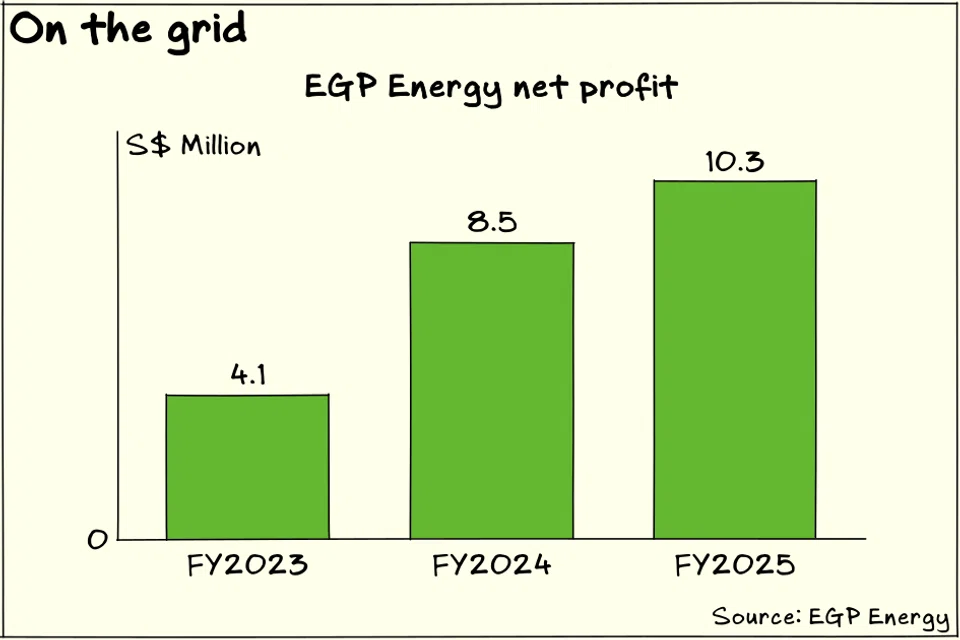
From a shareholder returns perspective, EGP Energy has indicated that it plans to distribute up to 40 per cent of net profit as dividends for 2026 and 2027. The company posted net profit of S$10.3 million in 2025, or about 4.57 Singapore cents per share based on its post-offering share capital. EGP Energy’s order book stands at S$282.1 million for completion through 2031.
While EGP Energy’s strength in Singapore provides a firm foundation and outlook for the company, it’s the potential for expansion into Malaysia and Indonesia where more exciting growth may lie. Frost & Sullivan notes that Indonesia’s official 10-year electricity supply business plan foresees that the national utility will spend about 191.1 trillion rupiah (S$13.8 billion) in transmission and substation networks between 2025 and 2029, increasing to 201 trillion rupiah from 2030 to 2034.
Malaysia’s Tenaga Nasional Berhad has RM42.8 billion (S$13.5 billion) of capital expenditure planned for the 2025 to 2027 period. Both Indonesia and Malaysia also have ambitious renewables and data centre development plans.
But capturing that potential growth is more uncertain for EGP Energy. The T&D market is dominated by government-run utilities in these countries, and barriers of entry can be high for aspiring contractors, especially foreign companies. Going it alone could slow the pace of growth for EGP Energy in these markets, while teaming up with partners could dilute its margins.
EGP Energy will also have to be more strategic about its exposure to fossil fuel-related assets in Malaysia and Indonesia. Pursuing T&D projects related to renewables projects, energy storage or fossil fuel assets with credible transition plans could allow the company to tap sustainability-focused capital sources. On the other hand, contracts tied to high-carbon electricity generation, especially longer-term maintenance contracts, could expose the company to stranded assets or close off sustainable finance avenues.
Unfortunately, EGP Energy’s IPO prospectus does not include substantial discussions about the sustainability of the business or its sustainable strategies. If EGP Energy is to pursue the green grass of energy transition in Malaysia and Indonesia, addressing those issues could assure shareholders about its ability to realise those ambitions.
Sustainable finance
Long end of Singapore’s sovereign yield curve turning green
The longest end of Singapore’s sovereign debt market is turning green, which reflects both the country’s commitment to its environmental goals as well as a financing strategy that lowers long-term borrowing costs.
Singapore has priced a S$2.6 billion offering of new 2.375 per cent 20-year sovereign green bonds via syndication to yield 2.4 per cent. The offering drew a S$4.6 billion order book, and the deal amount came at the high end of the indicated range between S$2.1 billion and S$2.6 billion.
The yield priced about 15 basis points tighter than initial price guidance of 2.55 per cent, but about six basis points wider than the prevailing 2.34 per cent yield at which the existing 20-year Singapore Government Securities (SGS) were trading.
DBS, Deutsche Bank, HSBC, OCBC and Standard Chartered ran the books.
With the new deal, the 20-years-and-longer portion of Singapore’s sovereign debt yield curve will now comprise three green bond series and three non-green series. The three green bonds – the new series, the 3.25 per cent bonds due 2054 and the 3 per cent bonds due 2072 – will have S$16.1 billion outstanding, based on statistics maintained by the Monetary Authority of Singapore.
The non-green 2.75 per cent bonds due 2046, 1.875 per cent bonds due 2050 and 1.875 per cent bonds due 2051 have a combined outstanding amount of S$23.7 billion.
All of the green bonds have been issued in the past four years.
The greening long end of the market is a consequence of Singapore undertaking green-eligible projects that will be built, run and repaid over many years, including new train lines for which the debt proceeds will be used. The long-term nature of the projects are the reason that the longest tenures are green bonds.
Making use of green labelling to raise the financing also allows Singapore to widen the pool of available capital to investors with sustainability mandates. This helps to raise demand for the bonds, thereby lowering the borrowing cost for Singapore and mitigating the price tag for greening Singapore’s infrastructure.
The signal to the market is commitment to a credible long-term sustainability strategy.
Other ESG reads
- Temasek eyes AI breakthroughs to slash energy demands
- Energising MTI: New name, two co-ministers show priority of Singapore’s clean power push
- Coal dominance, fiscal constraints to temper South-east Asia’s clean energy boom
- Malaysia data centre boom enters ‘reset mode’ as resource, funding realities bite: S&P
- Pension funds try to come to grips with the scariest global warming scenario
TRENDING NOW

DBS, OCBC, UOB rout lops billions off STI as inflation, rate concerns spook investors

Grab CEO’s wife Chloe Tong on life with Anthony Tan and finding her purpose
OCBC sheds S$8 billion in value as shares close nearly 6% down; analysts cautious on banks

Deal between tycoon friends sparks scrutiny of Philippine power sector

