

Energising MTI: New name, two co-ministers show priority of Singapore’s clean power push
The latest Cabinet reshuffle also indicates PM Lawrence Wong’s willingness to test first-term officeholders

[SINGAPORE] When a ministry has a triple-barrelled name, the impression might be one of bringing together loosely-related fields – as with the Ministry of Culture, Community and Youth, perhaps, or its predecessor, the Ministry of Community Development, Youth and Sports.
In the renaming of the Ministry of Trade and Industry (MTI), however, a different logic is at play.
It is not that energy is being added to MTI’s purview. Energy matters have long come under MTI, as shown for instance by the placement of the Energy Market Authority statutory board.
Rather, in renaming MTI to the Ministry of Energy, Trade and Industry (METI) with effect from Oct 1, the government is signalling the primacy – quite literally – that energy has in Singapore’s economic future.
As Prime Minister Lawrence Wong put it in Wednesday’s (Jul 22) press conference on Cabinet changes: “Energy is becoming increasingly central to Singapore’s economic competitiveness, industrial transformation and long-term resilience.”
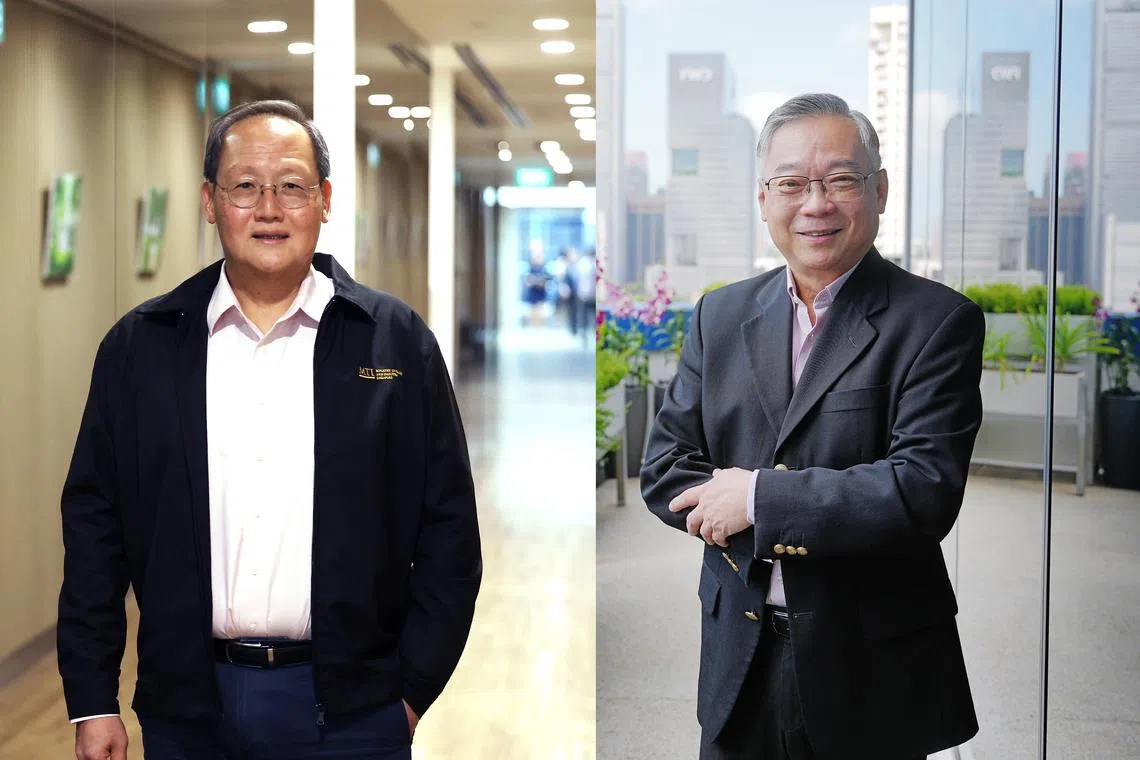
In addition to the renaming, there will now be two Ministers for Trade and Industry, with effect from Jul 27.
As PM Wong stressed, this is not about the ministry gaining a second minister, but about having two co-ministers.
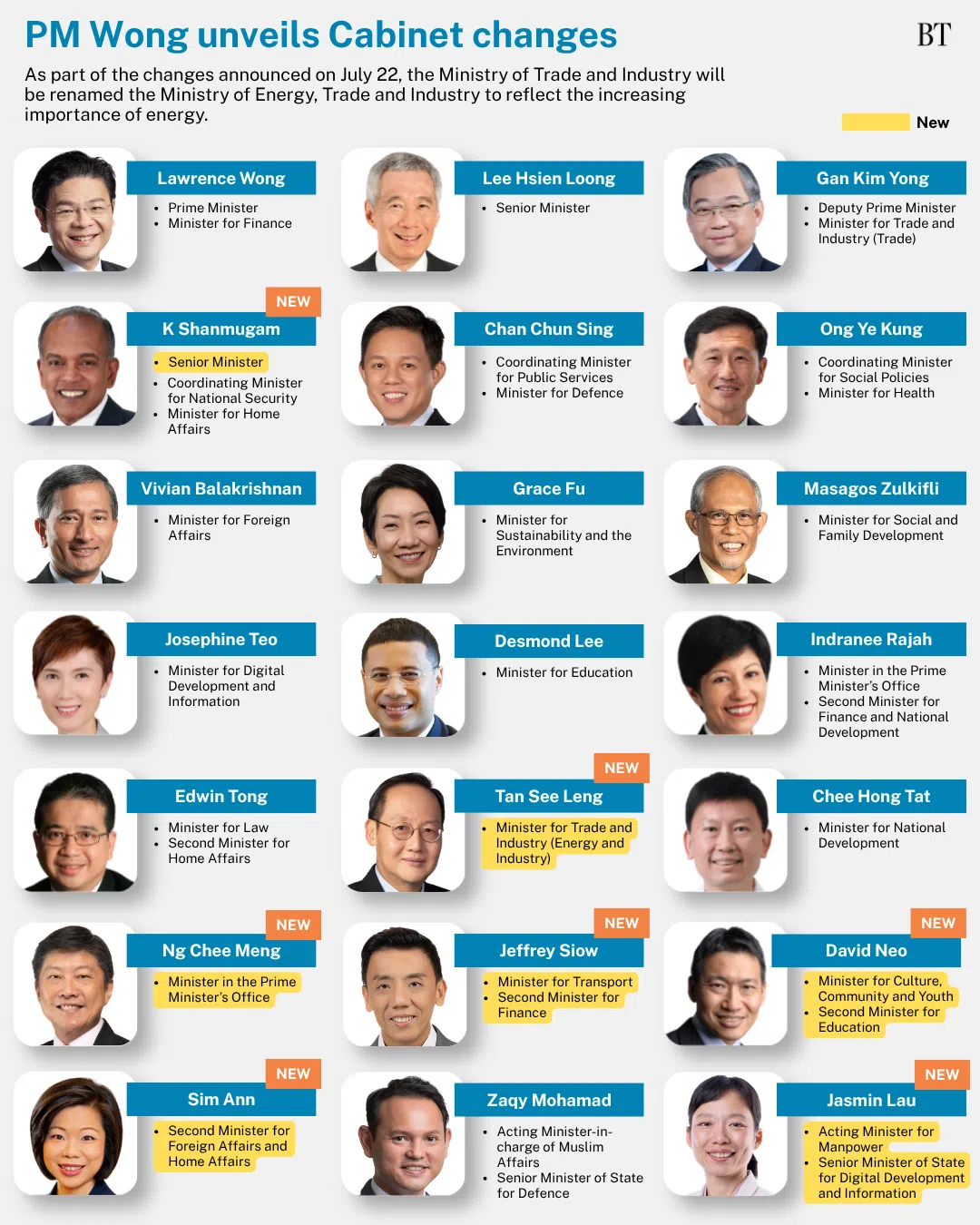
Dr Tan See Leng, who has been Minister-in-charge of Energy and Science and Technology, will become Minister for Trade and Industry (Energy and Industry).
Deputy Prime Minister Gan Kim Yong will become Minister for Trade and Industry (Trade), overseeing trade and Singapore’s “broader economic strategy”, said PM Wong.
Double the leadership
This is not the first time that MTI has had two captains. In a Cabinet reshuffle in September 2015, both MTI and the Ministry of Education were given two ministers each.
“Their scope of work has expanded considerably,” then prime minister Lee Hsien Loong said at the time, explaining the move.
MTI used to focus on attracting foreign investment, but later devoted resources to helping local small and medium-sized enterprises as well as encouraging entrepreneurship and research, Lee said then. The ministry had also become more active in international economic diplomacy and negotiating trade agreements.
Lim Hng Kiang was thus made minister for trade and industry (trade), while S Iswaran was minister for trade and industry (industry). This lasted till 2018, when Chan Chun Sing became the sole minister for trade and industry, and Iswaran was redesignated as minister-in-charge of trade relations.
At the press briefing on Wednesday, PM Wong similarly mentioned an increase in work.
The scope of MTI’s work has grown so large that it is appropriate for two ministers to helm it – not least as the geopolitical environment necessitates much travelling for trade negotiations, he said.
Indeed, it is notable that Grace Fu remains Minister-in-charge of Trade Relations, even as DPM Gan has become Minister for Trade and Industry (Trade).
The significance of Dr Tan’s move from Minister-in-charge to co-minister, meanwhile, can be seen in how he is relinquishing his portfolio as Manpower Minister to “devote his full attention to this portfolio”, as PM Wong put it.
A clear priority
But the addition of “energy” to the ministry’s name is not just about the increased quantity of work. It also signals a fundamental qualitative shift in how Singapore thinks about its economic progress.
The Republic used to talk about “the water challenge”, noted PM Wong. Increasingly, energy – and specifically clean energy, he added – will be “the national challenge for Singapore”.
The great expansion in MTI’s work scope includes feasibility studies on nuclear energy, for instance, he added.
Replying to a question from the media, PM Wong said he would not rule out having a standalone Energy Ministry in the future.
This, he said, will depend on Singapore’s decisions – including those made in the light of the aforementioned feasibility studies. Work requirements may grow significantly based on these, he added.
Setting aside near-term global energy pressures caused by the US and Israel’s war on Iran, what Singapore faces is not just a question of securing energy supplies.
As PM Wong said, the challenge is also one of powering the economy with clean energy specifically, and pursuing both growth and net-zero carbon emissions.
In a separate statement on Wednesday, MTI noted that growth depends on “continued access to stable and competitively priced energy”, and must be balanced against the transition to a low-carbon economy.
The conflict in the Middle East and disruptions to global energy supplies are also reminders that energy security cannot be taken for granted, added MTI.
The renaming of MTI to METI highlights the trade-off between growth and environmental impact, and serves as a constant reminder to keep the energy angle in mind even while encouraging industrial development.
Rising to office
The Cabinet reshuffle also focused on a different aspect of the future: emerging political leaders.
Perhaps one of the most significant promotions was that of Jasmin Lau. Now a Minister of State for Education as well as Digital Development and Information, she is being promoted to Senior Minister of State in the latter portfolio – and is also becoming Acting Minister for Manpower.
Given how hefty the Ministry of Manpower is, this may seem a dramatic leap for someone who entered politics only at last year’s general election.
Still, it is worth bearing in mind that several first-time MPs have gone straight into acting minister roles upon election – including Lau’s contemporaries Jeffrey Siow and David Neo, who have both been confirmed as full ministers in the latest reshuffle.
The choice of Lau, rather than a more established politician, as the Acting Manpower Minister is a signal of PM Wong’s commitment to renewal.
Indeed, at the press conference, PM Wong was flanked mostly by first-term officeholders. The only exception was Senior Minister of State for Defence Zaqy Mohamad, who became the new Acting Minister-in-charge of Muslim Affairs on Monday.
Notably, DPM Gan and Minister for Home Affairs K Shanmugam were not present. This is despite both having changes to their roles, with Shanmugam becoming Senior Minister in addition to his existing portfolios.
There could be no clearer – literally visible – sign of PM Wong’s intention to keep the focus firmly on the younger and newer members of his Cabinet.
TRENDING NOW
LTA proposes combining car COE categories, adding rebate-surcharge system
StarHub to acquire MyRepublic’s mobile business amid ongoing telco consolidation

DBS, OCBC, UOB rout lops billions off STI as inflation, rate concerns spook investors

Grab CEO’s wife Chloe Tong on life with Anthony Tan and finding her purpose

