

Issue 206: GenZero’s strategy in ‘challenging time’
This week in ESG: Climate-focused investment platform reports lower direct impact in 2025

Sustainable investing
GenZero seeks moats to protect double bottom line
Climate action-focused investment platform GenZero has sharpened its focus on economic and policy resilience as it seeks to deliver both impact and returns despite headwinds.
In its latest sustainability report, Temasek-backed GenZero shares investment strategies that include a focus on carbon-credit projects with non-carbon revenues, green technologies that augment energy security, and climate adaptation solutions.
“As regulatory and policy forces behind climate action weaken, demand for climate solutions will increasingly have to be market-led,” GenZero head of investments Kimberly Tan says in the report. “We remain focused on commercially viable solutions and projects that can compound climate impact by generating real returns and scale over the long term.”
Singapore government-owned investor Temasek launched GenZero in 2022 with S$5 billion of capital and mandate to deliver not just long-term sustainable financial returns, but also positive climate impact.
That has not been easy the past couple of years with the geopolitical and economic turmoil that have slowed down the flow of capital to climate investments.
Chief executive Frederick Teo says: “It is a challenging time for investors in climate solutions. Tighter financing conditions, regulatory uncertainties, and macroeconomic headwinds are constraining access to capital. Sustainability-focused funds recorded US$84 billion in net outflows in 2025. The availability of capital to scale climate solutions is under pressure that we have not seen in recent times.”
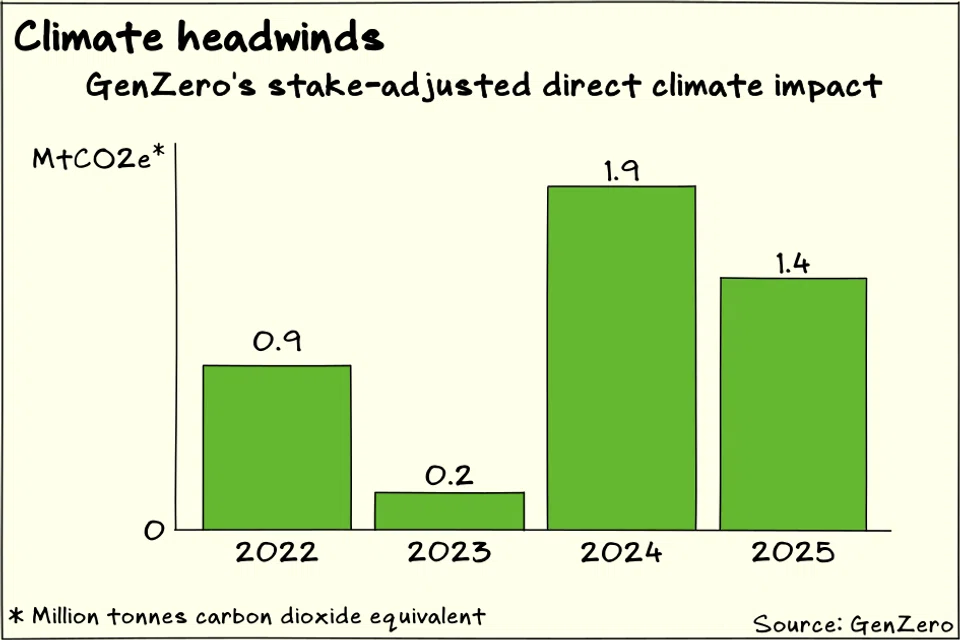
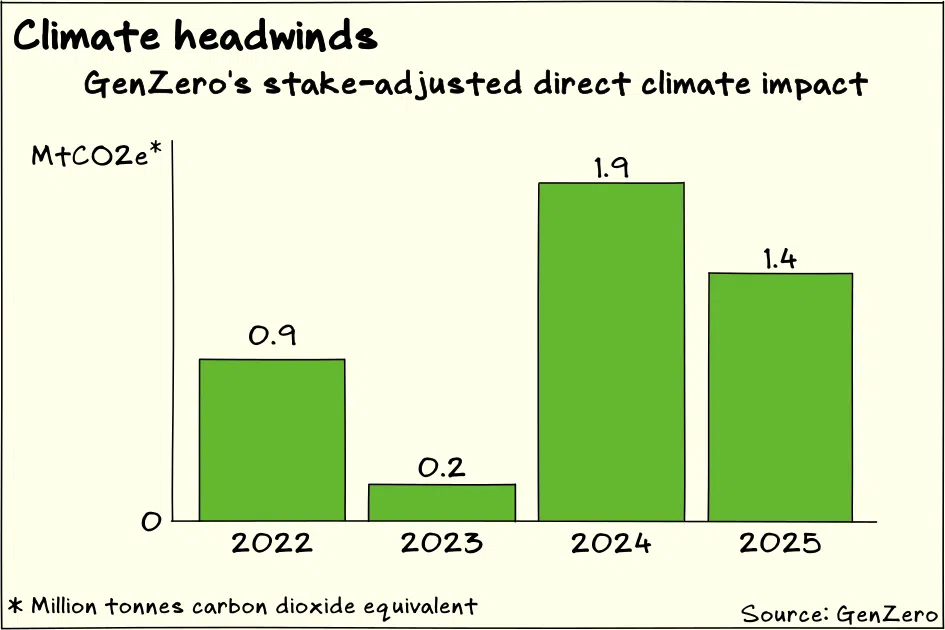
GenZero does not disclose investment returns. However, it measures its climate impact on a number of metrics, including carbon emissions removed or reduced by investee companies. Direct climate impact, adjusted to reflect GenZero’s stake in each company, declined to 1.4 million tonnes of carbon dioxide equivalent (MtCO2e) in 2025 from 1.9 MtCO2e in 2024. GenZero attributes the decline to “broad carbon market headwinds, baseline methodology transitions, and delays in carbon credit issuances”.
Cumulative stake-adjusted direct impact from 2022 to 2025 now stands at 4.4 MtCO2e. GenZero says it is “on track” to meet its target of 7 MtCO2e of direct impact by 31 Mar, 2028 as its portfolio matures and new projects come online.
Tan describes the firm’s investment stance as “principled pragmatism”. This reflects the view that climate ambition and economic value are increasingly “intertwined”.
This means that Investment underwriting must be “policy-resilient and commercially robust”, she explains. Decarbonisation solutions that also address energy security will be in demand. Furthermore, adaptation solutions will become increasingly relevant due to the persistent investment gap in climate mitigation.
One of GenZero’s key investment pillars is in nature-based solutions, where carbon markets remain a soft spot. Weakness in carbon markets played a significant role in the lower year-on-year direct impact reported by GenZero, with nature-based solutions accounting for 62 per cent of total stake-adjusted direct impact in 2025.
GenZero policy and analytics director Anshari Rahman sees a gap between demand and supply in carbon markets.
On the demand side, carbon pricing mechanisms – including emissions trading systems and carbon taxes – now cover about 28 per cent of global emissions and generate more than US$100 billion in annual revenues.
However, on the supply side regulatory ambiguity hinders project developers and investors. For example, carbon credit supply that meet Carbon Offsetting and Reduction Scheme for International Aviation (Corsia) requirements are about 30 per cent short of what is needed, Rahman says, citing industry analyses.
“Unclear authorisation processes, slow issuance of letters of authorisation, and inconsistent national implementation frameworks raise the cost and risk of developing high-integrity supply,” Rahman says.
“The consequences are real: when regulatory certainty fails to materialise, projects stall, capital retreats, and compliance markets face supply gaps precisely when they need depth.”
GenZero says its strategy is to focus on nature-based projects with non-carbon revenues, such as sustainable forestry. For projects with a material economic dependence on carbon credits, GenZero seeks either credible demand signals such as secured offtake agreements, or multiple-market eligibility. The aim is to insulate the investments from “the dual risks of uncertain corporate demand and host country non-compliance”.
In technology-based solutions, another major pillar for GenZero, the firm is looking at solutions such as biomethane and geothermal that benefit from heightened interest in energy security following the Iran War. GenZero is also prioritising scalable and cost-effective solutions in hard-to-abate sectors, such as green supplementary cementitious materials.
“With corporates more hesitant in the current risk-off environment, drop-in solutions that slot into existing workflows, equipment, or infrastructure are best placed for adoption and growth,” GenZero says.
To deliver on its double bottom line in these turbulent times for climate investing, GenZero appears to have adopted a strategy that seeks out impactful investments protected by economic moats.
Says Teo: “We continue to prioritise investments with clear pathways to scale, applying disciplined and transparent measurement, and focusing on commercially viable models that deliver both climate outcomes and returns.”
Other ESG reads
- Keppel Infrastructure Trust acquires 45% stake in second German solar portfolio from Enpal for US$39.2 million
- Too little, too late? Manila’s billion-dollar bid to ignite its sputtering EV industry
- For a competitive circular economy, Singapore should measure what matters
- Shell sells European onshore renewables to TotalEnergies
TRENDING NOW
S$8 billion wiped off OCBC value as shares slide 5.8% in heavy trade

Grab CEO’s wife Chloe Tong on life with Anthony Tan and finding her purpose
Brookfield denies accusation it cut Soilbuild out of Mapletree deal
8 public officers referred to police over property buys near unannounced MRT stations: Chan Chun Sing

