Beyond beaches or Bali: Singapore’s push for urban wellness tourism
A billion-dollar thermal bath facility is part of the city-state’s bid to grab a slice of the fast-growing pie


[SINGAPORE] When Therme Group won the tender for a wellness attraction in Marina South last November, some wondered how the Austrian company’s thermal baths and saunas would fit in a tropical city.
Wellness tourism in South-east Asia is more likely to be associated with Bali’s jungle retreats, Phuket’s beachside spas and Chiang Mai’s meditation escapes, rather than a S$1 billion complex minutes from Singapore’s bustling financial district.
But the city-state is not competing directly with traditional nature retreats. Rather, it aims to become an urban wellness destination, with premium experiences integrated into business travel.
“Singapore faces structural constraints including land scarcity as well as high labour and operating costs,” says Joshua Loh, course chair of Ngee Ann Polytechnic’s diploma in tourism and resort management.
“Our physical density and tropical climate also pose challenges to the development of traditional wellness products and programmes.”
What the city offers, however, is “convenience, quality assurance and accessibility”, which could attract “time-constrained affluent travellers seeking premium wellness experiences”, he adds.
Complementing the region
Christopher Khoo, managing director of tourism consultancy MasterConsult Services, agrees that Singapore does not compete on the same basis with regional destinations.
“Destinations like Bali, Phuket, Koh Samui and Chiang Mai offer things we don’t: nature, space, lower cost, a spiritual or retreat atmosphere,” he says.
“But Singapore has a differentiated value proposition. We should start with urban wellness. We shouldn’t hide away from what we are: a clean, safe, hyper-efficient city.”
Khoo likens Singapore’s wellness tourism ambitions to its early push into cruise tourism.
In the 1980s, the cruise industry was nascent in the region and needed strong state backing to take off, he recalls. “It was a struggle. We built the hardware, worked with regional partners and convinced them – everything that comes with trying to grow a new industry.”
Today, Singapore is South-east Asia’s leading cruise hub, accounting for almost half of the region’s 3.9 million cruise passenger visits in 2024.
“This (wellness tourism push) reminds me a lot of that time,” says Khoo. “We identified a big market where some of our neighbours are very strong… and asked how Singapore could play a role and benefit alongside them.”
The city-state can position itself as an urban wellness gateway to the region, he suggests, where travellers can undergo preventive screening before heading to resorts elsewhere.
“We used to be a stopover: Europeans stopped in Singapore on the Kangaroo Route to Australia. But we’ve given them so many other reasons to come. I think wellness is going to become yet another reason.”
Wellness for business
In 2022, the Singapore Tourism Board (STB) announced a plan to develop Singapore as an urban wellness haven, to capitalise on that booming sector.
The global wellness tourism market is projected to expand at a compound annual growth rate of 9.1 per cent, to reach US$1.38 trillion by 2029, according to the 2025 Global Wellness Economy Monitor report.
For Singapore, the business case for wellness tourism may lie not only in attracting new visitors, but also in persuading existing travellers to stay longer and spend more.
Associate Professor Sin Harng Luh, provost’s chair at the Singapore University of Social Sciences (SUSS), notes that the average stay in Singapore has traditionally hovered around two-and-a-half to three days.
“The biggest potential in Singapore is not top-line visitor numbers, but rather extending the length of stay,” she adds.
“Instead of staying two nights in Chinatown, you may stay two nights there and another two nights at a wellness resort hotel.”
As a hub for meetings, incentives, conferences and exhibitions (Mice), Singapore sees a ready pipeline of business travellers for wellness offerings. “Bleisure” tourism, which mixes business and leisure, is also on the rise.
In 2025, Singapore saw a record S$32.8 billion in tourism receipts from 16.9 million visitors. Mice tourism receipts alone rose more than 35 per cent year on year to S$2.3 billion, from S$1.7 billion previously.
About one-third of Singapore’s visitors are business or Mice travellers, notes MasterConsult’s Khoo. “Give them a good reason to extend their stay by two to three days; it’s going to make a lot of difference. They are high-spending people.”
Ngee Ann Polytechnic’s Loh says that business and bleisure visitors may be attracted to premium offerings such as longevity clinics, medical wellness centres and high-end urban spas, alongside executive wellness retreats and team wellness experiences.
Khoo points out that Singapore’s existing strengths in preventive health, medical tourism and Mice tourism mean that it is not entering the wellness space from scratch.
He notes that wellness tourism also fits Singapore’s broader push towards “high-yield” tourism rather than mass-market arrivals.
Wellness travellers tend to spend more per trip than the average traveller, says Ashlynn Loo, STB’s director of land and concept development.
Citing the 2025 Global Wellness Economy Monitor report, she notes that globally, wellness accounted for 8 per cent of all tourism trips but represented almost 18 per cent of tourism expenditure in 2024.
Hotels ride the wave
Hotels in Singapore are increasingly incorporating wellness into their offerings, says Guy Llewellyn, academic director and assistant professor at hospitality management school EHL Singapore.
“Wellness tourism is about reducing stress and prioritising your own personal well-being,” he says. “Singapore is really turning to this as the next evolution of offerings, and it’s going to be a very big area for hotels and resorts.”
Some hotels have dedicated wellness floors or spaces, and offer specialised amenities, wellness-focused dining and “sleep-oriented experiences”.
“A lot more hotels are putting in special rooms designed to help guests sleep – warm baths, candles, nice teas, serving food earlier to aid digestion,” says Prof Llewellyn.
After a seven-figure upgrade of its fitness, spa and relaxation facilities, Pan Pacific Hotels Group (PPHG) reopened the St Gregory wellness floor at Parkroyal on Beach Road last November.

The floor was redesigned as a “modern urban retreat”, with resort-style elements around the hotel’s outdoor pool. It offers spa therapies and sound baths, as well as traditional Chinese and Indonesian therapies.
There is also a gym equipped for strength training, cardio and reformer pilates, alongside a diagnostic body composition machine that provides guests with insights into their health.
Wee Wei Ling, who has overseen the St Gregory brand since its 1997 inception, says she has “witnessed first-hand how wellness has evolved from a luxury to a key part of self-care”.
Across PPHG’s properties, take-up rates vary but gyms, pools and spa facilities are generally well utilised, says Wee, who is the executive director of sustainability partnerships, lifestyle and asset at PPHG.
The newer wellness offerings at Parkroyal on Beach Road are popular not only with hotel guests, but also with locals, who can buy fitness or wellness memberships.
Meanwhile, Grand Hyatt Singapore refreshed its wellness offerings in November 2024 as part of a multi-phase renovation that ended last August.
A badminton court was redeveloped into a wellness space offering daily classes such as yoga and pilates, complemented by spa therapies incorporating infrared and vibroacoustic technologies.
The hotel upgraded its main gym with various fitness stations and a Hyrox training zone, while two tennis courts were replaced by a semi-Olympic swimming pool.
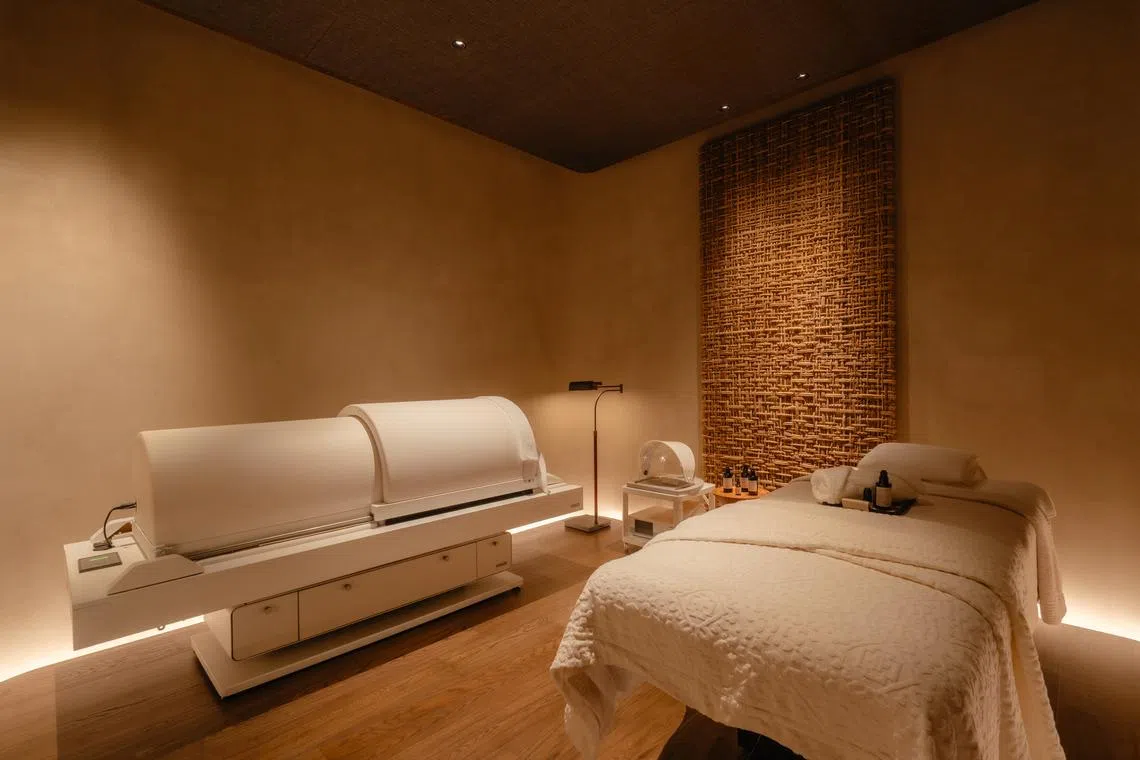
The wellness revamp was part of Grand Hyatt Singapore’s broader renovation, during which it reassessed how guests were engaging with its spaces and amenities.
“We were looking to understand what our guests want overall, and part of that is definitely an increasing awareness and desire to engage with their own well-being,” says hotel manager Timothy Parr. The hotel thus made sure it had “the right facilities to cater for that”.
When planning the renovation, the management was also “quite cognisant” of STB’s broader push to position Singapore as a wellness destination.
“Demand for meaningful, high-quality wellness experiences continues to rise and guests, particularly those choosing Singapore, are willing to pay a premium for them,” says Parr.
“The hotel has observed strong guest appreciation for its wellness facilities and programming, particularly among guests who value fitness and well-being as part of their travel experience.”
Wellness has become a significant part of the hotel’s identity, he adds. It has influenced booking decisions, with some guests staying specifically for its retreats and workshops.

Mega Marina South project
Perhaps Singapore’s boldest wellness bet is being developed by European operator Therme Group, whose Asia arm is led by former national development minister Mah Bow Tan.
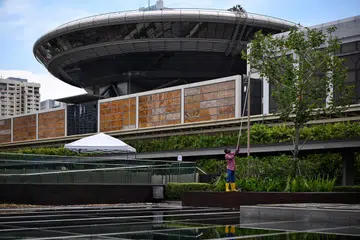
The S$1 billion wellness attraction in Marina South is slated to open in 2030.
With a gross floor area of over 720,000 square feet, the seven-storey development will have more than 20 pools and water attractions. There will also be over 70 treatment rooms – comprising saunas, steam rooms and massage rooms – and 18 waterslides.

Therme is exploring ways to incorporate South-east Asian and local wellness elements into the facility’s offerings, such as traditional Chinese medicine concepts and regional massage therapies.
The facility is aimed at providing a place to relax – in hot and humid Singapore, this means going indoors, says Tan Boon Khai, chief executive officer of Therme Singapore.
“At the end of the day, it’s meant to immerse you in a place and take you away from the stress of Singapore,” he explains.
The experience is not just about enjoying baths or massages, but having a day out with friends and family, including meals and entertainment, he adds.
Therme expects the attraction to draw around two million visitors annually at full capacity, with nearly half from overseas.
Tan notes that this target is relatively conservative given Singapore’s overall tourism arrivals.
“Our projection is about one million international visitors, so we are doing less than 10 per cent – in fact, about 5 per cent – of total arrivals in Singapore. I would say it is a fairly prudent projection.”
STB expects the project to generate economic benefits through increased arrivals; longer stays; higher per-capita spending; and employment opportunities across various roles and skill levels.
Loo adds that there will also be “spillover effects to other attractions, as well as food and beverage and retail establishments, particularly within the Marina Bay area, and across Singapore”.
Therme plans to work with Mice operators to integrate the attraction into existing tourism and business travel itineraries. It will also partner hotels to offer their guests a chance to visit the facility.
“It’s like F1,” says Tan. “People don’t come just for the race. They have meetings, parties, festivals and other activities. F1 becomes the focal point, but there are events built around the experience.
“Therme could be the same: You attend your meetings and conferences, then come here to relax and socialise.”
Competition and cooperation
Singapore’s infrastructure, connectivity and regulatory framework make it difficult for Therme’s project to be replicated elsewhere in the region, Tan points out.
“Where else can you find something of this scale, in a downtown location, with this level of investment and certainty? It’s not easy to build a development of this sort.”

SUSS’ Prof Sin notes that “as a science-backed, tech-integrated wellness concept”, the Therme facility has very few competitors in the region.
MasterConsult’s Khoo, however, cautions that while Singapore may enjoy an early-mover advantage as an urban wellness hub, barriers to entry are relatively low compared to sectors needing significant infrastructure investments, such as cruise tourism.
“We don’t have a dominant position,” he points out. “Eventually, if the urban wellness market takes off in 10 or 15 years, people don’t need to come to Singapore; they can go directly to Kuala Lumpur or other places.”
What could differentiate Singapore, he argues, is not physical infrastructure but “software”, in the form of tie-ups with medical and wellness practitioners.
Large wellness projects do face execution risks, particularly as consumer demand is still developing, he adds. He points to ventures such as the S$70 million Tang Dynasty City – a theme park in Jurong in the 1990s – which failed to gain traction despite ambitious plans.
“If you go wrong at the start, make a couple of wrong decisions, you might end up with something that doesn’t work,” he says.
Still, Khoo reckons that Singapore’s tourism ecosystem is resilient enough to absorb failed experiments and evolve.
“Singapore has structural disadvantages: no mountains, limited beaches and a very high cost base. These are real difficulties that we have to work through,” he says. “But we should be able to come up with concepts and products that can work and develop into wellness tourism.”
Beyond the Marina South attraction, STB is working with operators to bring in “high-quality wellness facilities” and “anchor mid-to-large-scale wellness events and experiences”.
These include bathhouse concept Nowhere at Dempsey and Future Resonance at New Bahru, which offers light-based and sound-based wellness therapy.
Such facilities are not only meant for tourists. Just as the Therme project expects about half of its customers to be locals, Singapore’s wellness push is likewise partly aimed at a domestic audience.
Therme is positioning the Marina South facility as a social and wellness space for locals too, and developing a publicly accessible coastal park that spans almost four hectares and links the building to Marina Barrage.
Tan says that for local seniors, Therme Singapore could perhaps organise programmes where the elderly can visit the facility for various activities, helping them “benefit from social connection and thermal wellness”.
Singapore’s wellness ambition ultimately extends beyond attracting visitors, says SUSS’ Prof Sin.
“Our version of wellness tourism is very much that wellness can coexist in a very urban, high-density, high-intensity environment. And to succeed, it means our whole country needs to change,” she says.
“It’s not just about building one or two resorts. It is about shaping the whole of society. If this wellness initiative succeeds, it is the locals that benefit the most.”