

Reits that don’t trade well should be privatised, or sell assets and be liquidated
After selling One Raffles Place, OUE Reit should be taken private or divest the rest of its properties

[SINGAPORE] As investor interest in local equities rises, boards of listed entities need to be proactive in optimising value for investors.
Kudos to the board of directors of OUE Real Estate Investment Trust ’s (OUE Reit) manager for working together with UOB to determine market interest in One Raffles Place.
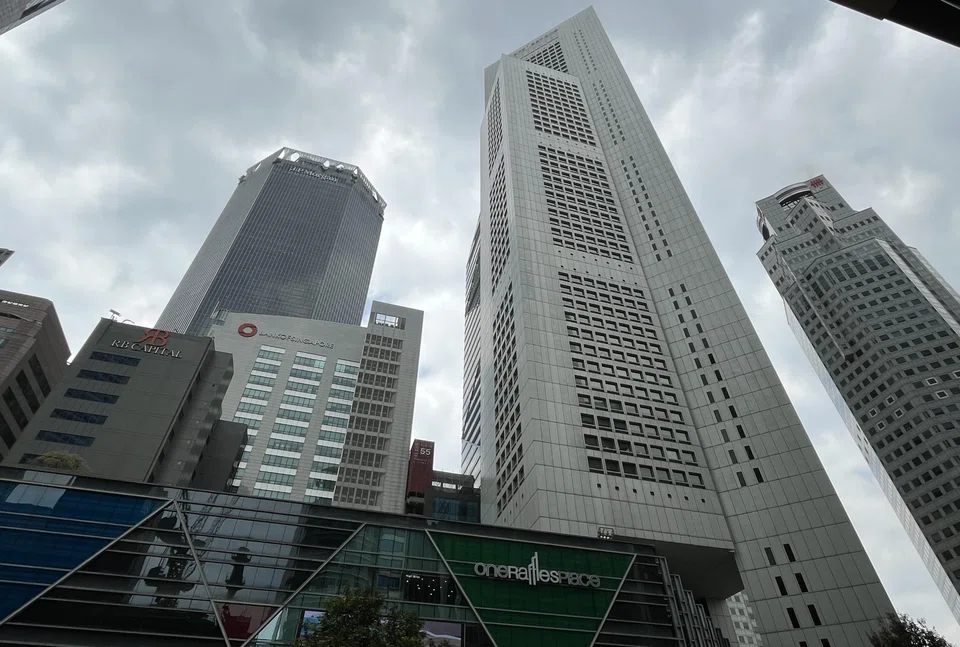
On Feb 19, my colleague Kalpana Rashiwala reported that all the owners of One Raffles Place, which has a direct underground link to the Raffles Place MRT station, are understood to have appointed marketing agents to sell the property.
The indicative asking price for One Raffles Place, which has two office towers – of 62 storeys and 38 storeys – and a six-level retail podium, is reportedly around S$2.3 billion to S$2.4 billion.
OUE Reit holds an 83.3 per cent indirect interest in OUB Centre Ltd, which has an 81.5 per cent interest in One Raffles Place. UOB holds the remaining 18.5 per cent stake in the property. OUB Centre’s stake in One Raffles Place was valued at about S$1.9 billion or S$2,745 per square foot as at end-2025.
One Raffles Place is a key revenue contributor for OUE Reit, whose effective interest in the property is around 68 per cent.
Based on the fourth-quarter revenue for 2025 and OUE Reit’s proportionate interest in its various properties, this Central Business District (CBD) property contributed to 25 per cent of the trust’s portfolio revenue.
Effects of selling One Raffles Place
OUE Reit trades substantially below its net asset value per unit of S$0.56 as at end-2025.
Should One Raffles Place be sold at or above valuation, OUE Reit will send a clear signal to investors that its discount to book value is unwarranted.
Also, OUE Reit’s unitholders could perhaps enjoy a one-off boost in distribution per unit (DPU), should the trust distribute some of the proceeds from selling One Raffles Place to them.
However, divesting One Raffles Place will shrink OUE Reit’s property portfolio substantially and cause the trust’s DPU on a sustainable basis to plunge.
As it stands, OUE Reit, which had total assets of S$5.6 billion as at end-2025, lacks scale. In the Reit universe, having ample asset size and trading liquidity can contribute to better unit-price performance. For example, Singapore’s largest listed Reit by market capitalisation, CapitaLand Integrated Commercial Trust , had total assets of S$27.4 billion as at end-2025.
Of course, if OUE Reit sells One Raffles Place, it can recycle sales proceeds to buy other properties. Indeed, trading assets with lower growth potential for those offering more scope to grow income can make sense.
Still, OUE Reit may struggle to replace One Raffles Place with a CBD office asset of similar quality at a price that will substantially boost DPU.
Possibly, the trust can buy non-CBD Singapore office properties that provide superior net property income yield than One Raffles Place.
However, investors may not welcome OUE Reit adding less-prime office assets to its portfolio.
The Reit’s office property portfolio comprises Singapore CBD Grade A office properties. Its other office assets are OUE Bayfront and the office components of OUE Downtown. In its latest results, the trust’s office property portfolio performed well.
OUE Reit’s other properties are the 1,080-room Hilton Singapore Orchard, the 575-room Crowne Plaza Changi Airport and retail asset Mandarin Gallery along Orchard Road.
Perhaps, the trust will buy more assets in Australia. It recently announced its entry into Australia with the proposed purchase of a 19.9 per cent interest in Salesforce Tower, a commercial property located at 180 George Street in Sydney, at an agreed property value of about S$320 million.
While buying properties overseas may be DPU accretive, might investors object to dilution in the trust’s Singapore focus?
Ultimately, getting scale by, say, doubling the property portfolio size through asset acquisitions within a few years will be challenging for OUE Reit.
Could OUE Reit scale up by merging with a Reit that trades better?
However, pursuing a merger can be tricky. Negotiating suitable terms will be complex and there will invariably be post-merger integration issues.
More critically, a counterparty may not view all of OUE Reit’s property portfolio as being a good fit, and hence may baulk at merging with OUE Reit as such a move risks being badly received by investors.
After all, many investors are wary of Reits, which trade well, merging for scale when the strategic fit is questionable.
Winding up or being privatised
Doubtless, selling One Raffles Place for a good price can benefit OUE Reit’s unitholders.
With softer interest rates and the Singapore CBD Grade A office property market’s strong fundamentals, conditions appear supportive of a successful sale of One Raffles Place.
What can then be optimal subsequently for OUE Reit’s investors is either for the trust to sell the remaining assets, return cash to unitholders and be wound up; or for the trust to be privatised at or above book value.
Perhaps, the trust’s sponsor, property and healthcare group OUE Ltd , can work with partners to privatise OUE Reit. Tycoon Stephen Riady is executive chairman, group chief executive officer and a substantial shareholder of OUE Ltd.
Amid softer interest rates, investor interest in yield plays such as Reits may pick up. Indeed, conditions could support more new Reits listing on the local bourse.
Still, even as new Reits debut, it makes sense for numerous Reits that trade at substantial discounts to book value to seriously consider exiting the bourse.
A healthy Singapore Reit market need not be one where the number of trusts keeps rising. Instead, what will win over investors is that boards of Reit managers work diligently to optimise unitholder value.
Reits largely own portfolios of investment properties. Where property values are robust and yet trusts trade significantly below book value, there is a problem that needs to be rectified.
Boards of managers of Reits which do not trade well should explore divesting assets or privatisation.
May a maturing Singapore Reit market see the sector increasingly populated by high-quality Reits that trade well.
The writer owns units in OUE Reit
TRENDING NOW

Malaysian king buys stake in Singapore-listed mining firm expanding into rare earths

Grab CEO’s wife Chloe Tong on life with Anthony Tan and finding her purpose

Once staunchly pro-China, Malaysian Chinese businesses are now distancing themselves from Beijing

Longer wait times expected as S’pore healthcare institutions report system disruptions

