

Singapore recycles, but are we actually recovering enough?
Why the Beverage Container Return Scheme – South-east Asia’s first of its kind – is key to closing the gap
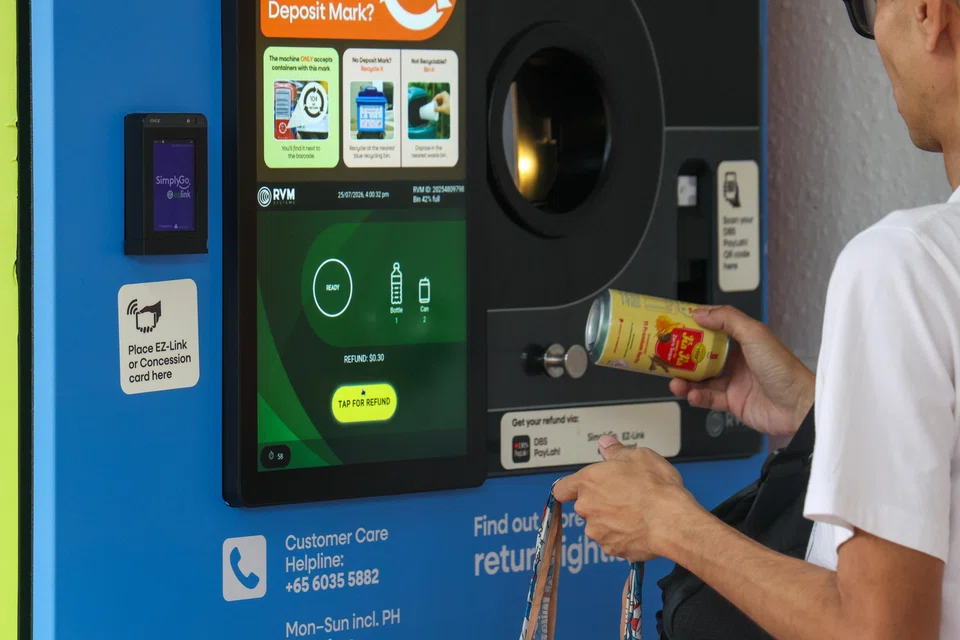
FOR a land-scarce nation with rising waste volumes, Singapore’s Zero Waste Nation ambition is critical for its long-term resilience.
The country disposed of 3.36 million tonnes of waste in 2025, up from 3.02 million tonnes a decade earlier. Even as waste volumes climb, overall recovery is not keeping pace, resulting in a lower recycling rate than 10 years ago.
This makes the Beverage Container Return Scheme (BCRS), South-east Asia’s first nationwide deposit return scheme, an important step.
The Singapore Environment Council has been engaging community groups ahead of the scheme’s full implementation on Thursday (Oct 1). Key concerns raised include identifying the deposit logo, using the reverse vending machines and ease of refund.
However, BCRS is not only about improving the recycling of beverage containers; it is also about making our economy more circular. At its core, the scheme is about whether Singapore can begin closing the loop on how packaging materials are used, recovered and kept in circulation.
Circularity matters more than ever
International work on circularity by Sitra, the Finnish Innovation Fund, has shown that advancing a circular economy is as much an economic and strategic agenda as an environmental one.
For a land-scarce city-state such as Singapore, where Semakau Landfill is projected to reach capacity around 2035, circularity is a necessity. By keeping materials in use for longer, Singapore can preserve its limited landfill space while unlocking business opportunities.
Amid geopolitical uncertainty and volatile markets, circularity is also a source of resilience and competitiveness.
In today’s interconnected economy, instability in one part of the world can quickly expose vulnerabilities elsewhere.
Calbee switched some snacks to black-and-white packaging after a disruption to naphtha (a hydrocarbon liquid) used in its ink. In Malaysia, shortages of polyethylene terephthalate, or PET, resin used in fresh-milk bottles left grocery shelves empty.
South-east Asia’s exposure to tensions in the Middle East is a reminder of how easily global shocks can disrupt supply chains and test business continuity.
For Singapore, an economy dependent on open markets and trade, circularity is also a form of resilience. It extends limited waste disposal capacity while reducing reliance on imported resources and enabling greater self-sufficiency when supply lines come under strain.
Circularity succeeds with collective action
A credible circular system goes beyond good policy design or new infrastructure. It requires shared responsibility across the value chain.
Producers shape what enters the market through packaging design, materials and labelling; retailers and F&B operators influence how products are consumed; consumers decide how packaging is disposed of; and waste collectors and recyclers return them to productive use.
BCRS puts that principle to the test. While it leans on consumers building the habit of returning beverage containers, the scheme’s success will hinge on whether the waste management industry can recycle the materials, and whether beverage producers can access them.
Ultimately, responsible action must be clear and convenient for consumers, and commercially viable for businesses.
Circularity needed beyond beverage containers
Beverage packaging is only one part of Singapore’s packaging waste challenge.
Since 2020, we have used more than 200,000 tonnes of disposables, comprising both packaging and non-packaging waste; most of this is incinerated at waste-to-energy plants. Furthermore, the recycling trajectory is not headed in the direction we wish to see.
Plastic recycling remains in the low single digits, and the rate at which paper and cardboard is recycled has fallen 44 per cent since 2018, even as e-commerce and food delivery adds to packaging waste.
The problem is not simply a lack of recycling awareness, but that convenience-led consumption has outpaced recovery systems.
A single e-commerce parcel or takeaway meal generates paper, plastic, composite packaging and food waste in one transaction – a reality that today’s recovery systems were not built for.
Beyond personal choices, the recycling industry continues to face rising collection and freight costs, alongside volatile commodity markets that affect the value of recovered materials.
While BCRS should be seen as the first step towards packaging circularity, the larger opportunity lies in building recovery systems for a wider range of materials, including paper, cardboard and glass.
A refundable deposit works well for beverage containers because they are fairly uniform in value and easy to sort, but it will not translate cleanly across the board.
Measures such as reducing unnecessary packaging, raising recycled content in products and/or packaging, strengthening collection and supporting recycling services may be needed. BCRS could offer early lessons for a wider system.
Why regional alignment matters
BCRS could also matter beyond our borders. As South-east Asia’s first nationwide beverage container deposit refund scheme, it offers an early case study of how a deposit refund system can be operationalised.
Many international producers that supply Singapore also do so for regional markets using similar packaging.
While collection systems differ across Asean, producers’ experience with BCRS here may encourage greater discussion around packaging alignment, recovery standards and producer responsibility across the region.
Circular systems succeed with scale. When packaging is designed to common standards and recovered materials can move between markets, recycling becomes efficient.
Singapore’s recovery system is closely tied to the region’s; the plastic and aluminium recovered through BCRS may end up at bottling and canning plants throughout South-east Asia.
A multi-material recovery system, spurred by BCRS, would also signal to Asean producers the value of alignment in packaging formats and labelling. This reduces fragmentation and enables recycling operations to scale effectively.
Leading the next chapter
BCRS is only the starting point. Like any system being built at scale for the first time, it will require adjustment, learning and sustained commitment.
What matters is whether it can build a durable foundation for recovery, participation and shared responsibility across the packaging value chain.
As a system, BCRS is part of Singapore’s steps towards greater circularity. Countries are expanding producer responsibility schemes, recycled content requirements, recovery infrastructure and markets for secondary materials.
What was once a sustainability initiative is increasingly recognised as part of economic strategy and industrial competitiveness.
Singapore has long turned constraints into competitive advantage. Circularity now offers a similar opportunity to turn resource constraint into strategic strength.
Cheang Kok Chung is executive director of the Singapore Environment Council, an environmental non-governmental organisation dedicated to advancing sustainability through standards, consumer action and education.
Kari Herlevi is programme director for Global Circular Economy at Sitra, the Finnish Innovation Fund. He leads the EU-funded Circular Economy Resource Centre and works with governments, businesses and international organisations to advance circular economy policies and solutions globally.
TRENDING NOW

DBS, OCBC, UOB rout lops billions off STI as inflation, rate concerns spook investors

Grab CEO’s wife Chloe Tong on life with Anthony Tan and finding her purpose
OCBC sheds S$8 billion in value as shares close nearly 6% down; analysts cautious on banks
Deal between tycoon friends sparks scrutiny of Philippine power sector

