From targeted strike to regional firestorm: how the US-Israeli attack on Iran escalated
It is now a regional war – fought across at least seven countries, with missiles falling on civilian airports, naval headquarters and residential districts
WHAT began as a coordinated military operation against a single state has, within days, metastasised into the most dangerous regional conflict the Middle East has seen in a generation.
Beginning on Saturday (Feb 28), Israel and the US launched coordinated joint attacks on Iran – code-named Operation Roaring Lion by Israel and Operation Epic Fury by the US – targeting key Iranian officials, military commanders and facilities, with the stated aim of regime change.
The ambition was sweeping. The consequences have been wider still.
The opening blow
US President Donald Trump’s Operation Epic Fury sought not merely to degrade Iran’s capabilities, but also to dismantle the Islamic Republic itself. Trump claimed the operation would eliminate Iran’s nuclear and missile programmes, destroy the country’s navy, and force a change in its leadership – addressing the Iranian public directly, telling them that “this will be probably your only chance for generations”.
The strategy was a gamble of historic proportions: that military shock could catalyse political revolution from within. That gamble began to look far more costly than its architects had anticipated, within hours.
In the first days of air strikes, the US and Israel killed Supreme Leader Ayatollah Ali Khamenei as well as several top leaders of the Iranian military and the Islamic Revolutionary Guard Corps (IRGC). The death of the ayatollah – the longest-serving autocrat in the region – was met with celebrations in some quarters of Iranian society.
But it did not stop the Iranian war machine. It enraged it.
Iran’s regional counteroffensive
Iran has long made its deterrence doctrine clear, previously warning that if attacked, it would respond by attacking US military facilities across the region, which it considers legitimate targets.
That warning was not a bluff. Teheran responded by launching waves of missiles and drones at Israel, and towards several US military bases in the Middle East. Iran’s IRGC claims to have launched attacks on 27 bases hosting US troops in the Middle East, as well as Israeli military facilities.
The conflict’s footprint has expanded rapidly across the region. Iranian counterstrikes targeted not only Israel and US forces, but also neighbouring Arab states – including Bahrain, Kuwait, Qatar, the United Arab Emirates, Oman, Iraq and Jordan.
US military assets in these countries were targeted alongside civilian sites such as airports, with the number of aerial attacks estimated at several hundreds.
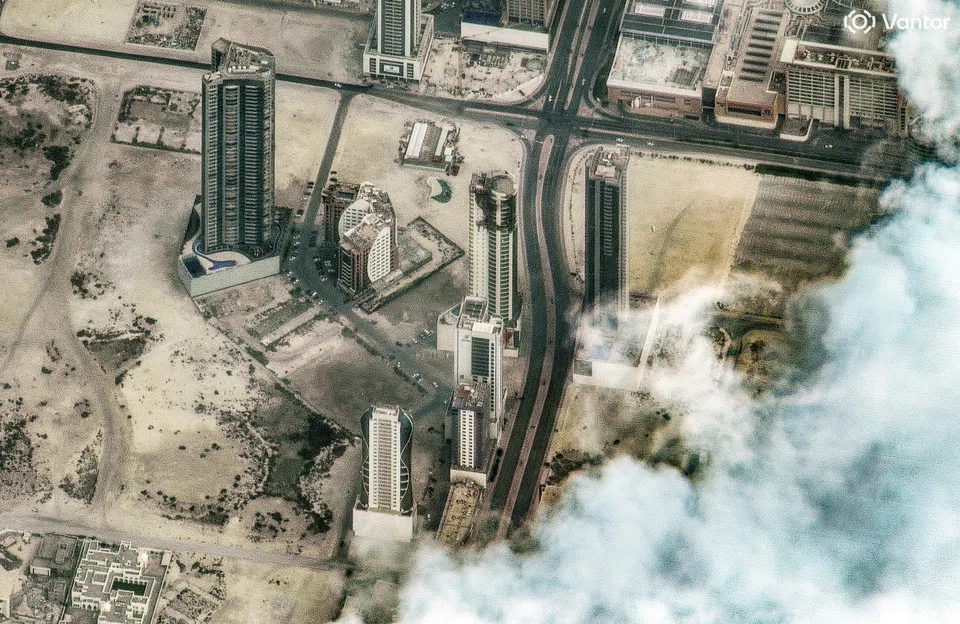
Iranian missiles targeted the headquarters of the US Navy’s Fifth Fleet in Bahrain’s Juffair area. The Bahrain International Airport was targeted with a drone, resulting in “material damage”, as confirmed by the country’s interior ministry.
On Saturday night, Iranian drones struck several residential buildings in the capital, Manama. The war had arrived on the doorsteps of states that had spent years trying to stay out of it.
Proxies enter the fray
The conflict’s expansion was not limited to Iran’s direct military strikes. Israeli sources reported projectiles being launched from within Lebanon towards its territory, setting off sirens across Haifa and the Upper Galilee. Hizbollah confirmed its responsibility, saying it attacked an Israel Defense Forces base in Haifa in response to Ayatollah Khamenei’s killing.
Meanwhile, the Houthis in Yemen and Hizbollah in Lebanon – both actors in Iran’s so-called “axis of resistance” – also launched attacks from the Red Sea and Israel’s northern border with Lebanon, respectively, spurring fears of further regional spillover.
Iran’s network of proxies, painstakingly cultivated over decades and never fully dismantled despite years of Israeli pressure, had activated. The decapitation of Iran’s leadership had not severed these ties – it had tightened them.
“It is difficult to see how genuine political transformation develops amid sustained war, chaos and potential fragmentation.”
The deeper context
To understand how this conflict escaped its intended boundaries, one must appreciate how thoroughly the regional chessboard had already been reshaped.
Many of Iran’s regional allies had been significantly weakened, primarily by Israeli military action from 2023 and with longstanding ally president Bashar al-Assad of Syria being ousted by rebel forces in 2024. Joint US-Israeli strikes in 2025 undermined Iran’s defences and nuclear programme.
A weakened Iran, cornered and with not much left to lose, has proved no less dangerous – arguably more so.
Even with a weakened Iranian government, there is a real risk of this conflict escalating and drawing other states in. The Iranian government has experience regenerating under pressure – external military force may weaken a regime, but it does not automatically build a viable alternative.
The uncomfortable questions
The transformation of a targeted military operation into a regional war raises uncomfortable questions about the gap between the stated objectives and foreseeable consequences.
Trump’s decision to bypass a vote or even debate in Congress creates both constitutional problems and political challenges. He provided only a cursory public justification of his decision once the bombs started dropping.
The US president has spoken about freedom for the Iranian people, a powerful message rhetorically. But it is difficult to see how genuine political transformation develops amid sustained war, chaos and potential fragmentation. History offers few examples of a democracy being bombed into existence.
The conflict in Iran is no longer a bilateral affair between a superpower-backed coalition and a single state. It is a regional war – fought across at least seven countries, with missiles falling on civilian airports, naval headquarters, and residential districts from Manama to Haifa.
The architects of Operation Epic Fury sought to resolve, in days, a 47-year adversarial relationship. What they have produced, at least for now, is its most explosive chapter yet. How – and whether – it can be contained remains the defining question of this moment.