Unitree’s IPO will test the ‘embodied AI’ valuation shortcut
Its listing will force investors to make distinctions between robotics companies’ propositions more carefully
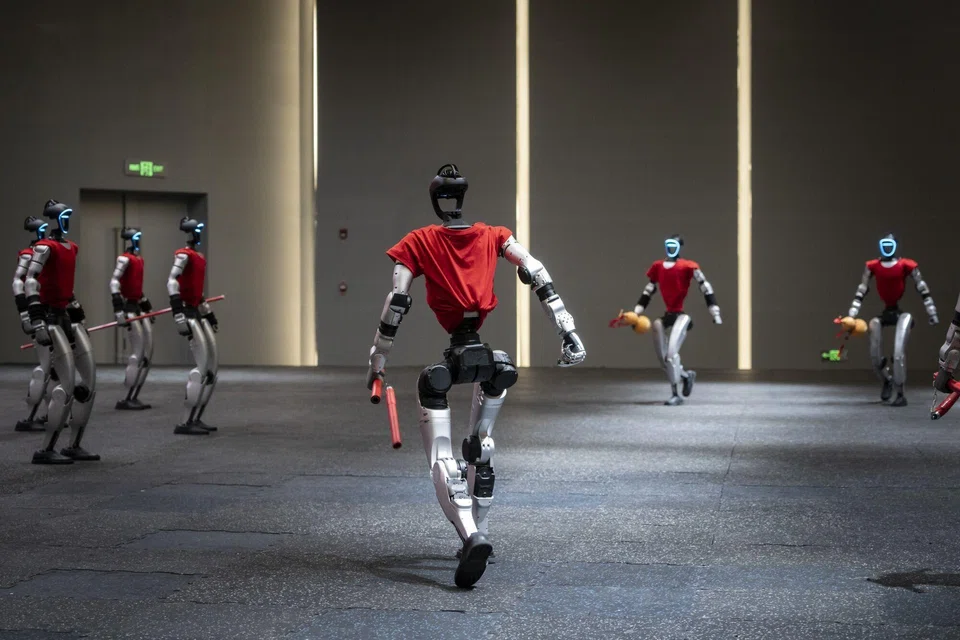
UNITREE Robotics, a Chinese company specialising in humanoid robots, is reportedly seeking a valuation of about 4.2 billion yuan (S$802 million) in its planned Shanghai listing.
Set against 1.7 billion yuan of revenue in 2025, that implies a price-to-sales multiple of roughly 25 times.
The immediate question is whether mainland investors will be comfortable with that number. The more consequential test is for the label – “embodied artificial intelligence” – that has helped finance the sector.
The term now covers at least three different assets: profitable robot makers, specialist industrial systems and general-purpose platforms whose strongest economic argument still lies in future software and data.
Such a definition is too broad to accurately peg a value to the companies that come under its umbrella.
Different propositions, different valuations
Unitree is not China’s first publicly traded robot maker. Competitors UBTech and Dobot are already listed in Hong Kong. Neither, however, has the same combination of scale, profitability and experience with both humanoid and quadruped robots.
In 2025, Unitree reported a gross margin of 60.4 per cent and a net profit of about 591 million yuan, excluding non-recurring items.
Those figures do not validate its target valuation. But they do make raising funds a tougher proposition for companies still asking investors to pay mainly for future growth.
Chinese robotics companies have raised capital on very different propositions.
Some sell a vision of general-purpose intelligence. Others emphasise proprietary data, industrial orders, cheaper hardware or the eventual replacement of labour.
That variability has helped fund the sector, but it has also allowed very different business models to borrow the same AI premium.
Unitree’s listing, if successful, would change the reference set. A company’s last private funding round, a policy-backed valuation or a distant US startup in the same sector would no longer be the only benchmarks for price.
A listed Chinese peer would provide a live market capitalisation, regular financial results and a visible cost of any investor disappointment.
Unitree’s own filing also defines the relevant peer group: In its response to the Shanghai Stock Exchange’s listing-review questions, it named UBTech, Dobot, Deep Robotics and Leju Intelligence as comparable companies.
Leju Intelligence offers an early example of how the field can differ in terms of finances and market reception.
Its draft prospectus values the company’s latest private funding round at 4.33 billion yuan. With a revenue of 258 million yuan in 2025, that works out to a valuation of roughly 17 times sales.
The gap with Unitree’s reported target does not show that one company is cheap and the other, expensive. Leju is much smaller, is making a loss and is at an earlier stage of scaling its full-size humanoid robot business.
The comparison instead suggests that investors may pay more for operating maturity and current earnings than for the humanoid label alone.
Deep Robotics points to another source of value. In 2025, it reported 337 million yuan in revenue, a gross margin of almost 53 per cent and an overall profit.
Nearly four-fifths of its revenue came from industry applications, including inspection and emergency response. The company has filed for an initial public offering with a price-to-sales ratio of roughly 41 times.
A specialist with almost 80 per cent of revenue from industrial applications and positive earnings may support a higher multiple than a general-purpose platform still proving its economics.
Its trade-off is a lower upside ceiling if broader systems eventually deliver high software-like margins at scale.
Defining the field more clearly
For South-east Asian manufacturers and investors, this distinction is practical rather than semantic.
Task-specific robots can fit into existing automation budgets and factory workflows sooner, while general-purpose platforms require more integration, capital and patience.
The market is therefore not choosing one multiple for the entire robotics sector. It is choosing how much to pay for three sources of value: scale and profit, repeat industrial use, and software or data that may eventually produce revenue with higher margins.
Treating all three as “embodied AI” hides these distinctions.
The first effects of Unitree’s potential IPO are likely to appear in the fundraising and listing plans of competitors.
Companies with stronger revenue growth and clearer commercial evidence may seek public capital while enthusiasm is running high. Others may delay listings, accept more restrained pricing or remain reliant on strategic and state-backed investors for longer.
Unitree’s own valuation still has to be tried by the book-building process and public trading. A targeted 25-times sales multiple is neither a permanent ceiling nor a reliable floor.
Factors other than a company’s fundamentals can also affect its share price; the public market’s demand for a fashionable sector can rise when it offers few investable assets.
Unitree may mark the point at which “embodied AI” stops being a sufficient valuation argument.
Subsequent offerings will help investors separate robot manufacturers, industrial-equipment suppliers and companies that may one day earn software-like margins.
The market will still pay for the future; it will simply demand a clearer account of which future it is buying.
The writer is a former DiDi executive and venture-backed technology founder in China
The commentary is based on the writer’s own observations and argument. AI tools were used for ideation, drafting and editing. The writer remains fully accountable for the commentary’s accuracy, originality and final form.