

Many happy returns for resale homes
But buyers of new launches face slimmer gains on higher purchase prices

[SINGAPORE] When 30-year-old medical professional Joshua (not his real name) shelled out S$2.1 million for a gleaming new freehold luxury two-bedder in the Holland Village area in 2023, he and his wife thought they were making a smart investment.
The home was pricey, but the location suited their lifestyle, and the progressive payment scheme meant a smaller initial pinch to their wallets.
More importantly, gains still felt inevitable in Singapore’s red-hot property market, where prices seemed to only march higher.
Nearly three years on, Joshua describes the buy as “stupid”.
The value of his 700-square-foot (sq ft) unit has hardly grown, and his concern now is simply breaking even when he eventually sells it for a larger family home.
Joshua is not alone.
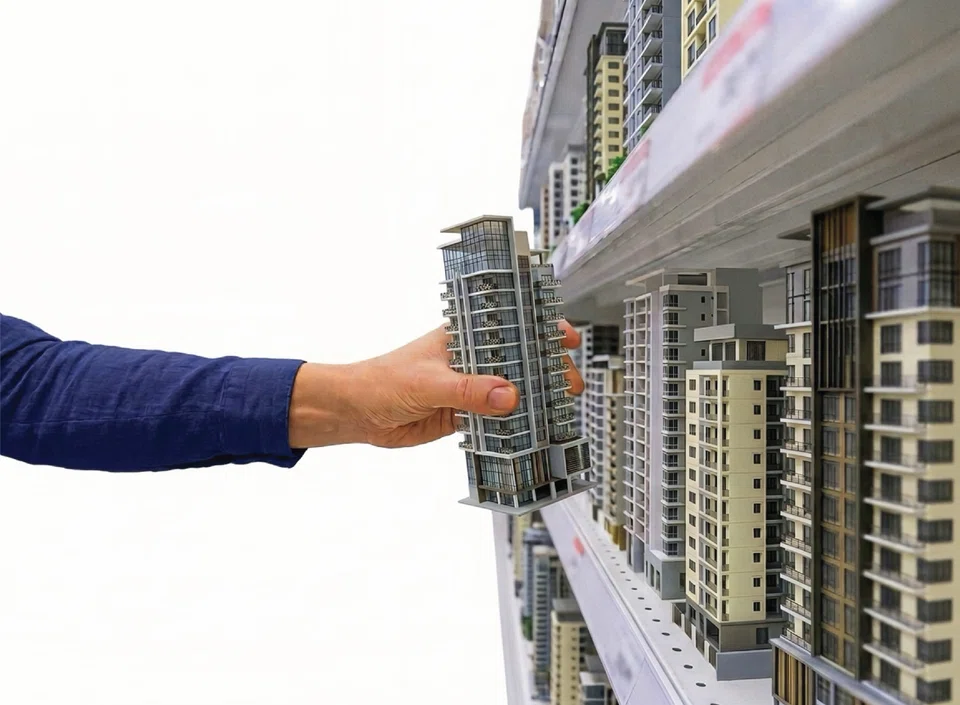
Prospective homebuyers in Singapore often grapple with the choice between a pricier new condominium apartment or a more affordable resale unit.
Some property agents, along with well-meaning family and friends, point them to the primary market for supposedly stronger investment potential.
But the data crunched by property players for The Business Times suggests the opposite is often true.
Resale properties frequently earn higher returns when sold again, owing to their lower base price compared with the large sums that new launches often fetch.
Homeowners may thus have to ask: Is a brand-new buy really worth it?
Consistent advantage
Over the past three decades, resales have consistently been more profitable than new non-landed private homes.
New private homes notched a historical median annualised return of 2.7 per cent on the market, compared with 3.7 per cent for resale units that changed hands again, indicate statistics compiled by real estate researcher Vairavan Shanmugam.
Vairavan, a doctoral student who was formerly a data insights specialist at proptech firm Ohmyhome, studied more than 630,000 transactions from 1995 to June 2026, focusing on purchases and subsequent resales with a minimum holding period of three years.
His findings exclude transaction costs, taxes, financing, rental income and inflation, and the study captures only realised returns. In other words, poorly performing homes that have yet to be sold are not reflected in the data.
Still, Vairavan found that the resale advantage remained consistent across different regions, tenures and holding periods.
“Importantly, the difference is not limited to the median,” he says.
Although the difference is more pronounced for higher-value deals – widening to a 3.1-point difference at the 90th percentile, from just 0.6-point at the 25th – resale homes outperformed new-sales across the board.
Age and size matter
Christine Sun, chief researcher and strategist at Realion (OrangeTee & ETC) Group, attributes the stronger returns of resale properties partly to their age and longer holding periods, which give them more time to appreciate.
In contrast, many of the more recent projects have yet to see enough resale transactions to fully reflect their potential gains.
“Moreover, there are more properties that were freehold in the past, which may yield higher gains,” she adds. Meanwhile, many newer launches sit on 99-year leasehold sites.
Dr Lee Nai Jia, director of property insights platform Property Doctors, says the resale advantage reflects differences in size, tenure and location.
In fact, average returns on new-sale homes in the past two years surpassed resale returns for leasehold units larger than 1,500 sq ft in size.
But for properties between 700 and 1,000 sq ft, resales still posted materially stronger returns, commanding a premium of as much as 12.4 percentage points.

Notably, older leasehold resales still had an edge over new homes, albeit a narrower one. Properties with less than 70 years left on their lease in 2021 recorded a median return of 23.7 per cent, compared with 17 per cent for new-sales.
Dr Lee says this “suggests that a shorter remaining lease would moderate the advantage, but does not necessarily prevent medium-term appreciation when the entry price is sufficiently attractive and there’s possibility of en bloc redevelopment”.
The resale advantage persisted even after the authorities hiked additional buyer’s stamp duty rates in April 2023 to cool the housing market.
Before the curbs, resale homes carried a median annualised return of 2.8 per cent islandwide, versus 1.9 per cent for new homes, according to an analysis by Mogul.sg research officer Nicholas Mak.
After the cooling measures were introduced, resale properties recorded a median annualised return of 4.3 per cent, against 3 per cent for new-sales.
The price of buying new
Underlying some of these dynamics is the hefty premium buyers pay for new homes to begin with, as Vairavan has found.
Over the past five years, new homes in the Core Central Region (CCR) sold for 41 per cent more than resale units on a per-square-foot basis.
The gap was 48 per cent in the Rest of Central Region (RCR), and 50 per cent in the Outside Central Region (OCR).
“That premium is committed to on Day One, before the market has done a single day of work to justify it,” Vairavan says.
“In a strong upcycle, rising prices can eventually absorb the premium. In a flat or softening market, it tends to sit as dead weight, and the owner spends years climbing back to a cost already locked in.”
Alan Cheong, Savills Singapore executive director of research and consultancy, has observed the same trend.
In fact, the price premium commanded by new-build homes on 99-year leases expanded from a 10-year average of 26.4 per cent to 31.2 per cent in the first eight months of 2026, he says.
He adds that the phenomenon “is not surprising”, since land is becoming increasingly expensive.
Government land sale prices have grown more quickly than the private-home price index in the last three years. Higher land costs are priced into new launches, pushing new-sale prices to rise at a faster clip than resale market ones.
The premium can also be reinforced by developers’ significant marketing firepower, Cheong adds.
Developers can build sales galleries, appoint multiple agencies and mobilise thousands of agents to hype up a new launch, effectively pushing up the eventual sale price more than a lone resale property seller could.
But new launches are not necessarily overpriced. Developers have to factor land and construction costs, branding and expected neighbourhood improvements into their price tags, says Knight Frank research head Leonard Tay.
“Homebuyers are also generally willing to pay more for a new product with trending bells and whistles,” he notes.
These include multi-sport hard courts, family and pet amenities such as themed playgrounds, golf simulators and work-from-home lounges.
A question of value
At the same time, the market could be moving towards a point where many buyers are consciously paying for consumption value and lifestyle preferences “rather than maximising investment returns”, says Tay.
That certainly seems to be the case for buyers of homes in the exclusive CCR area.
According to Vairavan’s research, about 28 per cent of new-sales in the CCR made losses over the past decade, compared with 14.9 per cent for resales in the same period.
New launches in the CCR notched losses between 22.4 and 35.6 per cent in that period, and were not confined to a few bad years.
“If even the prime market shows elevated loss rates and lower median annualised returns for new-sale-entry buyers, buyers should be cautious about treating ‘prime (homes)’ and ‘safe (investments)’ as the same thing,” says Vairavan.
Even so, profitable deals remain the majority.
Mak found that 71.7 per cent of CCR transactions since the April 2023 cooling measures were introduced turned a profit, although this was well below the 96.2 per cent and 98.6 per cent recorded in the RCR and OCR, respectively.
Beyond the CCR, Realion’s Sun likewise notes that of the new-sale homes in Singapore that were subsequently resold, most were profitable.
In 2025, 94.3 per cent of deals islandwide turned a profit, up from 82.2 per cent in 2020.
The sums at stake are also growing – for losers and winners alike.
The average gross loss increased by 40.8 per cent in that five-year period, to about S$321,000 in 2025, while average gross gains spiked by 81.1 per cent to S$498,000.
“From an investment perspective, the principle remains unchanged,” Tay says. “As the premium widens, the hurdle for future capital appreciation becomes higher.”
That said, as long as a resale property’s remaining lease does not materially affect its mortgageability or financing attractiveness, Cheong expects buyers to place greater emphasis on the “relative value” that it offers against a pricier new-build.

A short-lived convergence
Though prices of resale homes may sometimes be comparable to those of new-builds, analysts believe that any such market catch-ups are only temporary.
“Once the market has time to rebuild (its) purchasing power, developers may gradually re-establish a higher pricing benchmark through subsequent launches,” says Cheong.
How long homebuyers will continue absorbing higher launch prices is another question.
Since the pandemic, they have largely accommodated rising prices, suggesting that they have yet to reach “the limits of their affordability envelopes”, Tay says.
But resistance could emerge if the growth of private-home prices were to “be so relentless as to surpass income growth”, he notes – resulting in slower take-up rates, more cautious buying and a shift towards resale projects offering more space or better value.
“More households at the high end of the (Housing & Development Board) salary ceiling might opt for Build-To-Order flats rather than new-launch private units,” Tay adds, pointing to the recent increase in the monthly household income ceiling for public-housing eligibility.
What a “reasonable” premium for a new condominium is varies, Dr Lee says. “A premium of around 30 to 40 per cent may be understandable in some comparisons, particularly when the competing resale stock is considerably older.”
Ultimately, however, buyers are not necessarily choosing between lifestyle and investment considerations.
Dr Lee notes that new launches also offer advantages such as progressive payments, lower initial maintenance and renovation costs, as well as the assurance of a defect-liability period.
For all the focus on capital gains, the continued willingness to pay a premium for new homes suggests that maximising returns is just one part of the homebuying equation.
TRENDING NOW

S$8 billion wiped off OCBC value as shares slide 5.8% in heavy trade

Grab CEO’s wife Chloe Tong on life with Anthony Tan and finding her purpose

Brookfield denies accusation it cut Soilbuild out of Mapletree deal
8 public officers referred to police over property buys near unannounced MRT stations: Chan Chun Sing

