Private residential rents rise 0.7% in Q2 as home prices inch up 0.5%: URA
Rents rise the most for landed homes, while prime area condos outpace other regions and suburban rents ease

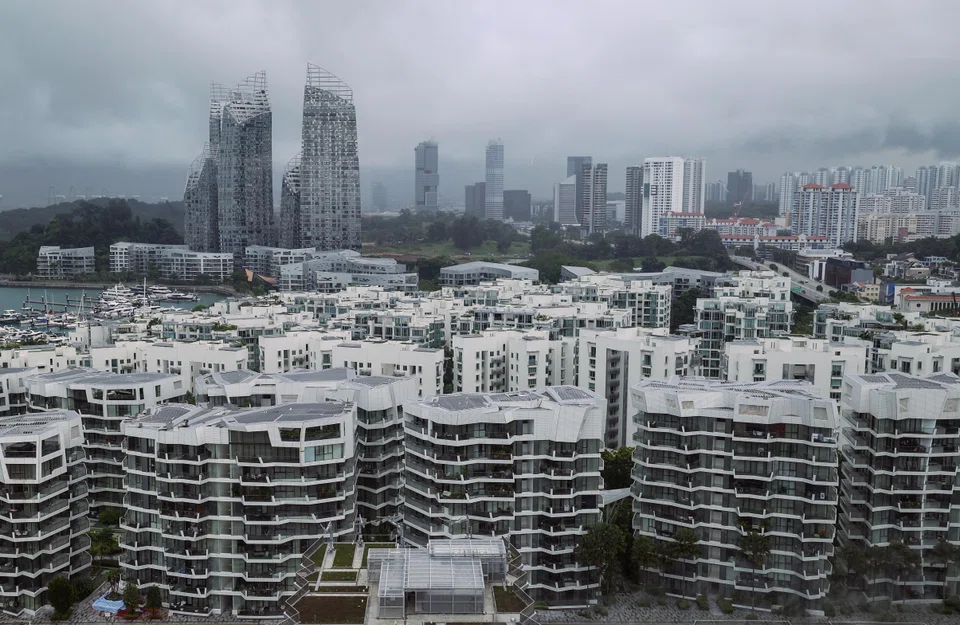
[SINGAPORE] Rents for Singapore private homes were up 0.7 per cent in the second quarter of 2026, rising slightly faster than the 0.3 per cent increase in the first quarter of the year.
Home prices rose 0.5 per cent, as previously indicated in flash estimates released earlier in July, according to data released by the Urban Redevelopment Authority (URA) on Friday (Jul 24).
The Q2 movements brought rental growth for H1 2026 to 1 per cent, down slightly from 1.2 per cent in H1 2025. The pace of growth for private home prices also eased to 1.4 per cent in the latest half year, from the 1.8 per cent increase in H1 2025.
The quarterly uptick in both rents and prices came even as the vacancy rate climbed to 6.4 per cent as at end-Q2, from 6.2 per cent in Q1.
It follows the completion of 1,212 private housing units in Q2, of which 512 were executive condominiums (ECs) and 700 were private residential units.
This was a tad lower than the 1,271 units completed in the previous quarter, and around half the quarterly average of 2,317 units over the past two years.
PropNex chief executive Kelvin Fong noted higher leasing demand in Q2. Caveats data showed a 5.1 per cent increase in private home rental contracts, excluding ECs – from 21,203 in Q1 to 22,290 in Q2.
Wong Xian Yang, Cushman & Wakefield’s research head for Singapore and South-east Asia, said that fewer new completions and steady demand have supported rental growth, though global economic uncertainty could cap upside.
Rents for landed properties rose the most in Q2, increasing 2.7 per cent against a 0.1 per cent gain in the previous quarter. Non-landed home rental growth was flat, with a 0.4 per cent increase mirroring the rise in Q1.


“Sustained wealth migration into Singapore is expected to support leasing demand in the Core Central Region (CCR) market,” added Wong.
Rents in the “mid-tier” Rest of Central Region (RCR) market were unchanged after slipping 0.2 per cent in Q1. Rents of mass-market Outside Central Region (OCR) condos eased 0.3 per cent in Q2, reversing from their 1 per cent increase in the previous quarter.
In the public housing market, there were 58,855 Housing & Development Board (HDB) flats rented out as at end-Q2, with 10,002 approved rental cases in the quarter, up 4.9 per cent from Q1.
The highest median monthly rental price was for five-room flats in the central area at S$5,100, while the lowest was for two-room flats in Sengkang at S$2,350.
Christine Sun, chief researcher and strategist at Realion Group, expects landlords to see stiffer competition for tenants in the coming months, as more HDB flats complete their five-year minimum period (MOP) and become eligible for rental.
In 2026, 13,480 HDB flats will meet their MOP.
The private residential market, meanwhile, is expected to see a “moderate” 5,012 private home completions in H2 2026, said Fong from PropNex.
The bulk of H2 2026 completions are expected to come from the RCR and OCR, noted Tricia Song, CBRE research head for Singapore and South-east Asia. She added that the limited upcoming supply in the CCR is likely to support rents in the area.
Fong pointed out: “That said, a larger supply of new completions is projected to come on in 2027 and 2028 at 8,440 and 9,856 units, excluding ECs, respectively.”
Sun observed anecdotally that expatriate professionals have been “adjusting their housing arrangements”, following job changes or corporate restructuring over the past few months. This is especially so for those working in sectors affected by automation and artificial intelligence.
“Demand may soften in the second half of this year if the macroeconomic outlook worsens,” she said.
While the URA index showed private residential prices inching up by 0.5 per cent in Q2, much of the increase came from landed homes, where prices rose 2.5 per cent, compared with a 0.1 per cent dip for non-landed homes.
As indicated in the earlier flash estimates, CCR prices of non-landed homes also outpaced the other markets with a 1.8 per cent increase, versus the 1.2 per cent and 0.1 per cent declines seen for such residences in the RCR and OCR, respectively.
In the primary market, developers launched 1,783 private homes (excluding ECs) for sale in Q2, some 3 per cent less than Q1’s 1,844 units. Sales volume however rose to 2,141 units in Q2, from 2,013 units previously.
Resale market
Meanwhile, resale transactions rose 18.2 per cent to 3,813 units in the quarter, and sub-sales by 10.9 per cent to 194 units. Inventory of unsold uncompleted homes fell 7.2 per cent from Q1 to 14,929 units (excluding ECs) at end-Q2. PropNex’s Fong noted this was only slightly higher than the record low of 14,087 units in Q1 2022.
Including completed units, unsold inventory fell 7.2 per cent to 15,057 units. This is significantly lower than the previous peak of 37,799 units in Q1 2019, and implies less than two years’ landbank for developers, based on the five-year annual average new home sales of 8,766 units, said Song of CBRE.
Given the low unsold inventory, she noted that developers became increasingly bullish at state land tenders that closed in the CCR in Q2. “In particular, (the parcels at) Peck Hay Road, Dunearn Road and River Valley recorded benchmark bid prices above comparable 2025 government land sale tenders in the same location.”
In public housing, resale flat prices extended a 0.1 per cent dip in Q1 to ease another 0.3 per cent in Q2, data from HDB showed.
Transaction volumes of resale flats, on the other hand, rose 1.8 per cent in Q2 to 6,396 units, from 6,285 units in the previous quarter. Year on year, this was an around 10 per cent decline.
Wong Siew Ying, PropNex head of research and content, noted that the easing in resale prices “came without a contraction in transaction activity which indicates that buyers have not stepped away from the market”.
“It is likely that flats recently out of their five-year MOP had helped to support the resale volume in Q2.”
ERA key executive officer Eugene Lim also observed that there were markedly more million-dollar HDB transactions – with 491 of such deals in Q2, up 19.5 per cent quarter on quarter and 18.3 per cent year on year. The Q2 tally also surpasses the previous record of 480 units in Q3 2025.
These transactions accounted for 7.7 per cent of all resale transactions in Q2, from 6.5 per cent in Q1.
Decoding Asia newsletter: your guide to navigating Asia in a new global order. Sign up here to get Decoding Asia newsletter. Delivered to your inbox. Free.
Copyright SPH Media. All rights reserved.