

Mooted COE changes will solve category issues, but higher premiums likely: observers
Combining categories will mean more intense competition; private-hire cars will also benefit from rebates

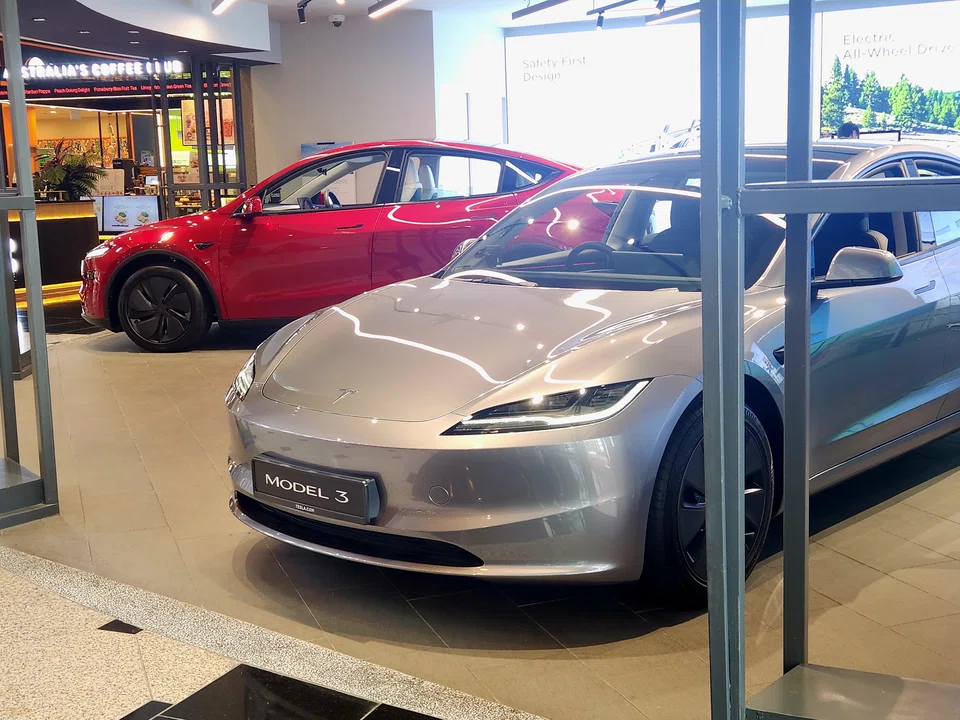
[SINGAPORE] The proposed changes to the Certificate of Entitlement (COE) system will solve problems with the current categories and help differentiate mass-market and luxury cars, said industry observers, but they are also likely to push premiums up and boost the take-up of private-hire vehicles.
Walter Theseira, associate professor of economics at the Singapore University of Social Sciences, said: “Giving a rebate to mass-market cars for COEs and a surcharge to cars with a higher cost will achieve the objective of having a price difference in COEs between mass-market and luxury cars.”
But automotive consultant Say Kwee Neng said: “In terms of overall affordability or price level, merging the two categories may be the worst thing to do as it is almost guaranteed to bring premiums to a higher level.”
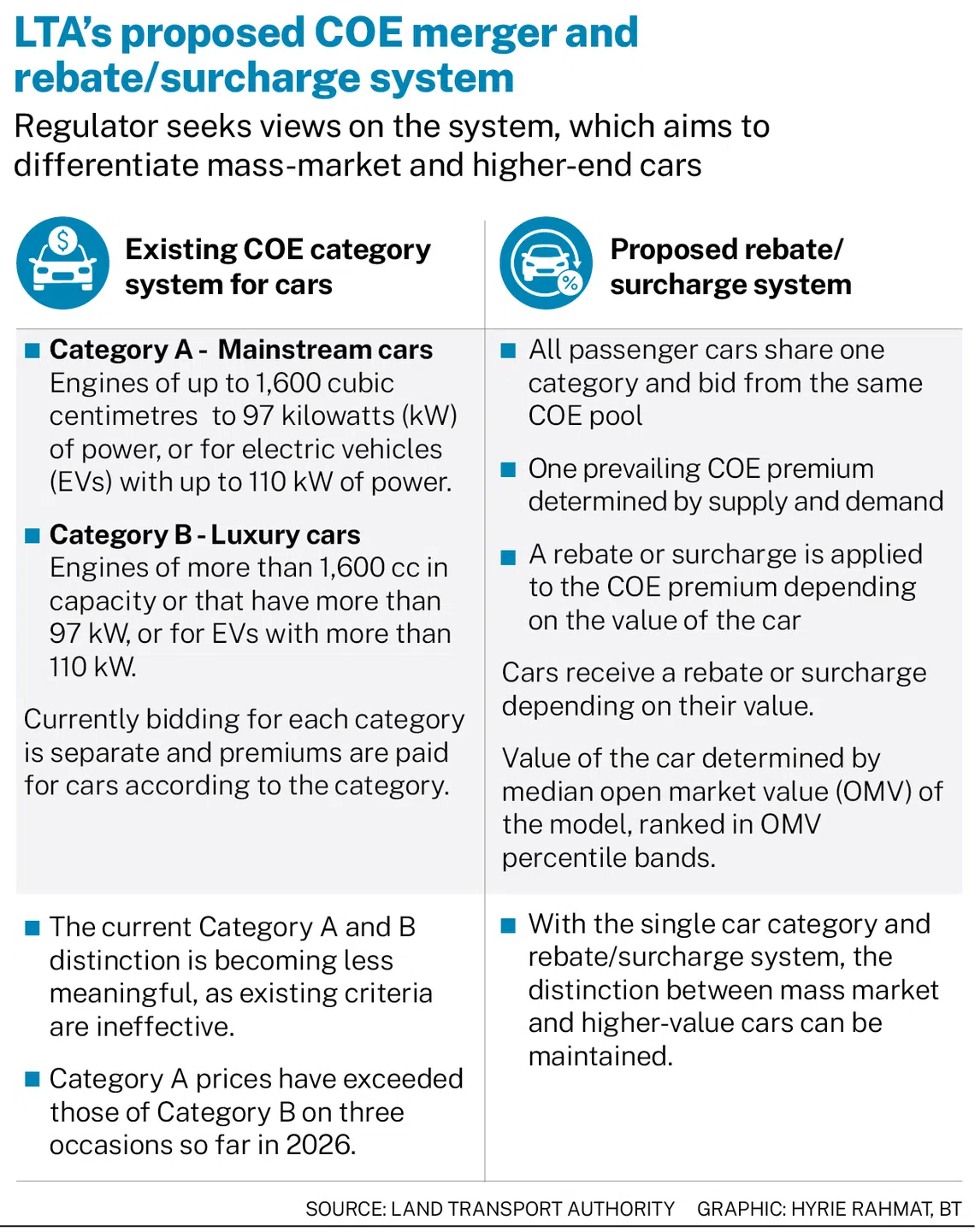
On Thursday (Oct 8), the Land Transport Authority (LTA) revealed that it is considering merging Categories A and B into a single passenger-car category.
It is also mulling the application of a system of rebates and surcharges based on the car’s value. Under this proposed move, buyers of cars will be awarded a rebate or surcharge of up to S$15,000 to the COE premium, depending on their cost.
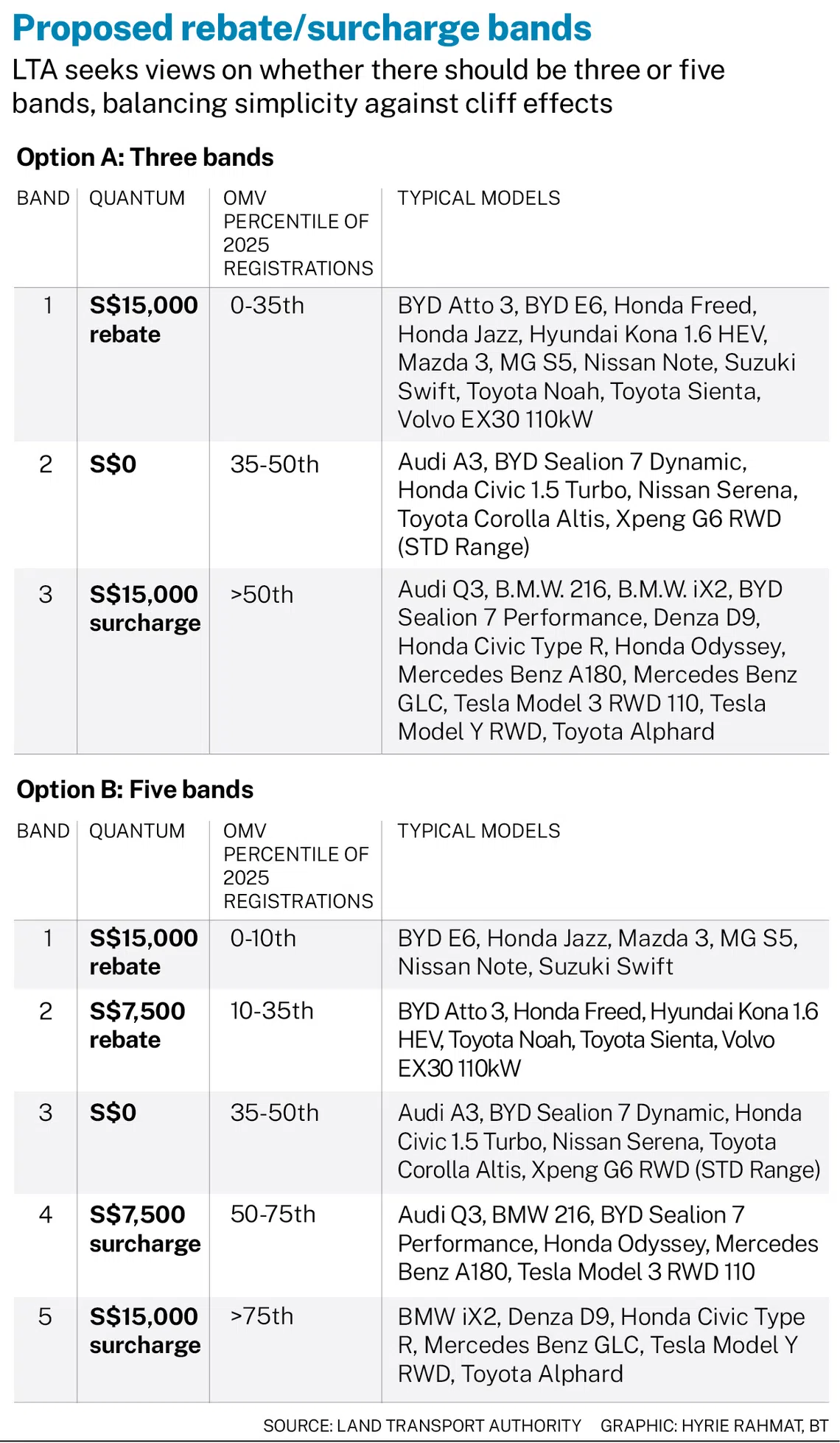
Each car model would be sorted into a band, determined by the median of its open market value (OMV) percentile. Three-band or five-band structures have been suggested.
The rebate/surcharge amounts would be based on historical COE data. The amounts, along with the bands themselves, would be reviewed yearly.
The regulator has opened the proposal to public consultation; gathering of feedback on the design and implementation of the scheme closes on Nov 2.
The findings of the review will be published by the end of 2026, and changes to the COE system are expected to be enacted by the first half of 2027.
OMV a fairer gauge of value
Most observers who spoke to The Business Times said the move will address the existing, outdated limitations of the passenger car categories as determined by engine capacity and horsepower.
A Category A mainstream car is now defined as one with an engine of less than 1,600 cubic centimetres (cc) of capacity, or with less than 97 kilowatts (kW) of horsepower. For electric vehicles, this limit is 110 kW.
A car that does not meet these requirements must use a Category B certificate.
Shuhei Hashimoto, project manager at consultancy Roland Berger, said: “Moving from engine and power specifications to OMV is the right direction, as it closes the loophole that has allowed premium brands to tune models to Category A (specifications).”
LTA said that the main point behind the changes is to differentiate mass-market and higher-end cars in the COE system, while allowing premiums to continue to be determined by market forces.
But since early 2026, Category A and B prices have been closely aligned; premiums in Category A even exceeded those for B thrice this year. This is because manufacturers, especially those of EVs, can easily limit motor power to meet the Category A requirement.
Hashimoto added: “Engine capacity and power output were originally proxies for a car’s price bracket, and that link has weakened with small turbocharged engines and EVs whose power output can be easily configured.”
Mind the gap
Most analysts welcomed the potential changes, although some warned that the rebate-surcharge system would need to be carefully implemented and updated to be effective.
Nicholas Wong, CEO of Honda authorised distributor Kah Motor, said: “(LTA is) on the right track. Typically, the difference between Category A and B has been around S$15,000 to S$30,000, so I think this is fair. It will help smaller cars to sell in greater numbers.”
Raymond Ong, associate professor in the department of Civil and Environmental Engineering at the National University of Singapore (NUS), said the changes keep the “core principle” that a buyer of a higher-end car should have to pay more for car ownership.
“In this aspect, having the median OMV is a fair indicator on how mass market or how high-end a car is.”
On the other hand, the suggested rebates may not be sufficient if COE premiums reach higher levels.
Christopher Tan, associate faculty member at the Singapore University of Social Sciences, said that under the proposed scheme, the effective maximum COE price differential between a mainstream and luxury car is S$30,000.
“This would not be a significant gap if premiums remain at their current high levels, as it would only translate to a difference of around 25 per cent,” he said, noting the long periods in the past when the gap was as wide as 50 per cent.
The surcharges are also not likely to dissuade buyers of premium vehicles.
The maximum S$15,000 surcharge translates to only a 5 to 7 per cent premium on high-end cars in the S$200,000 to S$300,000 range, so it is “unlikely to change what luxury buyers choose”, said Hashimoto.
NUS’ Prof Ong said the system of banding, which slots any given car model into one of several bands, would need to be monitored and updated regularly, along with the rebate or surcharge for each band.
Upside, downside
The majority of the eight observers BT spoke to said the move could lead to an overall rise in premiums.
This is because the total passenger-car COE quota will remain the same, and premium buyers will now compete directly with mainstream ones for certificates.
Keith Oh, president of the Automobile Importer and Exporter Association (Singapore), or AIEA, said: “When you combine the two (categories), the premium will definitely go up because right now, the people buying larger, more expensive cars with higher OMVs are already in Category A.”
For example, Tesla is now the third-best-selling brand in Singapore, having racked up 3,723 registrations in the first eight months of the year. Its popular Model 3 RWD 110 and Model Y RWD are Category A cars, but buyers of these two models would receive surcharges under the proposed system.
SUSS’ Prof Theseira said: “If you merge a market with limited supply, it is the buyer of the more expensive thing and their willingness to pay who will set the prices.”
He added: “Singaporeans don’t like to think about it, but all buyers are premium buyers with these COE levels. Assuming buyers of more expensive cars are larger in number, until that demand by premium buyers is exhausted, prices won’t come down.”
Joining the categories would also cause more intense competition for certificates in this combined pool.
The consultant Say said: “Category A prices have risen dramatically in the past two years because of intense competition and a small pool. With the new system, Chinese EVs competition for what used to be mostly Category A will now soak up the Category B quota too.
“Existing Category B players, already stunned by their diminishing market share, will likely raise their COE bids to attempt to hold on. This will add fuel to the fire and drive the prices north.”
Separately, rebates for mainstream cars will also increase the competition for COEs among private-hire vehicles (PHVs).
“Most PHVs are in the rebate band, and now they may have up to S$15,000 more bidding power,” AIEA’s Oh pointed out.
Mainstream models named in LTA’s proposed rebate band include those popularly used for ride-hailing cars. These include the Toyota Noah, Toyota Sienta and Hyundai Kona 1.6 HEV.
Say said: “I think the surcharge would intensify the level of competition in the mass-market segment, as more PHV companies look to buy more affordable cars for their fleets.”
Observers have identified PHVs as a contributing factor to the higher COE premiums in the last decade, given that they are mostly owned by ride-hailing fleets with the financial muscle to flex in bidding.
The PHV population reached an all-time high of 98,330 as at August 2026.
Say added: “This means the segment that LTA is trying to make more affordable and accessible to individual consumers would inadvertently drive up the single category price, making mass-market cars ultimately even more unaffordable.”
TRENDING NOW

Grab CEO’s wife Chloe Tong on life with Anthony Tan and finding her purpose

Once staunchly pro-China, Malaysian Chinese businesses are now distancing themselves from Beijing

Cliff Tan has 7 million followers and a 4-month waitlist. Why won’t he expand his business?

Singapore F1 to proceed despite haze; no changes planned to outdoor entertainment

