

Singapore tax revenue up 17% to S$80.3 billion in FY23/24 due to ‘strong economic, wage growth’
Tax revenue rises across most categories, although stamp duty collection dips slightly due to lower property transaction volume

SINGAPORE’S tax revenue rose 17 per cent to hit S$80.3 billion for FY2023/24, a result that the taxman on Wednesday (Sep 4) said reflects strong economic growth and nominal wage growth in 2022.
Tax revenue rose in most categories, based on the annual report of the Inland Revenue Authority of Singapore (Iras).
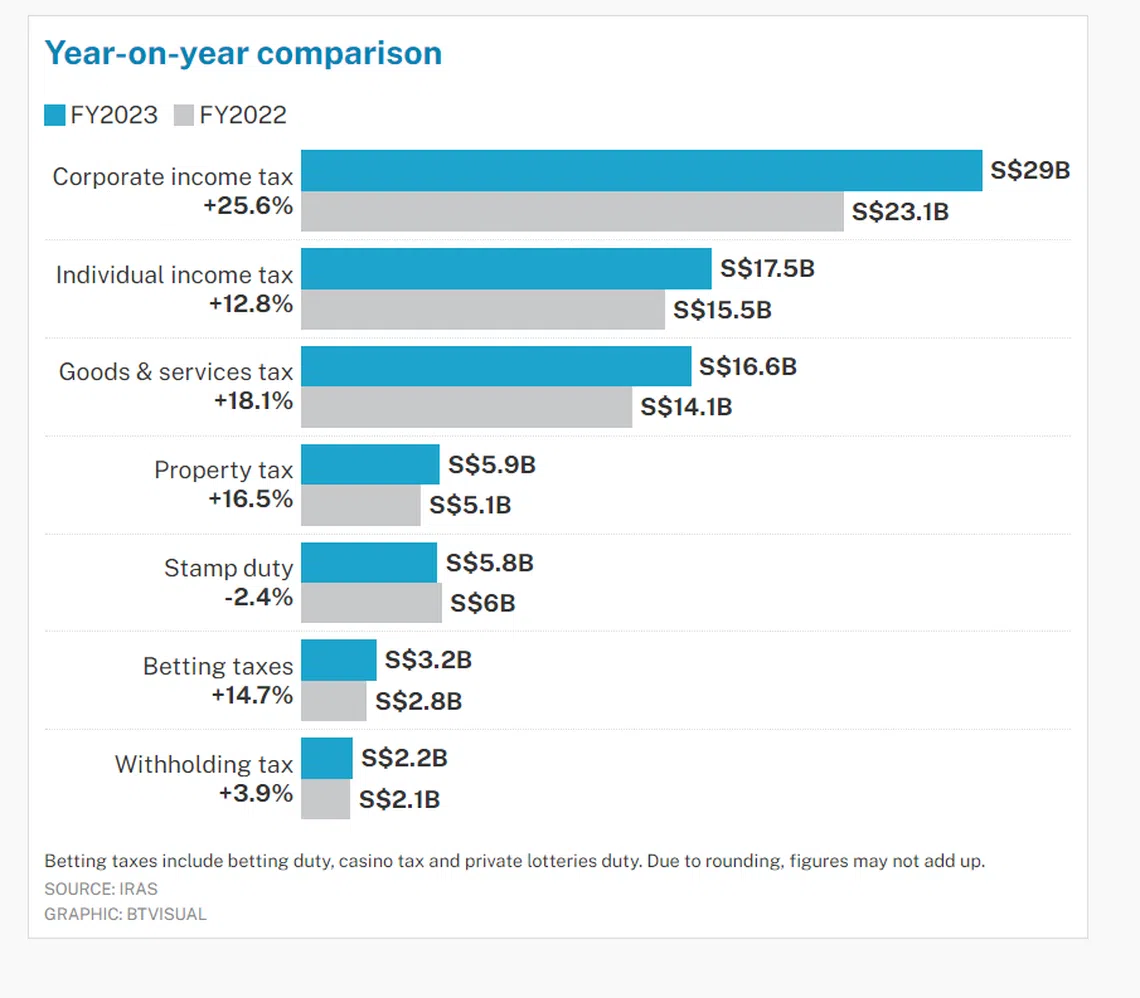
Corporate income tax takings jumped 25.6 per cent to S$29 billion due to strong corporate earnings, Iras said. This is the largest share of Iras’ revenue collection at over a third.
Harvey Koenig, partner for telecommunications, media, technology and tax at KPMG in Singapore, said the boost in corporate tax collections reflects strong confidence in Singapore’s economic growth, since the tax is collected on a preceding year basis.
Revenue from individual income tax grew 12.8 per cent, or S$2 billion, to S$17.5 billion. The authority said this was because of higher wages and an increase in the number of taxpayers.
There was an 18.1 per cent gain in receipts from goods and services tax (GST) to S$16.6 billion as a result of higher consumer spending and the one-percentage-point increase in the GST rate.
Property tax revenue went up 16.5 per cent to S$5.9 billion, but stamp duty collection dipped by about 2.4 per cent, or over S$100 million, to S$5.8 billion due to lower property transaction volume.
The total revenue collection represents about 77.6 per cent of the government’s operating revenue and 11.9 per cent of Singapore’s gross domestic product, said Iras.
“The taxes collected are used to fund essential services for our community, grow our economy, enhance our living environment, as well as support social development programmes to improve the lives of Singaporeans,” Iras said.
Maybank senior economist Chua Hak Bin said the higher tax revenue could have nudged Singapore’s overall fiscal position for FY2023/24 to being “near balanced”, compared with the earlier deficit projection of S$3.6 billion.
“A balanced budget for FY2023/24 will provide more fiscal room for the last and final budget, within this electoral term, in February next year,” he added.
Analysts told The Business Times they expect tax revenue to continue rising for the current FY.
“Given that 2024 GDP growth is likely to come in at the higher end of the official 2 to 3 per cent forecast range, and the GST rate was increased by one percentage point to 9 per cent in January 2024, tax revenue should grow, albeit at a more subdued pace,” said OCBC chief economist Selena Ling.
However, she questioned if tax revenue can continue to sustain double-digit growth in the coming years, given that more Singaporeans have been travelling overseas. “Spending by inbound tourists does not appear to have fully mitigated the slack, as illustrated by the local retail sales data despite the many Mice (meetings, incentives, conferences and exhibitions) events which are still happening,” Ling said.
Corporate tax collection is also expected to grow, with Singapore set to implement the Income Inclusion Rule and Domestic Top-up Tax components under pillar two of Base Erosion and Profit Shifting (BEPS) 2.0 framework from January next year.
However, analysts said the impact may not be seen within the next FY. This is because the earliest tax submissions and collections under the new global minimum tax framework will not take place until 2027, said Chester Wee, EY Asean international tax and transaction services leader.
However, he added that forecasting the precise impact of these tax reforms will be challenging, as it depends on a multitude of variables, including the overall economic climate and the implementation of BEPS 2.0 Pillar One.
Nonetheless, given the heavy presence of multinational corporations in Singapore, Maybank’s Chua believes the Republic could see corporate income tax revenue increase by “as much as 20 to 25 per cent”.
But such revenues are likely to be offset by measures to maintain the country’s competitiveness, Chua Kong Ping, tax partner at Deloitte Singapore noted, as indicated.
Apart from tax collection, Iras said it also processed close to S$2.3 billion in payouts to more than 131,000 businesses, supporting them as well as workers.
These are grants from schemes such as the Progressive Wage Credit Scheme, Senior Employment Credit and Jobs Growth Incentive.
Amendment note: Figures in the story were updated due to rounding.
TRENDING NOW

Once staunchly pro-China, Malaysian Chinese businesses are now distancing themselves from Beijing

Cliff Tan has 7 million followers and a 4-month waitlist. Why won’t he expand his business?

Could stablecoins be the future of money?

Grab CEO’s wife Chloe Tong on life with Anthony Tan and finding her purpose

