
Laser Cutting Materials Guide: What Can and Cannot Be Laser Cut

Updated: 7 days ago
One of the first questions we hear about laser cutting is simple: Can this material be laser cut?
The answer depends on the material, its thickness, its exact composition, and the type of laser being used. Two sheets that look similar can behave very differently once exposed to a laser.
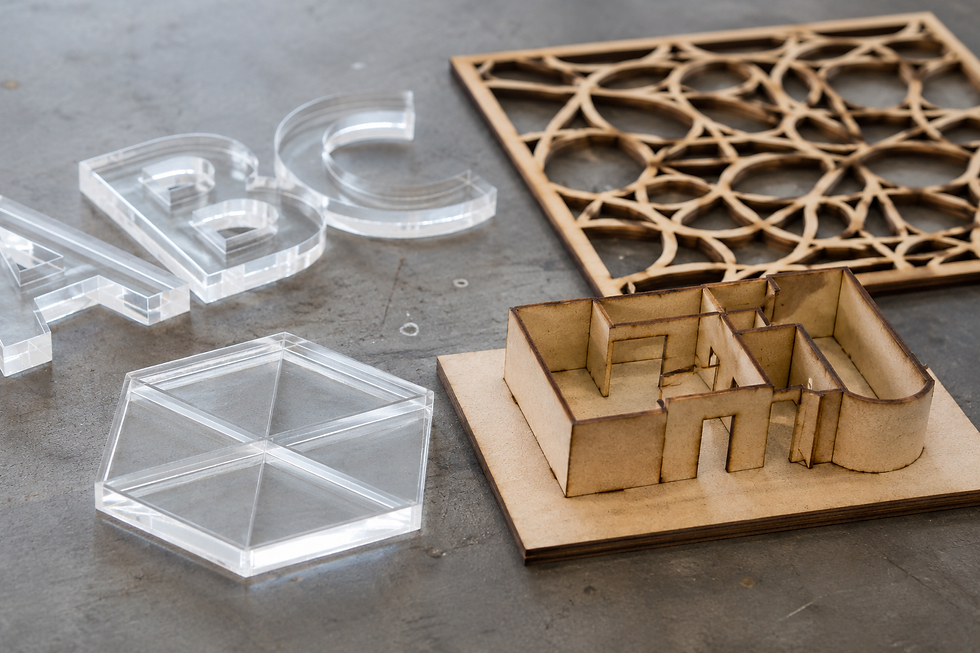
At GPG Printing, our laser cutting work in Singapore commonly includes acrylic, wood and MDF, leather and foam, paper and cardboard for projects such as signage, models, prototypes, displays, packaging, and custom parts.
This guide covers the materials that generally work well with CO₂ laser cutting, materials that need to be checked first, and materials that should not be laser cut.
Quick Guide: Which Materials Can Be Laser Cut?
Material | Laser Cutting? | What to Know |
Acrylic / PMMA | Yes | One of the most common CO₂ laser-cutting materials |
Wood / MDF | Yes | Edge colour can vary depending on the wood |
Paper / Cardboard | Yes | Good for detailed cuts and prototypes |
EVA / suitable foam | Yes | Composition must be confirmed |
Fabric | Often | Depends on fibre and coating |
Natural leather | Often | Composition and treatment should be checked |
Laser-safe rubber | Often | Exact material must be confirmed |
PVC / Vinyl containing PVC | No | Can release hazardous gases |
PTFE / Teflon | No | Not suitable for laser processing |
Unknown plastics | Check first | Do not cut without knowing the composition |
According to Trotec’s CO₂ laser material compatibility guide, materials such as acrylic, wood, paper, leather and textiles can be laser cut, although the result depends on the material and laser system.

Acrylic: A Good Material for Laser Cutting
Acrylic, also called PMMA, works well with CO₂ laser cutting. Cast and extruded acrylic behave differently during laser processing, so material type can also affect the final edge and engraving result.
Trotec identifies acrylic as suitable for both CO₂ laser cutting and engraving and notes that laser settings and material type affect edge quality.
Clear and coloured acrylic can both be used, but the thickness of the sheet matters. Thicker acrylic normally takes longer to cut, and the final result depends on the type of acrylic and the machine settings.
Wood and MDF
Wood and MDF also work well for many laser-cutting projects.
They are commonly used for:
Architectural models
Displays
Decorative pieces
Prototypes
Custom parts
Signage
MDF is relatively consistent because the material has a more uniform structure. Natural wood varies more because different wood species, thicknesses, moisture levels, and resin content respond differently to heat.
You should also expect some darkening around laser-cut wood edges. This is a normal result of using heat to cut the material rather than something that should automatically be treated as a defect.
Paper and Cardboard
Paper and cardboard are useful when a project needs fine shapes without using a heavy material.
Common uses include:
Packaging prototypes
Invitations
Paper models
Product mock-ups
Decorative patterns
Presentation pieces
Laser cutting is useful when the design contains small details or repeated shapes that would be difficult to cut manually.
Both Trotec and Epilog list paper among materials suitable for CO₂ laser cutting.
Because paper and cardboard are heat-sensitive, the type and thickness of the material still need to be considered before cutting.
EVA Foam and Other Foams
Foam is commonly used for protective inserts, product packaging, equipment storage and toolbox shadowing, where EVA foam is cut around individual tools to create organised storage.
For example, EVA foam can be cut around the shape of individual tools so each item has its own position inside a toolbox or drawer.
However, the word foam covers many different materials. Not every foam is safe for laser cutting. Trotec specifically identifies PVC-free foam as compatible while warning against PVC and other unsuitable chemical compositions.
If you are supplying your own foam, it is useful to provide the material specification rather than relying only on its appearance.
Fabric and Leather
Many fabrics can also be laser cut. Depending on the fibre, laser cutting can produce detailed shapes and may help seal the edge of some synthetic fabrics.
Epilog notes that both natural and synthetic fabrics can be laser processed, although test cuts are recommended because different fibres react differently.
Natural leather can also be suitable for cutting and engraving. However, the exact material needs to be known first.
Leather or artificial leather containing chromium VI or PVC should not be processed because of the substances that can be released during laser cutting.
This is why we would rather check an unfamiliar leather or synthetic material before putting it into the machine.

What Materials Should Not Be Laser Cut?
This is just as important as knowing what can be cut.
Some materials can produce hazardous gases, vapours or dust during laser processing. Trotec’s laser safety guidance specifically advises against processing materials such as:
PVC (polyvinyl chloride)
PVB
PTFE / Teflon
Leather containing chromium VI
Carbon fibre
Beryllium oxide
Materials containing certain halogens
Certain epoxy and phenolic resins
Trotec also advises extra caution with materials labelled flame-retardant, because some may contain bromine.
Be Careful With Unknown Plastics
A plastic sheet should not be laser cut simply because it looks similar to acrylic.
If the material composition is unknown, check the manufacturer's technical or safety information first. Epilog’s CO₂ laser material guidance also warns against materials containing vinyl chloride, halogens, chromium-containing artificial leather, epoxy and phenolic resins.
For customers bringing their own material, knowing the material name and composition helps us determine whether it is suitable.
Material Thickness Also Matters
A material being laser-compatible does not mean every thickness can be cut on every machine.
As thickness increases, the laser generally needs more time and energy to pass through the material. The practical limit depends on:
Material type
Thickness
Laser power
Desired edge quality
Detail in the design
This is why it is better to check the material and thickness for a specific project rather than relying on a single universal thickness limit.

Bringing Your Own Material for Laser Cutting
If you already have the material for your project, send us as much information about it as possible.
Useful details include:
Material name
Material thickness
Sheet size
Manufacturer or product specification, if available
Quantity
Your PDF or DXF design file
GPG Printing allows customers to choose from available materials or bring their own material for suitable projects. Our current artwork workflow also accepts PDF and DXF files, with separate lines used to identify cutting and marking requirements.
If the material composition is unclear, we may need to check it before confirming that it can be processed.
Laser Cutting in Singapore
The best material for a laser cutting project depends on what you are making. Acrylic may work well for signage and displays, MDF for models and prototypes, EVA foam for tool inserts, and paper or cardboard for packaging and presentation work.
The important part is not to assume that every plastic, foam, leather, or composite material is laser-safe. Check the material first, especially when you are supplying it yourself.
GPG Printing provides Laser Cutting Services in Singapore for businesses, designers, schools, students, workshops and custom projects. We work with materials including acrylic, wood and MDF, leather and suitable foam, paper and cardboard.
Our workshop is located at 18 Boon Lay Way, #08-99 TradeHub 21, Singapore 609966. You can send us your material, thickness, artwork, size, and quantity so we can review the project before cutting.


Comments