What’s happening in Singapore’s telco industry?
Singtel expects low double-digit EBIT growth whilst Starhub may be eyeing a merger.
Singtel continues to dominate Singapore’s telecommunications market due to its stronger ex-Singapore earnings prospects, capital management opportunities, and structural upside from new growth engines resulting in an expected return on invested capital (ROIC) growth of 10% for the 2025 financial year, according to RHB.
Singtel's EBIT is on track for a low double-digit growth in FY 2025. Meanwhile, EBIT from the core Singapore and Optus units grew 12.8% in H1 FY2025. The group’s wholly owned subsidiaries Optus’ EBIT (in AUD terms) surged 58% on good cost efficiencies, whilst NCS’ EBIT jumped 40% from higher delivery margins.
The group is also said to be on track to meet its halfway mark of $200m opex savings target for the financial year.
“Overall, we continue to see the group’s mid-term capital recycling target of $6b supporting the variable realisation dividend (VRD), with $1bn (6 cents/share) to be recognised over the next six months,” RHB Group said.
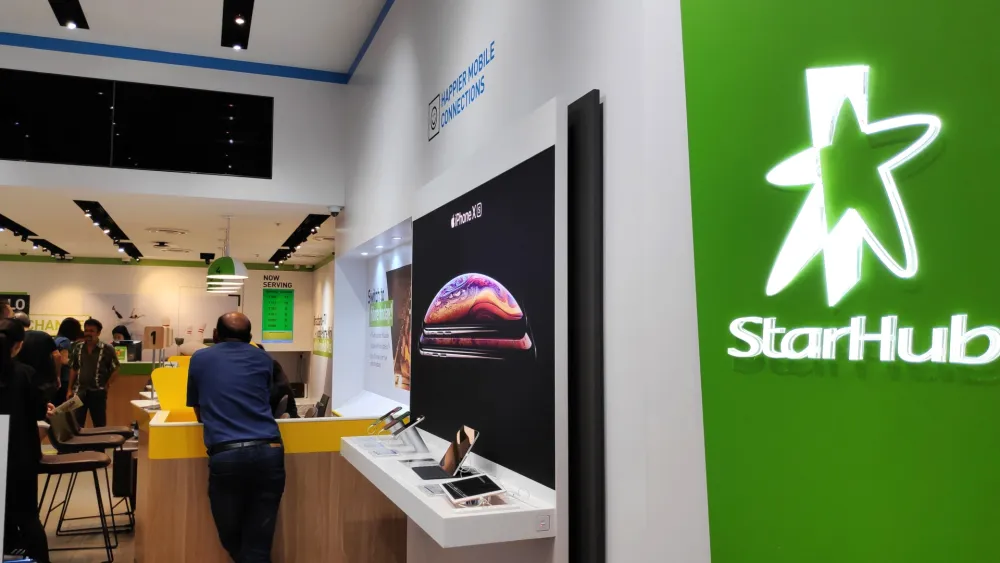
Meanwhile despite Starhub not yet releasing statements on potential mergers or acquisitions, talks of them, M1, and Simba Telecom merging is expected to ‘right-size’ the acute competition in the mobile virtual network operator (MVNO) space.
RHB said there is a possibility that 2025 could bring more M&A in the telecom sector, helped by the interest rate downcycle and strong investment propositions specifically for infrastructure assets. Telcos are also looking to strengthen their franchise values on the “techco” journey and on the back of the artificial intelligence (AI) boom.
“With investments from the multi-year transformation programme (2022-2025) largely behind the group, StarHub should start to capture the synergies and benefits from the transformation in 2025. However, the underlying impact on earnings may be more pronounced in FY26-27F, as costs associated with legacy networks taper off. The shift in the market’s competitive dynamics may temper the positive outcomes of the transformation, in our view, with potentially lower revenue growth and shallower opex savings,” RHB said.


























 Read Here
 Advertise
 Sign Up