


新加坡海外收入汇回:2026年公司与个人的纳税规则与免税条件

Ray Tay
海外收入汇回新加坡何时需纳税?本文解析第10(25)条“汇入”定义、第13(8)条三项免税条件、外国税收抵免、第10L条及文件留存要求。
Published: 1 August 2026 · Last reviewed: 19 October 2026 · Reviewed by Ray Tay, Co-Founder & Managing Director, VIVOS PTE. LTD. (ACRA Filing Agent FA20240323 · MOM EA Licence 24S2425)
Quick answer: A Singapore employer must file Form IR21 with IRAS at least one month before a non-Singapore Citizen employee (a foreigner or a Singapore PR) stops working for it, starts an overseas posting, or leaves Singapore for more than three months, and must withhold all money due to the employee from the day it learns of the departure. IRAS processes 80% of e-filed IR21s within 7 working days and then issues a Clearance Directive telling the employer either to pay the tax within 10 days or to release the money. Filing late or not at all without a valid reason is an offence that IRAS may compound for S$100 to S$1,000 or take to court.
IR21 tax clearance at a glance
| Item | Rule |
|---|---|
| Who needs tax clearance | Non-Singapore Citizen employees (foreigners and Singapore PRs), including all work pass holders such as EP, S Pass, ONE Pass and PEP holders |
| What triggers it | Ceasing employment in Singapore, starting an overseas posting, or leaving Singapore for more than 3 months |
| Filing deadline | At least 1 month before the cessation, posting or departure date, via myTax Portal (Corppass) |
| Withholding | All monies due to the employee, from the date the employer knows of the departure |
| IRAS processing time | 80% within 7 working days for e-filing; 80% within 21 days for paper filing |
| Clearance Directive | E-copy on myTax Portal within 3 working days of processing; any tax due must be paid within 10 days |
| Penalty | Composition of S$100 to S$1,000, or a court summons, for late or non-filing without a valid reason |
| Not required for | Singapore Citizens; SPRs not leaving permanently (with a Letter of Undertaking); certain short or low-income employments; some group transfers and short overseas postings |
Source: IRAS, Tax Clearance for Foreign & SPR Employees (IR21), checked 19 October 2026.
File Form IR21 at least one month before a non-Singapore citizen employee ceases employment, is posted overseas, or leaves Singapore for more than three months — and withhold all monies due from the moment you are aware of the departure. That is the core obligation. Miss it without a valid reason and IRAS may compound the offence for S$100 to S$1,000 or summon the employer to court, and the employer can become liable for tax it should have withheld.
What to do in the next 24–72 hours:
Immediate action checklist:
Pro Tip: E-file via myTax Portal rather than submitting a paper form. You receive immediate acknowledgement, faster processing, and can access the electronic Clearance Directive online without waiting for postal delivery.
Tax clearance applies to all non-Singapore citizen employees, including every category of work pass holder. The obligation is broad by design.
Employee categories that trigger IR21 filing:
Scenarios that trigger filing:
When IR21 is NOT required:
Certain scenarios are exempt. Tax clearance is not required when:
For exempt cases, submit the employee’s employment income via Form IR8A or the Auto Inclusion Scheme (AIS) by March 1 of the following year instead.
Pro Tip: When in doubt about whether an exemption applies, e-file the IR21. The myTax Portal will notify you immediately if tax clearance is not required, eliminating the risk of a missed filing.
Plan around the one-month rule. File at least one month before the employee’s last day of employment, the start of an overseas posting, or the departure date for a stay exceeding three months.

How the clock starts:
The filing deadline is counted back one month from the cessation, posting or departure date, while the duty to withhold starts on the date you become aware of the impending cessation or departure, not the date on the resignation letter. If an employee verbally confirms departure on March 2, withholding begins on March 2 and the IR21 must be filed by the date one month before the cessation date.
Calendar examples:
If you cannot meet the one-month deadline
Pro Tip: Build the IR21 filing date into your HR offboarding checklist the moment an employee hands in notice. Waiting until the final week creates avoidable risk.
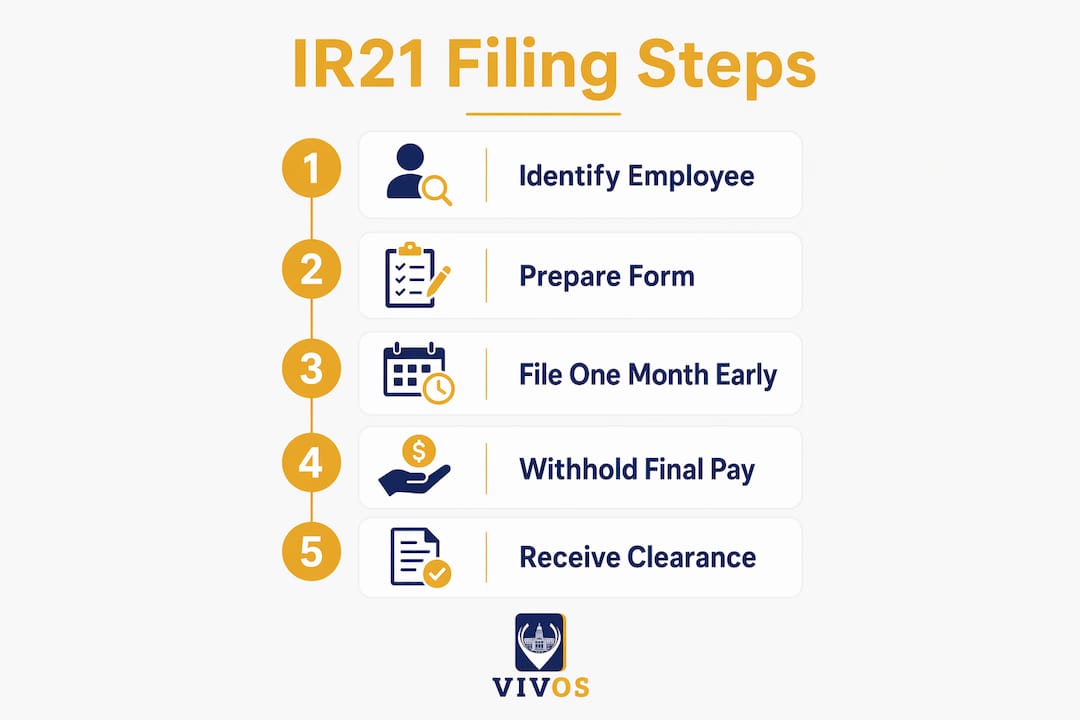
E-filing is the preferred method. IRAS strongly recommends it for immediate acknowledgement, faster processing, and online access to the Clearance Directive.
Step-by-step e-filing process:
Paper filing fallback:
Download the IR21 form (DOCX/PDF) from the IRAS website, complete it manually, and mail it to IRAS. Paper forms take longer to process and delay Clearance Directive delivery. IRAS accepts paper filing as a normal option, but e-filing gives an immediate acknowledgement and faster clearance, so it is the better route whenever it is available.

Required documents and data to collect before filing:
| Document / Data Item | Details Required |
|---|---|
| Employee identification | NRIC/FIN or passport number, nationality |
| Work pass details | Pass type, pass number, expiry date |
| Employment dates | Start date, cessation/departure date |
| Income by calendar year | Salary, bonuses, overtime, allowances, leave pay, gratuities |
| Withheld amount | Total monies withheld and breakdown by payment type |
| Spouse and children | Full name, ID number, relationship, date of birth |
| ESOP/ESOW details | Grant date, exercise date, gains (or Tracking Option status) |
| Reason for late filing | If applicable, supporting documentation |
ESOP/ESOW note: IRAS allows a Tracking Option for certain share plan gains so employers can report actual realized gains instead of deemed exercise values. Employers must apply for this option and meet qualifying conditions before using it on the IR21.
Pro Tip: Reconcile the last pay period’s pro-rata amounts before completing the “amount withheld” field. IRAS explanatory notes include worked examples for salary paid in advance — review these to avoid the most common revision trigger.
From the date you are aware of the impending cessation or departure, withhold all monies due to the employee. This is a legal obligation, not a discretionary step.
Monies subject to withholding:
Payroll withholding workflow:
If you cannot withhold the full amount:
Document the reason clearly in the IR21 form. Failure to explain why monies were not withheld may result in the employer being held liable for the employee’s unpaid tax. Common valid reasons include an employee who has already left Singapore before the employer became aware, or a case where the employee had no remaining pay due.
Employer liability is real. If you release monies before receiving the Clearance Directive and the employee has an outstanding tax balance, IRAS may pursue the employer directly for that amount. The withholding obligation is the employer’s primary protection against this outcome.
Internal controls to implement:
Pro Tip: Coordinate between HR, payroll, and finance at the point of resignation — not at the point of filing. Delays in internal communication are the most common reason employers miss the withholding start date.
IRAS processes 80% of e-filed Forms IR21 within 7 working days and 80% of paper forms within 21 days; it can take longer if information is incomplete or IRAS needs clarification. The electronic Clearance Directive appears on myTax Portal within 3 working days after processing, and the posted copy arrives within 5 to 7 working days.
Two possible Clearance Directive outcomes:
After the Directive arrives:
Refunds and overpayments:
If the withheld amount exceeds the tax in the Directive to Pay Tax, the employer pays IRAS the tax assessed and releases the balance to the employee. IRAS refunds the employee directly only if the employee later overpays, for example after an amended tax bill (IRAS says within 30 days).
Pro Tip: Check myTax Portal for the electronic Clearance Directive rather than waiting for the postal copy. The three-working-day electronic turnaround after processing means you can act on the Directive significantly faster than the postal timeline allows.
Employers who file late or not at all without a valid reason commit an offence: IRAS may offer to compound it for S$100 to S$1,000, depending on past filing and payment records, or summon the employer, including its directors, to court. Beyond the fine, releasing withheld monies before the Clearance Directive arrives can make the employer liable for the employee’s unpaid tax.
Most common IR21 filing errors:
Preventive checklist (8 items):
If IRAS queries your IR21: Prepare payroll records, the employment contract, the resignation letter, and all supporting income documentation. Respond promptly and in writing. Delays in responding to IRAS queries extend the processing timeline and delay the Clearance Directive. For complex disputes or assessments, tax dispute resolution support from a qualified corporate services provider reduces response time and risk.
VIVOS provides end-to-end IR21 support for employers in Singapore, covering every stage from payroll reconciliation to Clearance Directive receipt. The service is designed for HR, payroll, and finance teams that need reliable, compliant filing without building the process in-house.
What VIVOS delivers:
VIVOS engagement process:
VIVOS works directly with HR, payroll, and finance contacts within the employer’s organization. For straightforward cases, turnaround from document receipt to e-filing submission is typically within two to three business days. Complex cases involving ESOP/ESOW, multiple income streams, or cross-border elements take longer but follow the same structured process.
Beyond IR21, VIVOS’s capabilities in annual tax filing, withholding tax advisory, and tax dispute resolution mean employers have a single point of contact for the full range of Singapore employer tax obligations.
Pro Tip: Engage VIVOS at the point of resignation, not at the filing deadline. Early engagement allows payroll reconciliation to run in parallel with the notice period, eliminating last-minute errors and missed withholding.
Employers in Singapore must file Form IR21 sufficiently before a non-Singapore citizen employee’s cessation date, withhold all monies from the date of awareness, and act on the Clearance Directive within the prescribed deadlines to avoid fines and personal liability.
| Point | Details |
|---|---|
| File one month early | Submit Form IR21 at least one month before cessation, overseas posting, or departure exceeding three months. |
| Withhold all monies immediately | Hold salary, bonuses, leave pay, gratuities, and all other payments from the date you become aware of the departure. |
| E-file via myTax Portal | E-filing provides immediate acknowledgement and electronic Clearance Directive access within three working days of processing. |
| Act on the Clearance Directive within 10 days | Remit tax per a Directive to Pay Tax within 10 days; GIRO instalment plans do not apply to tax clearance cases. |
| Engage VIVOS for complex cases | ESOP/ESOW elements, tight notice periods, or IRAS queries benefit from VIVOS’s end-to-end IR21 and tax clearance support. |
Most IR21 errors are not caused by ignorance of the rules. They are caused by process gaps: the payroll team files the form before HR has confirmed the final bonus, or the finance team releases withheld funds because the employee is pressing for payment and the Clearance Directive hasn’t arrived yet. The form itself is not complicated. The coordination is.
The single most valuable step any payroll team can take is reconciling the last pay period before touching the IR21 form. IRAS’s own explanatory notes include worked examples for salary paid in advance precisely because this is where most revisions originate. A revised Clearance Directive adds time to the process and creates friction with a departing employee who is waiting for their final pay.
Spouse and children particulars deserve more attention than they typically get. Many employers skip this section because it feels like the employee’s responsibility. It is not. Including complete family details allows IRAS to apply relevant reliefs, which can reduce the assessed tax and eliminate the need for an amended filing. That is a small pre-filing step with a disproportionately large payoff in processing speed.
One more point that practitioners see repeatedly: employers who use e-filing and keep a scanned copy of the signed IR21 in their records resolve IRAS queries in a fraction of the time it takes employers who filed on paper. The audit trail is immediate and complete. For Singapore personal income tax matters that follow the IR21, having that documentation in order also protects the employer if the employee later disputes the income figures reported.
VIVOS is the practical alternative to managing IR21 tax clearance in-house, particularly for SMEs, multinational employers, and payroll outsourcers handling multiple departing employees at once. The concrete difference: your team hands over the payroll data and employee details, and VIVOS handles reconciliation, drafting, e-filing, IRAS correspondence, and Clearance Directive follow-up from start to finish.

For employers dealing with tight notice periods, ESOP/ESOW complications, or employees who have already left Singapore, VIVOS’s structured process reduces the risk of late filing penalties and employer liability. The service covers corporate secretarial compliance, tax filing, and payroll reconciliation under one engagement, so IR21 does not sit in a gap between departments.
Contact VIVOS for an IR21 health check or end-to-end filing support. Turnaround from initial document submission to e-filing is typically two to three business days for standard cases. Reach the VIVOS team at vivos.com.sg to get started.
The following IRAS pages are the authoritative source documents for all IR21 filing requirements. Bookmark these for your HR and payroll teams.
Official IRAS links:
Quick-reference summary:
| Resource | Primary Use |
|---|---|
| IRAS IR21 overview page | Confirm scope, exemptions, and SPR rules |
| Step-by-step guide | Deadlines, withholding obligations, penalty reference |
| Filing tax clearance page | myTax Portal e-filing workflow and Corppass setup |
| How to complete Form IR21 | Field guidance, income examples, ESOP/ESOW notes |
| Scenario-based FAQs | Processing times, GIRO exclusion, refund timelines |
This article provides general information on IR21 tax clearance obligations in Singapore. It is not legal or tax advice. Employers should verify current requirements directly with IRAS or consult a qualified tax professional for their specific circumstances.

 2 January, 2025
 2 January, 2025
What is IR21 tax clearance in Singapore?
Tax clearance is the process in which an employer notifies IRAS on Form IR21 that a non-Singapore Citizen employee (a foreigner or a Singapore PR) is ceasing employment, starting an overseas posting or leaving Singapore for more than three months, and withholds all money due to the employee until IRAS issues a Clearance Directive. It applies to all work pass holders, including EP, S Pass, ONE Pass and PEP holders.
When must an employer file Form IR21?
At least one month before the employee stops working in Singapore, starts an overseas posting or leaves Singapore for more than three months. If one month’s notice is not possible, for example because of an immediate resignation, the employer must state the reason in the Form IR21.
How long does IRAS take to process Form IR21?
IRAS processes 80% of e-filed Forms IR21 within 7 working days and 80% of paper forms within 21 days; it can take longer if information is incomplete or IRAS needs clarification. The electronic Clearance Directive is available on myTax Portal within 3 working days after processing, and the posted copy arrives within 5 to 7 working days.
What must the employer withhold during tax clearance?
All monies due to the employee, including salary, overtime pay, leave pay, allowances, reimbursements, gratuities and lump-sum payments, from the date the employer knows of the cessation or departure. If the employer cannot withhold everything, it must give the reason in the Form IR21; otherwise it may be liable for the tax the employee owes.
What is the penalty for not filing IR21?
Unless there is a valid reason, such as an employee’s immediate resignation, not filing Form IR21 or filing it late is an offence: IRAS may offer to compound it for S$100 to S$1,000, depending on the employer’s past filing and payment records, or summon the employer, including its directors, to court. Releasing withheld money before the Clearance Directive can also leave the employer liable for the employee’s unpaid tax.
When is tax clearance not required?
It is not required for Singapore Citizens; for SPRs who are not leaving Singapore permanently and sign a Letter of Undertaking (this does not cover overseas postings); for employees who worked 60 days or less in a calendar year, or 183 days or more while earning less than S$21,000 a year, provided they had no other Singapore employer in the cessation year or the year before; for certain transfers within a group; and for overseas postings of six months or less that meet IRAS’s conditions. The income must still be reported on Form IR8A or through the Auto Inclusion Scheme by 1 March of the following year.

海外收入汇回新加坡何时需纳税?本文解析第10(25)条“汇入”定义、第13(8)条三项免税条件、外国税收抵免、第10L条及文件留存要求。

Employment Pass holders can bring their parents to Singapore on a Long-Term Visit Pass only if they earn a fixed monthly salary of at least…


