Issue 171: COP30 turns spotlight on adaptation; MAS pushes forward on transition credits
This week in ESG: Climate negotiators tackle adaptation finance, indicators; industry coalition issues final report on carbon credits for early retirement of coal plants


COP30
Transforming the adaptation game
Adaptation and resilience have come into focus at the annual United Nations climate summit – known as COP30 this year – in Belem, Brazil.
Two key items are on the agenda for climate negotiators. The first is a new climate adaptation finance goal, and the second is what indicators to use for tracking and measuring adaptation and resilience.
Climate adaptation and resilience refers to actions aimed at addressing the impact of climate change. These stand in contrast to climate mitigation, which aims to slow or reverse global warming. Climate mitigation tries to put out the fire; adaptation and resilience deal with the burns.
Financing adaptation
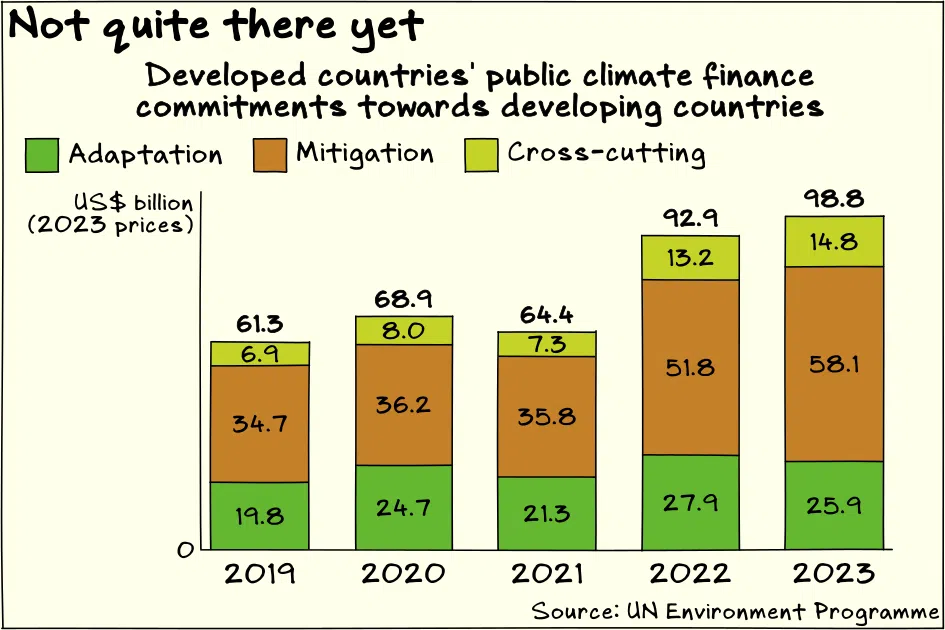
At COP26 in Glasgow in 2021, parties to the Paris Agreement agreed to aim to double adaptation finance flows from developed countries to developing countries by 2025, relative to 2019 levels.
Unfortunately, that target looks like it will be missed. An analysis by the UN Environment Programme (Unep) estimates that adaptation finance flows from developed countries to developing countries in 2023 stood at US$26 billion, significantly below the US$40 billion target for 2025. The 2023 flows were also slightly below 2022 levels due to a drop in funding from multilateral development banks.
Including adaptation finance from developing countries themselves, the total international public adaptation finance amount in 2023 would be US$35 billion.
Given the expiry of the Glasgow pact and the expected, parties in Brazil will be looking to set a new goal for adaptation financing, possibly for 2035.
What would be a credible target? Unep assessed countries’ adaptation plans and climate commitments, as well as models on adaptation costs, and estimated the cost of adaptation to be between US$310 billion and US$365 billion per year for developing countries by 2035 in 2023 prices. That represents a need of about 12 to 14 times current flows.
Adaptation’s evolution
It’s easy to be cynical about these targets. Even if negotiators arrive at a large enough amount to meaningfully address needs, the fact that countries failed to meet the less ambitious Glasgow target doesn’t instil confidence about meeting any new goals.
However, there are a few factors that might give a boost to adaptation and resilience financing in the coming years.
The first is that the world has fallen behind on its climate targets, which means that the risks of climate change are high and continue to climb. There’s a greater sense of urgency among policymakers, businesses and households to prepare for the impact of global warming.
That impetus leads to the second factor, which is that investors are beginning to see opportunities for profit in adaptation and resilience. Beyond expectations of greater end-user demand, a thematic shift away from climate mitigation amid a green pushback from some governments and businesses is also moving money towards adaptation and resilience.
A third factor is developing, and that’s the potential for better tracking and measuring of adaptation and resilience risks and outcomes.
Measuring adaptation
A major task for COP30 will be reaching agreement on what has been termed adaptation indicators.
For all the chatter over the past year about climate adaptation and resilience, there’s still no consensus on how to measure progress on adaptation and resilience. Part of the challenge is that adaptation and resilience cover a lot of ground. The framework for global climate resilience adopted at COP28 in the United Arab Emirates touched on seven thematic areas – water, food, health, ecosystems, infrastructure, poverty and livelihoods, and cultural heritage – and four dimensions – assessment, planning, implementation, and monitoring, evaluation and learning.
The nature of climate risk and adaptation are also highly contextual, which means that some flexibility needs to be incorporated into the indicators and how they are applied to make them useful.
From an initial list of more than 5,000 indicators, the discussions are currently dealing with about 105 indicators heading into COP30 with the aim to keep the indicators to about 100 or fewer.
Some of the points of contention revolve around how much work is required to obtain data. For example, advocacy group Adaptation Without Borders has argued that the adaptation framework can and should use indicators that are already being measured for other purposes to avoid imposing additional burdens on countries.
Adaptation indicators are widely seen as an important enablers of adaptation progress, because they establish a common language through which needs and progress can be communicated.
This is critical for the development of adaptation financing, which needs clarity about eligible activities and outcomes to prevent greenwashing. For instance, the Singapore-Asia Taxonomy for Sustainable Finance – a guiding document that defines what is eligible for sustainable financing – currently covers activities and technical screening criteria only for climate mitigation.
While climate adaptation is a stated objective of the Singapore-Asia Taxonomy, the taxonomy does not yet provide guidance on adaptation, stating:
“Adaptation measures respond to physical risks that are mostly location and context specific, hence, it is impossible to produce a stand-alone and exhaustive list of activities.”
Instead, the Singapore-Asia Taxonomy takes a principle-based approach: To qualify for adaptation financing, an activity should implement measures to increase its own resilience, or enable other activities to adapt to climate change.
With a common set of adaptation indicators, it becomes easier to determine those kinds of impact. Banks could even develop adaptation and resilience loans and bonds to spur the flow of private capital towards these purposes.
Climate adaptation and resilience has long been underfunded, especially in comparison to climate mitigation. But the pieces are falling into place for a boost in the coming years.
Carbon markets
Transition credits enter implementation phase
Transition carbon credits moved one small step closer to becoming reality, with work championed by the Monetary Authority of Singapore (MAS) entering the implementation phase.
Transition credits refer to a potentially new class of carbon credits issued for the early retirement of coal-fired power plants. Each transition credit will represent a tonne of greenhouse gas emissions reduced through the early phase-out of a coal plant.
MAS, which has positioned Singapore as a sustainable finance hub supporting the transition to low-carbon energy in Asia, has been the primary force behind the development of transition credits. Two years ago, MAS convened a multi-stakeholder initiative called the Traction Credits Coalition (Traction) to look into the feasibility of transition credits and to recommend how to develop and scale up the instrument.
Traction’s final report, published this week, estimates that a third of coal plants in 15 Asian markets could meet the requirements for issuing transition credits if they were to be phased out before their expected end-of-life, representing about one gigatonne of carbon dioxide equivalent emissions reduced every year. However, that estimate hinges on assumptions that the transition credit market works as expected, meaning governments adopt supportive policies and methodology developers establish credible and relevant guidelines for such credits.
Traction also recommends further innovation to improve scalability by improving the predictability of carbon revenues and by developing robust risk-mitigation solutions. For instance, credible buyers can provide clear demand signals, while projects can adopt alternative coal transition approaches to raise project viability and stakeholder buy-in.
“Just transition” principles also need to remain central to projects and credits, Traction says. A just transition refers to the greening of energy systems in ways that are considerate of the social impact of the transition.
Following the report, MAS is pushing into the next phase of transition credit development, which is to work towards the actual issuance and sale of transition credits. The Rockefeller Foundation and the Kinetic Coalition are key partners leading this next part of the process.
To instil confidence in the potential for transition credits, 21 parties have signed a statement of support for the instrument, including seven commercial banks, the governments of Singapore and the Philippines, and Singapore government-owned investor Temasek.
It’s still early days. Pilot credits will have to be issued to test demand in the carbon markets, and the economic impact of the credits on projects will have to be assessed. However, there is some urgency to this development. Phasing out of coal plants can only be considered “early” if the plants are retired no later than 2030 to 2040, and the decommissioning process can be quite lengthy, especially if alternative power sources need to be built. With only five years left until 2030, transition credits will probably need to become real within the next year or two to make a meaningful difference.
Other ESG reads
- Singapore’s Pulau Bukom to house new sustainable aviation fuel plant by Aster, Aether Fuels
- 3 in 4 SMEs have yet to go green due to financial and time constraints, lack of expertise: study
- ‘Fighting the sea every day’: Indonesia’s US$80 billion bid to save sinking Java coast
- Earth cannot ‘sustain’ intensive fossil fuel use, Lula tells COP30
- Data centres to drive energy storage ‘boom cycle’ in next five years, UBS says
- Shell drops two North Sea wind projects in fossil fuel shift