
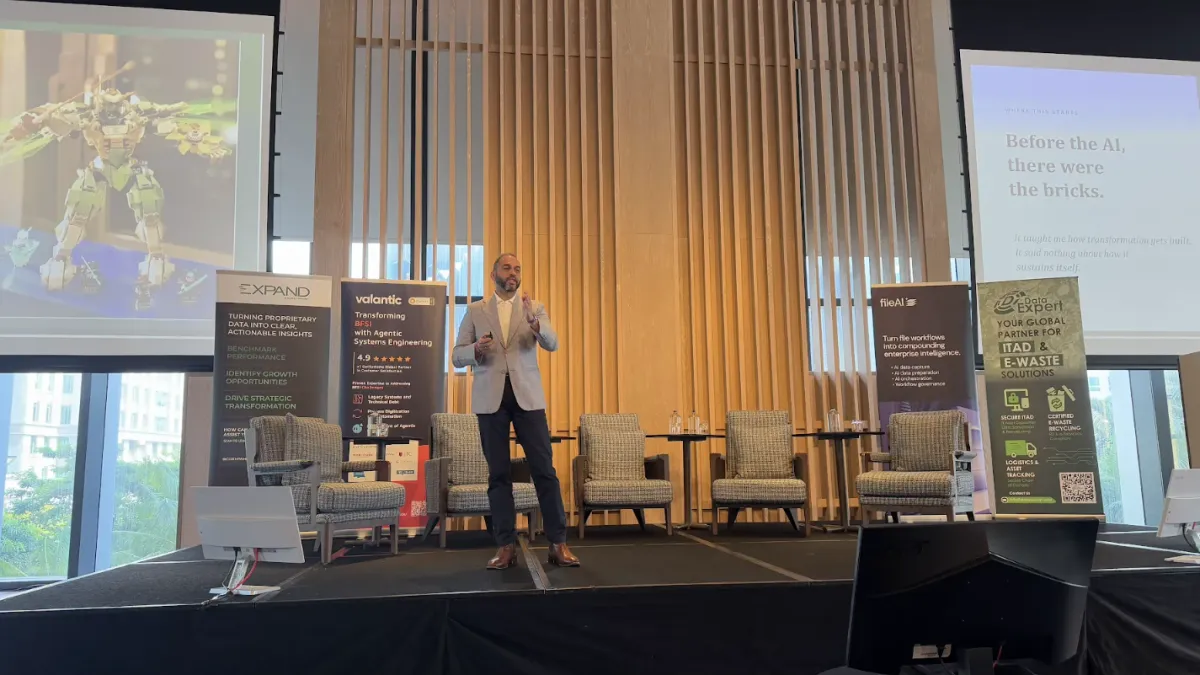
Industrialising AI pilots is insurers’ next enterprise test
Prudentials Mohit Tandon said usage is now the million-dollar question.
Insurers are finding that artificial intelligence (AI) pilots are easier to launch than to scale, as weak adoption, limited executive reinforcement, and unclear business impact prevent many initiatives from delivering enterprise-wide value.
Mohit Tandon, head of the Strategic Delivery Office at Prudential Plc, said at the Asian Banking and Finance and Insurance Asia summit in Singapore on 1 July that the insurance industry's biggest artificial intelligence (AI) challenge is no longer developing models, but ensuring they are adopted, reinforced, and embedded into day-to-day operations.
"There is no shortage of great ideas, there is no shortage of capability that is built," Tandon told the audience.
"But who's really using it? Is the organisation genuinely using the capability that AI built, and that's the million-dollar question, and that's the puzzle that we need to solve,"
According to Tandon, organisations have become proficient at launching pilots, yet far fewer have succeeded in industrialising them across the enterprise.
"My observation is it's really struggling," he said. "We have a lot of pilots, but it doesn't really scale, and the impact actually follows momentum, not really pilots,"
Insurers seek productivity gains amidst rising operational costs and increasing pressure to improve customer experience, he added.
However, executives are increasingly asking whether investments are translating to sustainable returns.
A McKinsey Global Survey on AI, released in 2025, found that whilst AI adoption continues to expand across industries, only a minority of organisations report material earnings impacts from generative AI initiatives, with many still struggling to move beyond experimentation into enterprise-scale deployment.
Similarly, Deloitte's State of Generative AI in the Enterprise 2025 reported that governance, workforce adoption, and change management remain among the biggest barriers to scaling AI across organisations.
Tandon also said that successful AI deployment depends on three interconnected factors: capability, adoption, and reinforcement.
"I define it as capability multiplied by adoption multiplied by reinforcement," Tandon said. "I want to emphasise the point—multiplication and not addition... any of these three pieces in the equation, if they are zero, it falls back to zero. Your pilot will not scale or industrialise."
According to Tandon, many AI initiatives lose momentum after deployment because organisations assume users will naturally embrace new tools.
He cited a common example involving AI-powered productivity software.
"You say, 'I have saved three hours.' Then you ask, 'Okay, you've saved three hours in the day, what did you do in those remaining three hours?' There's no answer," he said. "If you cannot clearly articulate that, once you've adopted, what is the impact to the organisation, you would struggle to have value,"
Whilst AI literacy is encouraged across organisations, Tandon added that specialised expertise will ultimately determine whether insurers can unlock enterprise value.
Looking ahead, Tandon expects AI innovation to continue. Still, competitive advantage will increasingly depend not on how many pilots organisations launch, but on whether they can consistently convert experimentation into sustained operational change.














![[Singapore Business Review] Report on the Asian Business Channel](https://www.cmgassets.com/s3fs-public/styles/video_thumbnail/public/2026-10/full-show-thumbnail_1.png.webp?VersionId=bJbrT_JKOuMWBnf7YkmsWjOSWIXddSvY&itok=zWuxHRNG)













 Read Here
 Advertise
 Sign Up









