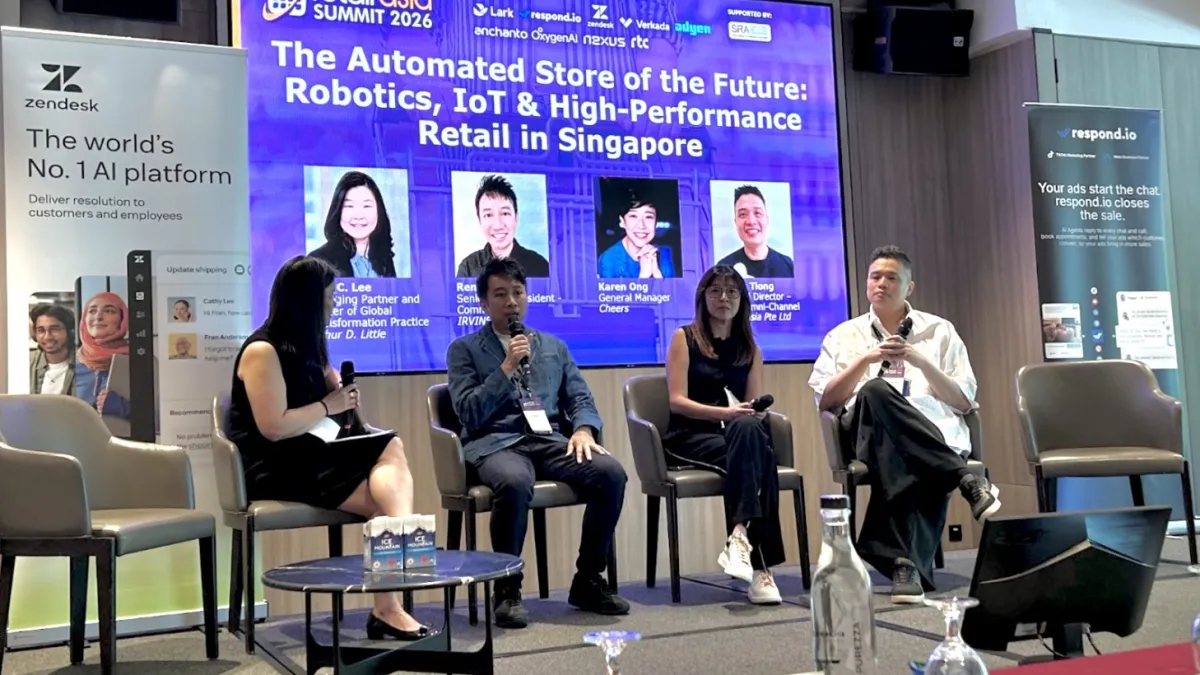
Retailers rethink frontline jobs as technology takes on routine tasks
AI, RFID, and self-service tools are helping stores extend operations whilst reducing routine workloads.
Retailers are redesigning frontline roles as technology takes on repetitive and low-value tasks, giving staff more time to focus on customers, according to industry leaders.
Speaking at the Retail Asia Summit 2026 in Singapore, ASICS Asia Regional Director – DTC & Omni-Channel Andros Tiong said retailers need to clearly separate tasks that can be handled by automation from those that require frontline staff.
“When we actually introduce automation as part of support, the brand itself, the company itself, needs to be very clear, like, what are all the low-value work?” he said.
Tiong said data-driven tasks that can be generated automatically should be handled by technology, whilst employees should focus on customers.
“What we are trying to do is not to replace the employees there,” he said. “What we are trying to do is, we're going to give you all the ammunition to face the customers, have the knowledge.”
He said frontline employees traditionally handle a wide range of responsibilities, from serving customers and checking inventory to managing stockrooms, scanning QR codes, and conducting stock takes.
With automation, retailers need to give staff clearer objectives and allow technology to take on tasks that can be automated, Tiong said.
“I think what is important for an organisation is not to continuously add technology to technology,” he said. “You need to understand what is existing in your organisation that works well.”
At IRVINS, Senior Vice President – Commercial Reno Chow said the company first audits its operations to identify where technology can address its biggest operational challenges.
“It’s not about getting a technology to hopefully one day it can actually resolve the issue,” he said. “First we should make an audit on that.”
The snack retailer has used technology to address staff rostering and inventory management, which Chow said can take up significant operational time across its stores.
The aim is to allow staff to spend more time on activities such as improving stores, visual merchandising, service, and planning for individual stores, he said.
Chow also said IRVINS maps technology to the customer journey rather than adopting technology for its own sake. At its Terminal 4 store, the company has introduced a hybrid unmanned store concept that allows the outlet to remain open during night hours.
The setup uses an AI agent trained on company information, brand history, FAQs and other content, which can answer questions in more than 40 languages. RFID tags are attached to products, whilst AI cameras check whether items taken from shelves match what customers pay for at self-service kiosks.
At Cheers, General Manager Karen Ong said the company is also reconsidering frontline job scopes as technology changes how convenience is delivered.
“I think convenience itself is being redefined as we speak with e-commerce, with Grab commerce, with live streaming, TikTok,” she said.
Ong said the company is working on an exercise to “completely redefine the job scopes” of frontline staff and redesign the structure of convenience-store operations.
“We are now doing an exercise together with the team to really redesign the entire frontline structure of the convenience store,” she said.
She said the objective is to use technology to remove repetitive work and allow employees to focus on higher-value activities.
“Remove the low-value work, remove the repetitive work so that they can, you know, bring better value to their jobs,” Ong said.
She added that the company is looking at how technology can extend operating hours without increasing manpower costs.
“To think that technology will now replace people, I don’t think that will ever be 100% true,” Ong said, adding that retail remains a people business and employees need to be trained to use technology to deliver better service.


























 Read Here
 Advertise
 Sign Up