Globe turns to Starlink to fortify network against disaster risks
The group is the first in Southeast Asia to integrate LEO satellite technology.
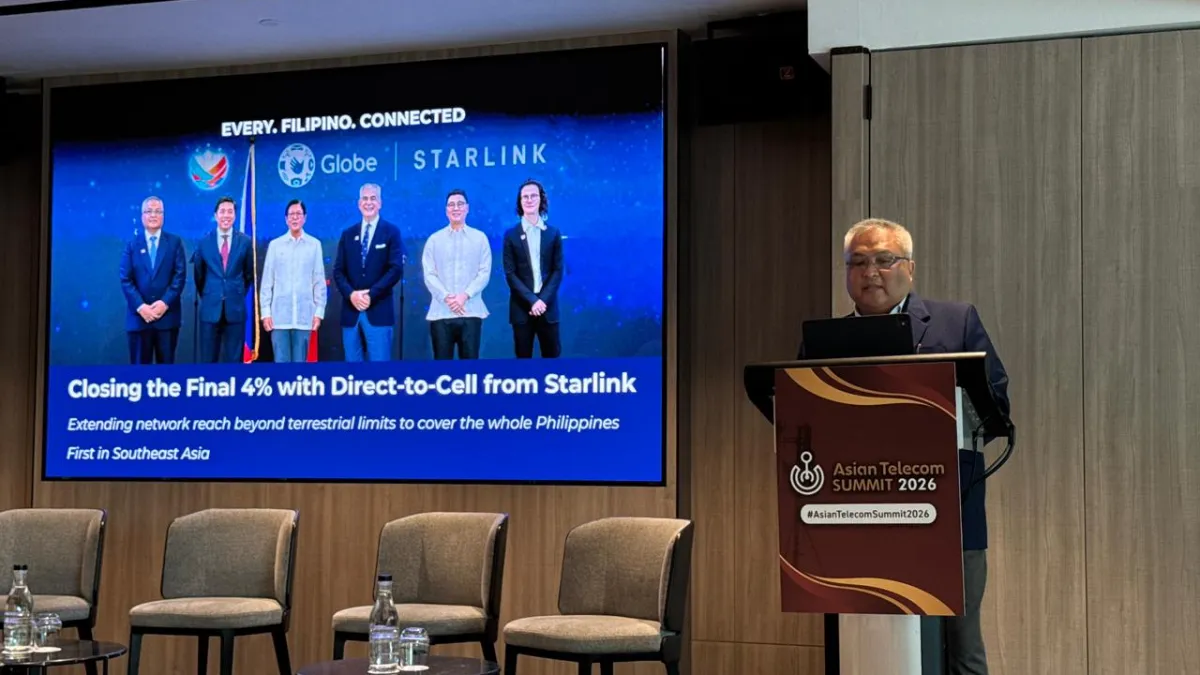
Philippines’ Globe Telecom has entered a direct-to-sell partnership with Starlink to embed low-earth-orbit (LEO) satellite connectivity into its broader network strategy, citing the need for infrastructure resilience in one of the world’s most disaster-prone countries.
The group has become the first operator in Southeast Asia to adopt LEO satellite technology, and second only in Asia after Japan, Globe Telecom President and CEO Carl Cruz said during the 2026 Asian Telecom Summit in Singapore.
“We deliberately designed the architecture to be intelligent and provide a seamless network, adapted to the unique real-world conditions of the Philippines,” he added,
The country’s geography, with over 7,600 islands, and disaster exposure shape the company’s network strategy. “[The Philippines] carries a risk index of 46.6.”
In 2025 alone, it faced over 21 typhoons that resulted in damages of close to $1b.
“In an archipelago such as the Philippines, there is no silver bullet technology to build a truly resilient network,” Cruz said.
In response, the group has built a multi-network ecosystem that integrates cell sites, fibre, fixed wireless and satellite technologies. Each plays a specific role—fibre delivers capacity in urban centres, mobile networks extend reach in rural areas, and satellites provide secure redundancy for critical services.
The ceo described connectivity as critical infrastructure. “We have entered an era where connectivity is no longer a privilege; it is the fifth utility, as essential to national progress as water and electricity.”
Earlier this year, Globe also formalised a partnership with the government focused on emergency telecommunications in the country’s capital, Metro Manila.
Under the agreement, the group integrates its infrastructure into the government’s master plan for a major earthquake scenario, commonly referred to as “the big one”.
“We are ready to deploy our network-in-a-box and cell-on-wheel solutions, capable of activation in hard-hit areas within hours,” Cruz added.
The group has also launched initiatives in provinces with limited connectivity, in partnership with the government and other industry partners.
Beyond infrastructure, Cruz said that the group is also collaborating with Nokia Corporation to roll out network application programming interfaces (APIs) via a Network Exposure Platform.
The APIs enable network-on-demand capabilities, including higher priority or enhanced security for specific transactions.

























 Read Here
 Advertise
 Sign Up