Payment firms call for regulatory alignment as cross-border links expand
Bilateral and multilateral payment links could improve network coverage and resilience across markets.
Payment firms are seeking greater regulatory alignment and interoperability across markets as efforts to connect national payment networks expand across Asia.
Payment firms are calling for greater regulatory alignment and common compliance standards across markets as efforts to connect national payment networks expand across Asia.
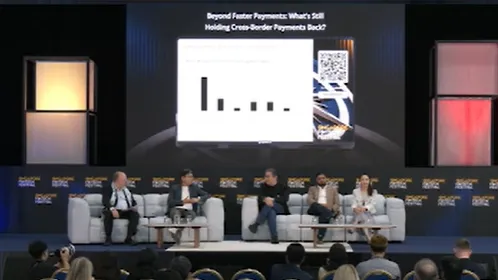
Speaking at the Singapore Fintech Festival 2026, Shadab Taiyabi, Asia head of fintech sales at HSBC's Global Payments Solutions, said existing payment infrastructure was largely in place, but regulatory differences remained a major source of friction.
"The real friction points sometimes lie in the overall regulation and compliance across the differences that could be there across markets," he said.
He said banks and payment providers needed to work with other players in the financial ecosystem to understand the entire transaction process and deliver smoother services to customers.
For businesses, the challenges extend beyond whether a payment can be made. Taiyabi said customers also consider the cost, timing and certainty of transactions.
Ben Wong, general manager for Southeast Asia and Hong Kong at Adyen, said merchants initially focus on payment costs but become more concerned with transaction success rates and settlement times as they gain experience.
Merchants assess how many transactions are successfully completed out of every 100 attempts, as well as how long it takes for funds to reach them and the currencies in which they can receive payments, he said.
Local regulations can also prevent merchants from processing payments domestically in markets where they operate.
Wong said businesses expanding from Singapore into Japan, for instance, may have to establish local operations before they can process payments locally. This could require them to pay local taxes and hire an operations team.
Violas Xiao, Singapore chief executive of XTransfer, said foreign exchange markups could significantly affect smaller businesses, particularly those with profit margins below 10%.
An FX markup of 3% to 4% could eat into their profits and determine whether a business remains viable, she said.
Some small and medium-sized enterprises in emerging markets also struggle to obtain US dollar liquidity, leaving them with limited alternatives such as informal transfer channels that can charge high fees and expose businesses to the risk of losing their money and goods.
Xiao said SMEs also face difficulties with digital onboarding and transaction monitoring because regulatory requirements differ across jurisdictions and trade documents are often not standardised.
XTransfer has developed in-house optical character recognition technology to read and verify trade documents, helping it detect potential fraud more quickly.
It has also developed 100 AI agents to verify trade documents by reading different languages and formats and checking information against databases covering logistics and customs.
Xiao said the company's monthly compliance cost per active merchant was about US$5.
She called on regulators to standardise licensing processes and risk rules for document tracking, as well as establish protocols for sharing know-your-business and know-your-customer information while protecting data.
Beyond regulatory alignment, executives said connecting national payment networks through bilateral and multilateral arrangements could improve the reach and resilience of cross-border transactions.
Jeremy Tan, founder and chief executive of Liquid Group, said regulatory support had increased over the past 12 to 24 months for linking national payment systems.
Although many systems follow similar transaction formats and standards, connecting more networks will require greater coordination to ensure they operate coherently, he said.
"Most payment systems, even though they are national and they support national payment clearing, a lot of them, most of them, do follow quite common standards," Tan said.
Tan said bilateral links could serve important payment corridors, whilst multilateral networks could extend coverage to markets without direct connections.
He cited Project Nexus, which is designed to facilitate peer-to-peer transfers between Singapore, Malaysia, Thailand, Indonesia, the Philippines and India, as an example of a multilateral arrangement that complements existing bilateral links.
Having multiple connections could also make payment infrastructure more resilient, while increasing competition and potentially lowering transaction costs, he said.
“I would like to see a lot more interoperability between payment methods that benefits not just ASEAN, it benefits the whole industry,” said Wong.
HSBC has also launched tokenised deposit services, which represent fiat currency balances on its blockchain.
Taiyabi said the services initially support round-the-clock, instantaneous intra-company treasury payments in Hong Kong, Singapore, the UK, US, Luxembourg and the United Arab Emirates. HSBC has recently expanded the services into other European countries, with the objective of eventually supporting interbank settlements.
HSBC has also completed an interbank transaction using a SWIFT-based blockchain ledger, he said.
Taiyabi said payment companies must maintain bank-grade compliance to remove friction from cross-border transactions. "There is no shortcut to compliance," he said.

























 Read Here
 Advertise
 Sign Up