AI boosts workplace efficiency, but profit impact remains uncertain
About 80% cite personal productivity gains, but only 37% see potential profit impact.
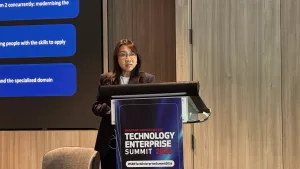
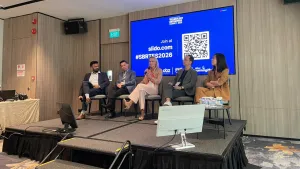
Artificial intelligence (AI) is delivering productivity improvements, but its impact on company profits remains less certain, according to executives speaking at the Singapore Business Review Technology Enterprise Summit on 12 November.
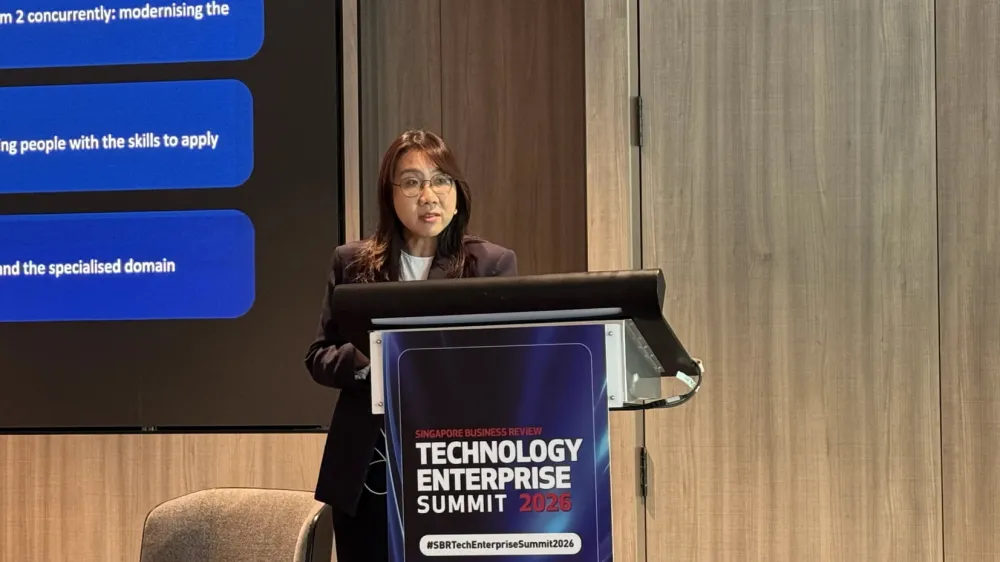
Utsav Garg, managing director and head of Southeast Asia and Australia at Alvarez & Marsal, cited a survey earlier this year showing that about 80% of AI users reported significant improvements in personal productivity.
However, only 37% believed their firms could see an impact on profit and loss.
Garg said most companies remain in the dip of a "productivity J-curve", where initial investments and organisational changes have yet to produce broader financial benefits.
“The upward curve is not automatic. It's not like you know over a period of time, we'll automatically all get there,” he said. “There has to be work required.”
Meanwhile, SATS Ltd is already seeing estimated productivity and planning gains of 10% to 15% from some of its early AI deployments.
SATS Chief Digital Officer Sandeep Sakharkar said the company is shifting from flight-based to task-based planning to improve scheduling and coordination across airport operations.
The approach allows more detailed planning of individual ground-handling tasks, including responses to flight delays, gate changes, adverse weather, and equipment issues.
SATS is also applying AI to cargo handling, particularly warehouse space utilisation and shipment movement, whilst conducting two late-stage pilots in Singapore and London's Heathrow Airport.
"We don't start with technology; we start with the problems," Sakharkar said.
Despite such operational improvements, broader AI implementation remains limited amongst Singapore businesses.
YCP Director Jason Ong, citing data from the Infocomm Media Development Authority, said only 6.6% of AI-using firms in Singapore have fully implemented the technology, whilst around 60% are still testing AI or developing their first use case.
This comes as AI usage amongst larger Singapore companies increased from 62.5% in 2025 to 70.4% in 2026.
Ong also cited a report showing that the share of companies in Singapore, Malaysia, and Thailand reporting strong returns on AI investments declined from 37% to 29%.
Another survey found that 38% of Singapore business leaders struggled to identify suitable AI use cases, whilst 36% reported uncertainty over investment returns.
Operating costs are another concern, with more than half of Asia-Pacific firms reportedly delaying or scaling back AI agent deployments because costs outweighed expected benefits.
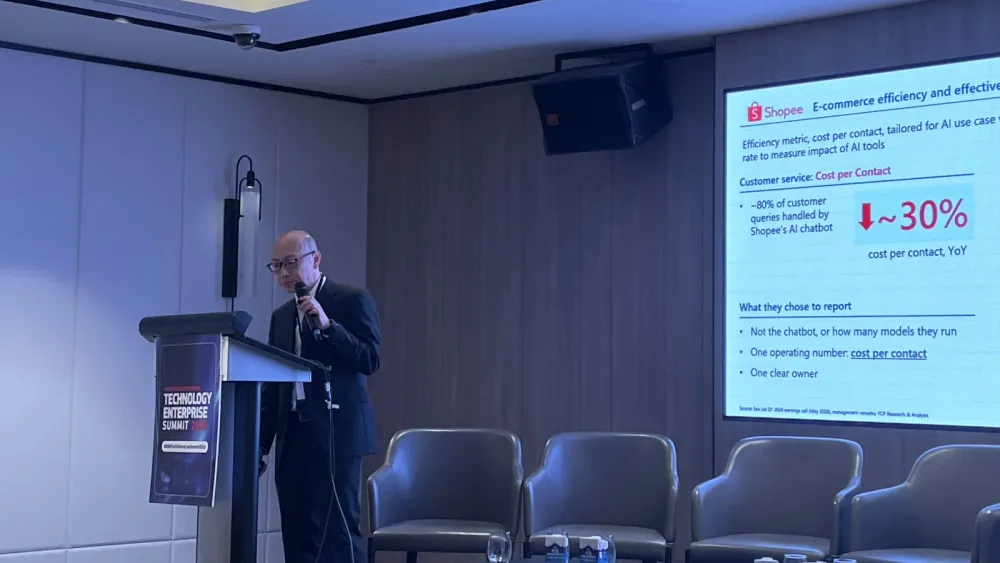
Ong said businesses need to establish measurable performance targets and assign responsibility for results, rather than introducing AI into existing processes without changing how work is performed.
"If you can't say what number is supposed to change and who owns it, then it means an experiment," he said.
Similarly, Garg advocated a 10-20-70 investment framework, allocating 10% of AI investment and effort to algorithms, 20% to technology and data, and 70% to people and processes.
Both executives also highlighted the need to manage the extent to which AI systems can make decisions independently.
Garg recommended gradually increasing the autonomy of AI agents, whilst Ong said companies should distinguish between decisions that AI can make independently, those requiring human approval, and those reserved for employees.
For SATS, Sakharkar identified data quality, process standardisation, governance, and workforce change management as requirements for expanding AI across operations.
"Autonomy, especially in the agentic AI world, has to be earned," he said.






















 Read Here
 Advertise
 Sign Up