AI returns favour companies that redesign work, says A&M
Most firms are caught in the dip of a productivity J-curve, they added.
Companies that rework how their organisations operate, rather than simply adding artificial intelligence (AI) tools to existing processes, are more likely to see positive results from adopting the technology, according to Alvarez & Marsal (A&M).
Speaking at the Singapore Business Review Technology Enterprise Summit on 12 November, Utsav Garg, managing director and head of Southeast Asia and Australia at A&M, said most companies are currently caught in the dip of a “productivity J-curve”.
Garg cited a survey earlier this year which found that about 80% of AI users saw significant improvements in their own productivity.
However, only 37% of them believed their companies could see an impact on profit and loss.
Getting out of the dip, Garg said, would require firms to redesign their operations around AI.
“The upward curve is not automatic. It's not like you know over a period of time, we'll automatically all get there,” he said. “There has to be work required.”
To get on the upswing, Garg endorsed a 10-20-70 investment framework. Under it, 10% of AI investment and effort goes to algorithms, 20% to technology and data, and 70% to people and processes.
“That is the right formula,” he said. “[The 70% is] the hard part. The 10% and 20% are the easy parts.”
AI agents, meanwhile, should be given autonomy gradually, he noted.
In one accounts payable project, Garg said AI initially recommended actions on simple invoices from low-stakes clients, with humans making every decision.
“When you hire a new employee, you don’t ask them on day one to sign big checks or make decisions on their own,” Garg said.
“You train them, you onboard them, and you slowly increase their autonomy,” he added.
Culture will also separate the winners, Garg said, citing two organisations that used the same technology over two years. One produced 141 AI solutions and the other just three.
The difference, he pointed out, came down to incentives, enthusiasm, and CEO messaging.
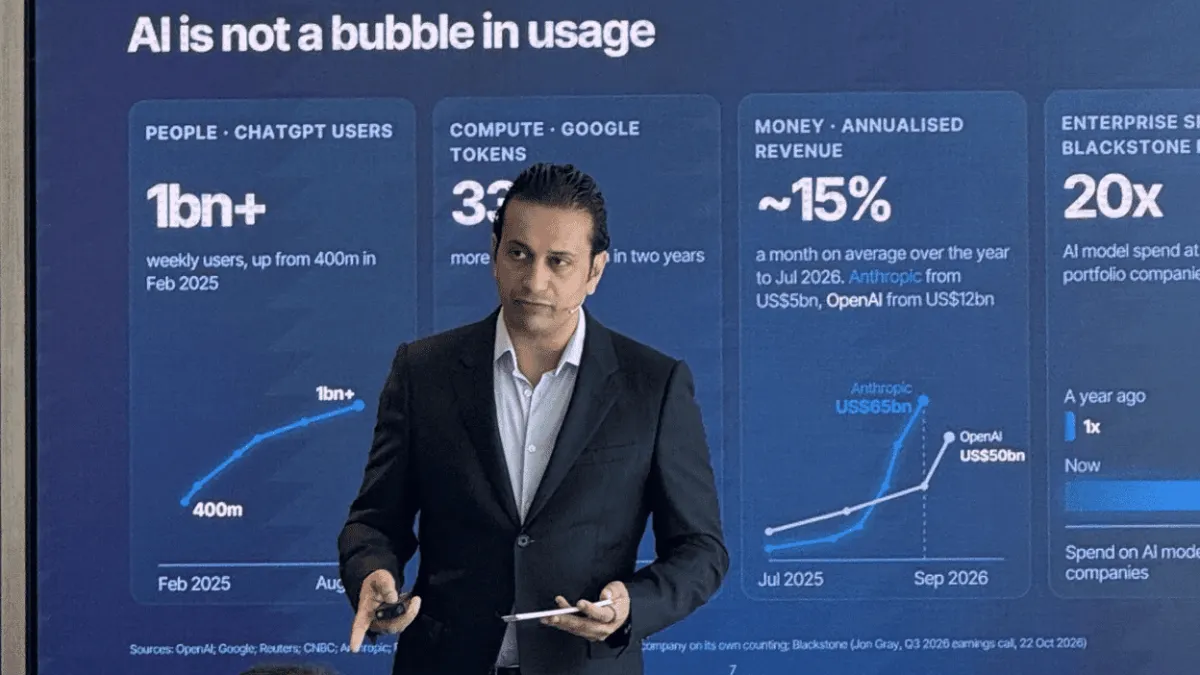
On whether AI is a bubble, Garg said usage is not, although investment is a different matter. He expects some companies to overbuild, some businesses to fail, and some valuations to prove overpriced.
“There is genuine demand [for AI]. However, that is not a guarantee for profits,” he said.
Looking ahead, Garg said companies that redesign their operations and build on successful initiatives will be better positioned to improve their competitiveness.
“If we don’t do it, somebody else will, and hesitation can be fatal here,” he concluded.


























 Read Here
 Advertise
 Sign Up