Singapore payments to hit $114b by 2030
Transaction value reached $39b in 2023 and is projected to grow 16.3% annually.
Singapore’s payments market continues to move away from cash, led by strong use of mobile wallets, card payments and real-time bank transfers.
Digital payments in Singapore reached a transaction value of $39.37b in 2023. This is projected to rise to $113.65b by 2030, at a compound annual growth rate of 16.3%, according to PwC's "Payments’ state of play 2026" report.
Singapore also leads Southeast Asia in cashless adoption. Around 97% of retail point-of-sale transactions were cashless in 2022. Over the past decade, digital wallet use has grown sharply.
E-commerce payments made through digital wallets rose from 7% in 2014 to 39% in 2024. In-store point-of-sale payments using digital wallets increased from 1% to 29% over the same period.
The shift is being driven mainly by younger consumers. Millennials are the largest group of digital wallet users in Singapore, with an adoption rate of 70%.
Amongst Generation Z consumers, 39% use GrabPay, whilst 68% prefer PayNow. A smaller share, 29%, uses GrabPay. Many younger users now rely on mobile phones for everyday payments, whilst cash use has fallen sharply.
Singapore has one of the highest card penetration rates in Southeast Asia, at more than 95%.
Card payments remain widely used for retail spending, business spending and online purchases. The market also includes FAST, PayNow, e-money wallets, stored-value cards such as EZ-Link, and digital payment tokens including Bitcoin, Ethereum and stablecoins.
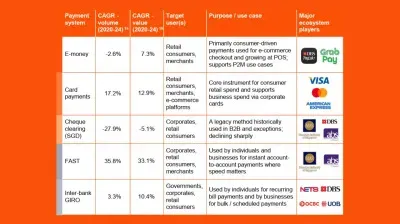
FAST is Singapore’s main account-to-account transfer system and is used by PayNow. It is one of the fastest-growing payment systems in the country.
Between 2020 and 2024, FAST recorded a compound annual growth rate of 35.8% in transaction value and 33.1% in transaction volume.
Card payments grew by 17.2% in value and 12.9% in volume over the same period.
Cheque clearing has continued to decline. From 2020 to 2024, cheque-clearing value fell by 27.9%, whilst volume dropped by 5.1%.
This reflects the move away from paper-based payments, especially as digital bank transfers become more common for both consumers and businesses.
Singapore’s payments sector is also attracting investment. Funding for payments companies reached more than $319m, or about S$410m, in the first nine months of 2025.
This was higher than the combined payment-related fintech funding recorded in Thailand, Indonesia, Malaysia, the Philippines and Vietnam during the same period. Payments accounted for 44% of Singapore’s total fintech funding in that period.
Cross-border payments are also expanding. PayNow is already linked with Thailand’s PromptPay and Malaysia’s DuitNow, allowing users to send money across borders more easily.
Singapore is also expected to develop the Singapore Payments Network, known as SPaN, by 2026. The network is expected to bring together governance for major national payment systems, including FAST, GIRO, PayNow and SGQR.
Foreign exchange services are also changing. Traditional money-changing services are increasingly being replaced or supplemented by digital remittance and foreign exchange platforms.

























 Read Here
 Advertise
 Sign Up