Hotels brace for ‘softer’ year-end as operators cut growth expectations: reports
Only 38% of operators expect revenue growth in 2025.
Singapore’s hotel sector is heading into a softer 2025, with only 38% of operators expecting revenue growth, placing the market amongst those on track for weaker performance in the year ahead.
Roughly two-thirds (66%) expect flat or lower growth for gross operating profit (GOP) this year, whilst only 28% expect an increase, according to a JLL survey.
The broader market context reflects similar pressures, with the city-state’s hotel room stock rising to over 74,000 rooms, up 1.5% year-on-year (YoY) as of October.
The market also recorded an 82% average occupancy rate in the first nine months of the year, largely flat YoY, while the average room rate fell 3.2% to $269.31. Revenue per available room declined 3.4% to $220.83, even as available room nights rose 1.8% to 17.76 million.
Despite softer trading conditions, the country attracted $546m in hotel investments in the first half of the year.
‘Volume-led rebound’
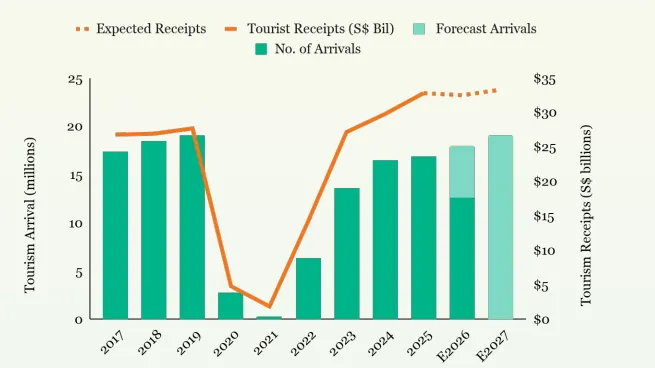
Meanwhile, 2026’s outlook is expected to improve, driven primarily by volume. The majority (88%) of operators expect revenue growth next year, supported by 81% anticipating higher occupancy.
“International demand remains supportive, and the supply pipeline is stabilising with more modest hotel openings expected in 2026 compared to previous years," said Sashi Rajan, EVP, Hotel Asset Management Southeast Asia, JLL Hotels & Hospitality Group.
For instance, Hilton is expected to debut the NoMad Hotel, whilst additional openings include the forthcoming DoubleTree by Hilton Singapore Robertson Quay.
Profit expectations also strengthen, with 63% projecting GOP improvement in 2026. Only 66% expect the average daily rate to rise, and most of those anticipate only marginal gains.
"Hotel operators have been prioritising occupancy-driven growth; however, we are hopeful that rate growth can be achieved as well, supporting an efficiency-led approach in an evolving regional landscape,” Rajan added.
Concerns about next year’s performance focus on demand risks. Reduction in corporate travel is identified as the top macroeconomic threat, followed by geopolitical uncertainty, economic slowdown, reduced tourist arrivals, and increased competition.
























 Read Here
 Advertise
 Sign Up