Banks plan own digital money but industry leaders question the odds
JP Morgan and Ripple doubt bank consortia can scale tokenised deposits.
Banks are choosing tokenised deposits over stablecoins, but industry leaders are questioning whether bank consortia can deliver them at scale.
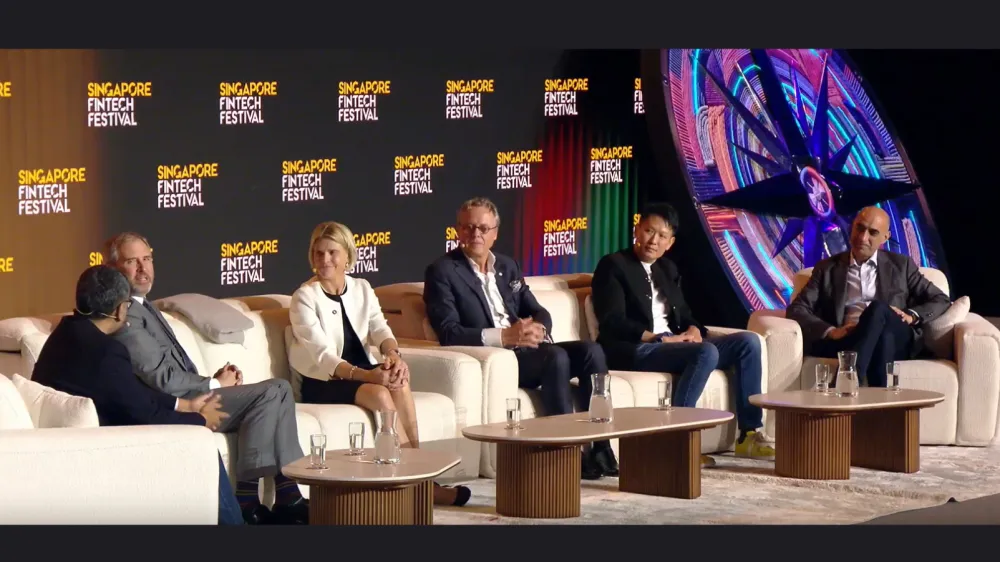
Speaking at a panel discussion at the Singapore FinTech Festival on 19 November, Umar Farooq, global co-head of payments at J.P. Morgan, said banks are forming groups because stablecoins pull liquidity out of the banking system.
Farooq pointed to a 21-bank group on the dollar side, a European consortium, and Project Agora, which involves central banks.
“Such groups are building closed systems, which is a good first step but not a feasible end solution”, he said. Banks would eventually need to accept each other’s tokenised assets, he added.
Brad Garlinghouse, chief executive of Ripple, was blunter, calling the bank consortia ‘almost dead on arrival '. He said this opens room for fast-moving, nimble players.
Ralph Hamers, chairman of Banking Circle, said trust is the basis of any such arrangement. “Everything happens only because there is trust,” he said.
On the stablecoin side, Farooq said the market stood at around $300b on 1 January and is at the same level today. “If this thing were explosive, you would see the stock go up through the roof,” he added.
Hamers cited McKinsey figures showing stablecoin volume has doubled in two years but accounts for only 0.02% of all money moving globally. Garlinghouse read the same figure as headroom. “That’s all opportunity,” he said.
Farooq said J.P. Morgan’s Kinexys platform processes more than $2 trillion in business-to-business transactions annually, which he described as much bigger than stablecoin volumes in that segment.
Use cases include weekend foreign exchange settlement for payment service providers in Asia, which avoids pre-funding, and margin payments for oil and gas companies when US markets are closed.
Meagen Burnett, chief financial officer at Schroders, said the asset manager will not issue a stablecoin, offer payments, or tokenise deposits.
“Because stablecoins pay no yield, Schroders instead launched a tokenised money market fund with J.P. Morgan through the Central Bank of Ireland, with corporate treasury as the next target,” she added.
Richard Teng, co-CEO of Binance, said traditional and crypto players are increasingly collaborating, citing DBS’s announcement a day earlier that it is working with Circle.
Hamers said he expects consolidation amongst the growing number of rails and currencies.
Farooq added that faster rails also raise the stakes if trading becomes automated. “There are no new problems—there are always old problems that are augmented because of new technology,” he said, adding that circuit breakers would be needed if agentic trading grows.
He also warned that markets will eventually face a discontinuity, as in 2022, with quite negative outcomes if everything is automated, tokenised and running around the clock.























 Read Here
 Advertise
 Sign Up