Payment networks face governance hurdles in cross-border expansion
Executives flag pricing, dispute and fraud concerns across different jurisdictions.
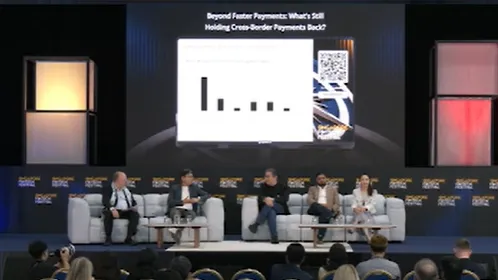
Differences in payment rules, commercial incentives, and dispute procedures are complicating efforts to connect national payment networks across borders, executives said at the Singapore FinTech Festival on 19 November.
Joyce Bo, executive vice president for core payments in Asia Pacific at Mastercard, said national QR payment schemes typically use push payments, whilst card networks and many mobile wallets rely on pull payments.
These systems have different messaging, authentication and settlement models, requiring technical integration alongside common commercial and regulatory arrangements, she said in a panel discussion.
Moreover, payment operators must reconcile differences in pricing, merchant arrangements and dispute rules to make cross-border connections commercially sustainable.
"Every participant needs to have the right incentives, and consumers need to continue to be protected," she added.
Andrew McCormack, CEO of Nexus Global Payments, said connecting payment systems also requires a common framework establishing the roles and responsibilities of participating institutions.
"Nexus is a technology platform, but probably more importantly, it's a scheme rule book," he said.
McCormack said the framework covers dispute resolution and how the network interacts with domestic systems such as India's Unified Payments Interface and Singapore's PayNow and FAST.
He added that banks and payment service providers remain responsible for authenticating their customers, whilst disputes involving fraud, human error or technical failures require established procedures.
Carlos Álvarez, chief risk officer at FLAR, said cross-border connections introduce additional participants, including foreign exchange and settlement providers, which can create operational risks.
"For instance, in smaller markets, will these providers be reliable and able to provide the services 24/7 and the like?" Álvarez said.
He also raised concerns about differences in how jurisdictions prevent fraud and recover funds. "Because in practice, what happens when there is a risk is that you have different standards for dealing with fraud, right? So the level of maturity between countries is different.”
Meanwhile, Mike Truter, head of industry engagement at Swift, identified regulatory reporting obligations, capital and foreign exchange controls, and inconsistent market practices as major obstacles in the final stage of cross-border payments.
He said addressing these issues requires coordinated action amongst policymakers, payment infrastructure operators, financial institutions and technology providers.
"It's not as simple as one pays; everyone has to pay. Everyone plays the game," Truter said.
Sohini Rajola, executive director for growth at the National Payments Corporation of India, said the commercial design of cross-border connections should prioritise reducing costs for consumers and merchants before determining how expenses are shared.
She said intermediaries must find ways to make transactions faster and cheaper without passing additional costs to end users.
"If there are incentives which don't align for that, you can have anything on paper as a blueprint. It's not going to be able to succeed or scale," Rajola said.
Despite these challenges, payment networks are pursuing additional international connections.
McCormack said Nexus plans to begin a pilot involving Singapore and Malaysia in 2027, followed by India and other participating markets.
Álvarez also highlighted Project Lumina, which is working with five Latin American central banks to assess the technical, regulatory and commercial requirements for future cross-border payment integration.

























 Read Here
 Advertise
 Sign Up